Ward's Pill and Drop
In 1734, Joshua Ward returned from French exile selling his pill and drop against any human ailment. He reset George II's dislocated thumb into royal patronage, won patrons like Chesterfield and a patient in Henry Fielding, and outlasted a 1748 bid to regulate his trade -- Parliament exempted Ward by name. A 1735 tract and a 1736 case-series examined the medicine in his lifetime; historians conclude his 'remedies killed as many as they cured.'
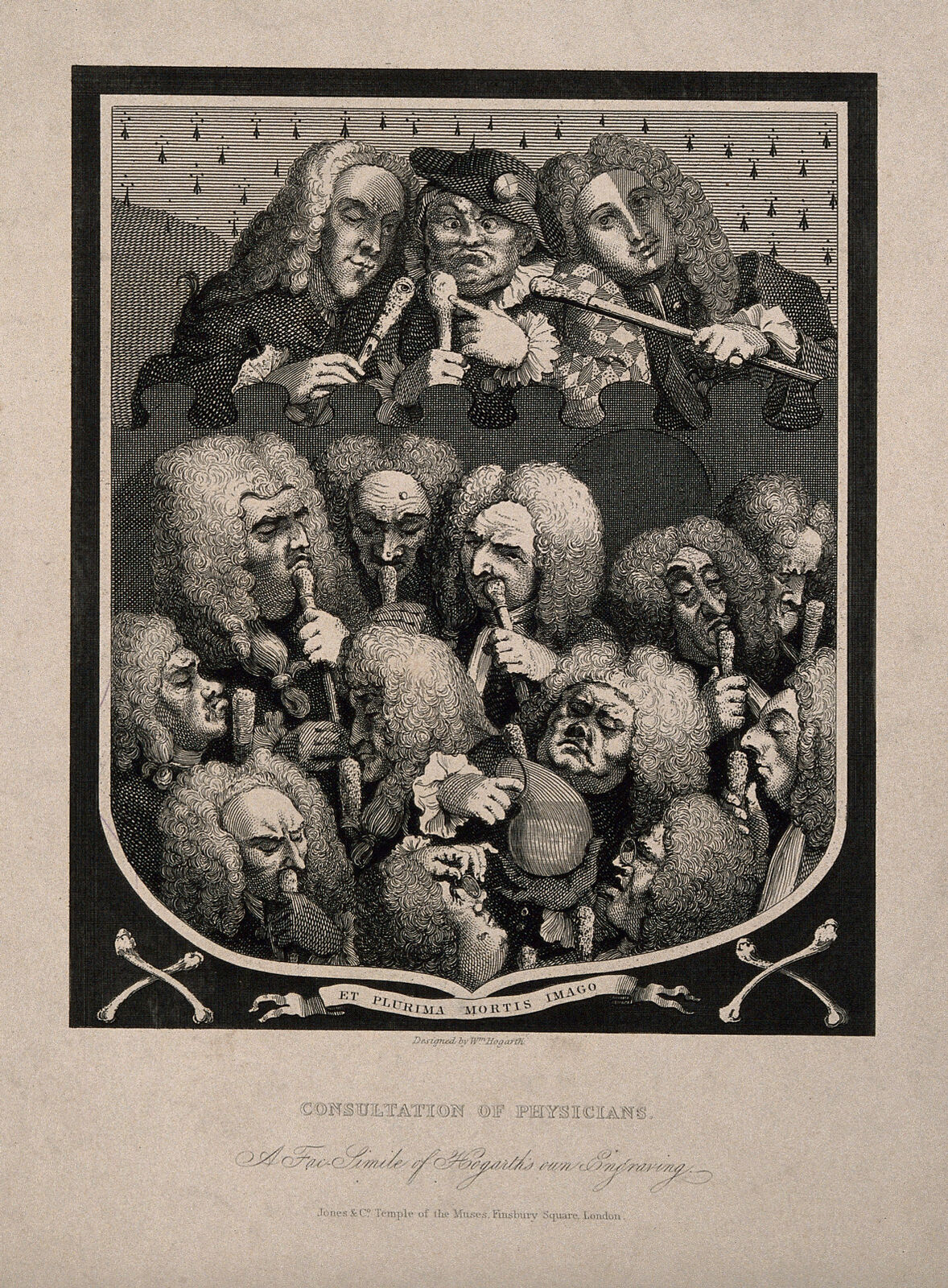
The exile who cured a king’s thumb
In January 1716/17, Joshua Ward was returned to Parliament as Member for Marlborough — despite, as the House of Commons later found, having “not received a single vote.” On 13 May 1717 the Commons erased his name and seated Gabriel Roberts in his place; by then Ward had already fled to France, a flight the 1899 Dictionary of National Biography suggests owed something to “some share in the rising of 1715.” He resurfaced at St. Germain and among the English exile community at Dunkirk, and there, according to the Dictionary of National Biography, “supported himself chiefly by the sale of his famous ‘drop and pill,’ with which he professed to cure every human malady.” Near the close of his French residence, Ward incurred the authorities’ displeasure; only “the good offices of John Page” — a fellow Englishman abroad who later became a Member of Parliament for Chichester and secretary of the Treasury — kept Ward out of the Bastille. Nothing reliable is known of what Ward did before this: the Dictionary of National Biography calls the claim that he began as a London drysalter “doubtful,” and states plainly that “beyond” it, “nothing is known of his earlier years.” What is documented is the reinvention: a discredited MP, unseated for a fraudulent return, became, in exile, the proprietor of a medicine that claimed to answer any disease at all.
Ward returned to England after a royal pardon at the end of 1733. The medicine had preceded him — Sir Thomas Robinson had already publicized Ward’s drop in London — and, in the Dictionary of National Biography’s words, “By extensive advertisement and by the accomplishment of some startling cures he soon became famous,” securing “an enormous sale.” The single event that sealed his reputation was personal to the king: Ward reset George II’s dislocated thumb “with a violent wrench,” turning the king’s “immediate displeasure” at the liberty into “more lasting esteem.” George II rewarded him with an apartment in the Whitehall almonry, and the aristocracy followed the king’s lead. The Earl of Chesterfield became a patron; Edward Gibbon later listed Ward among the figures of his own youth; Lieutenant-General Churchill promoted Ward’s wares among the nobility. Near the end of Ward’s life, the novelist and Bow Street magistrate Henry Fielding became his patient too, for the dropsy that would kill Fielding within the year. On Ward’s medical learning, the Dictionary of National Biography concludes only that “beyond some slight knowledge of pharmacy, Ward was destitute of medical learning.” His public authority instead came from a royal thumb, a king’s gratitude, and the aristocracy’s word.
One pill for every disease
The pill and drop were not marketed as a remedy limited to one ailment; they were marketed as an answer to all of them. Advertising for the medicine sold under Ward’s name — reprinted in an 1775 pamphlet describing the medicines commonly called Dr. Ward’s — claims the White Drop is one of the greatest antiscorbutics and best purifiers of the blood, that it does great service in leprosy and King’s Evil (scrofula), that it works as an antivenereal, and that it clears St. Anthony’s Fire and other inflammatory disorders. Companion products (a Sweating Powder, a Liquid Sweat, red pills, an essence for the head-ache) were pressed into service against gout, rheumatism, fevers, coughs, and children’s worms. Henry Fielding recorded that Ward considered dropsy the condition “over which he is always certain of triumphing” — first, in Fielding’s words, “in the list” of diseases the medicine cured. These records establish the breadth of the product line’s advertising, not how Ward diagnosed individual patients. The 1899 Dictionary of National Biography records that Ward’s pills came in three colors, blue, red, and purple, all containing antimony and two of the three also containing arsenic.
No name on it but his own
The surviving sources document both premium sales and charitable distribution during Ward’s lifetime, but do not date their overlap precisely enough to classify access for the full case era. At retail, an 1775 pamphlet by the son of the chemist who compounded the medicine for Ward records that the signature White Drop sold for a guinea during Ward’s lifetime, before falling to one shilling a bottle by 1775. The Dictionary of National Biography also records that George II granted Ward rooms in the Whitehall almonry, where he ministered “to the poor at his majesty’s expense”; Ward later purchased three houses in Pimlico for a hospital for poor patients and took another house in Threadneedle Street “for their benefit.”
Ward sold the pill and drop under his own name throughout his working life: no source in this bundle documents a licensing body inspecting the formula, though the chemist J. White compounded the medicine for him and so held working knowledge of the recipe well before Ward’s death (per an 1775 pamphlet White’s son later published defending its authenticity). The Dictionary of National Biography records that “he amassed a good fortune” from its sale. He also drew directly on public money: the apartment George II granted him at Whitehall let Ward treat poor patients “at his majesty’s expense,” a royal subsidy that widened his reputation and his patient rolls at the crown’s cost rather than his own. When an apothecaries bill came before Parliament in 1748 to restrain unlicensed persons from compounding medicines, the bill was amended with “a clause was inserted specially exempting Ward by name from the restrictions imposed.” Only at Ward’s 1761 death did the arrangement change: he bequeathed his formulae to John Page, the ally who had once saved him from the Bastille, and Page published the receipts and arranged for the profits from their sale to be divided between two London charities, the Asylum for Female Orphans and the Magdalen Hospital, under the charge of the magistrate Sir John Fielding. That posthumous charitable redirection is Page’s arrangement for Page’s inheritance; it does not extend backward to establish that Ward treated his own decades of personal earnings from the medicine the same way.
What the record showed
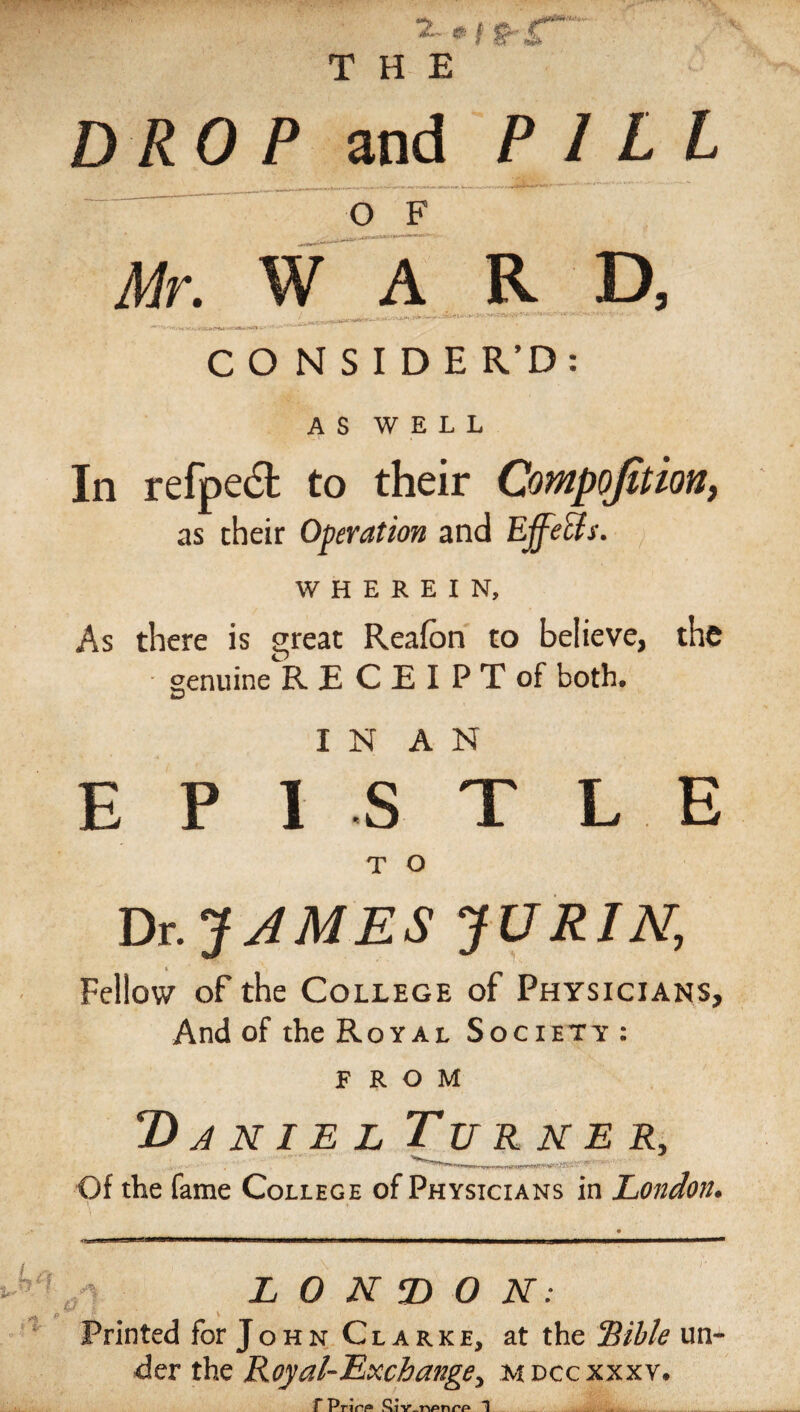
Challenges to the pill and drop began during Ward’s own lifetime and from within organized medicine, not after his death. In 1735, Daniel Turner published The Drop and Pill of Mr. Ward, Consider’d, an epistle to Dr. James Jurin, examining the medicine’s claimed composition, operation, and effects. The following year, Joseph Clutton published A True and Candid Relation of the Good and Bad Effects of Joshua Ward’s Pill and Drop, surveying the medicine’s reactions across sixty-eight documented cases. Public criticism ran alongside these examinations: from the close of 1734, Ward was, in the Dictionary of National Biography’s account, “constantly attacked in prose and verse,” including a Grub Street Journal campaign that Ward unsuccessfully sued over in the King’s Bench and Common Pleas. None of it stopped the trade in his lifetime; the 1748 bill exempted him by name rather than restrain him. The retrospective medical-historical judgment came later: the Dictionary of National Biography concludes that Ward’s pill and drop “were preparations of antimony very violent in their action, and quite unfit for general use,” and that “his remedies killed as many as they cured.” Henry Fielding supplied a documented first-person case: he became Ward’s patient for dropsy in February 1754, recorded that the medicine “had seldom any perceptible operation” on him, and that Ward himself “declared it was as vain to attempt sweating me as a deal board” — Fielding died of the same illness eight months later in Lisbon. No source in this bundle documents a controlled trial of the medicine; the evidentiary record is contemporaneous literature that raised the alarm, a documented patient failure from inside the disease the medicine claimed to cure best, and a retrospective verdict that the medicine killed as often as it healed.
The pattern repeats
The same structural machinery appears in different treatments and eras. These cases show the claimed mechanism and how the claim met evidence.
Morison's Vegetable Universal Medicine (Hygeian pills)
Holloway's Pills and Ointment
St John Long's Corrosive Liniment and Inhalation
More related cases · 9
Part of the lineage
External references
Evidence · 7 sources
- Ward, Joshua (1685-1761) (1899)
- The Drop and Pill of Mr. Ward, Consider'd ... In an Epistle to J. Jurin (1735)
- A True and Candid Relation of the Good and Bad Effects of Joshua Ward's Pill and Drop. Exhibited in Sixty-Eight Cases (1736)
- The Journal of a Voyage to Lisbon (1755)
- Observations on the Present State, of the Late Dr. Ward's Medicines: To Which Is Added an Account (from Experience) of Their Real Virtues and Efficacy (1775)
- A Shield Containing a Group Portrait of Various Doctors and Quacks, Including Mrs Mapp, Dr. Joshua Ward and John Taylor. Engraving after W. Hogarth, 1736 (1736)
- Title Page: The Drop and Pill of Mr. Ward, Consider'd (1735) (1735)