METHUSELAH ARCHIVE CASES / RADAM-MICROBE-KILLER-1887-1913
Archive case

Wm. Radam's Microbe Killer

A Prussian gardener who read Pasteur, decided one microbe caused every disease, and sold the cure on the borrowed prestige of the new germ science.
subjectWilliam Radam active1887–1913 ● disconfirmed outcomepublicly disconfirmed

On jugs lettered "CURES ALL DISEASES," William Radam, an Austin gardener with no medical training, sold a liquid he said killed the microbes behind every illness, building it from 1887 into seventeen factories and a Fifth Avenue mansion. His own 1889 patent shows the agent to be water acidulated with sulphur fumes; R.G. Eccles measured it at 99.381 percent water. Under the 1912 Sherley Amendment, federal prosecutors condemned the labelling and burned the seized stock.
The recurring five-stage cycle
01
Charismatic practitioner
A Prussian gardener who read Pasteur, decided one microbe caused every disease, and sold the cure on the borrowed prestige of the new germ science.
02
Exclusive access
Not price but brand and secret process: a cheap liquid sold by the jug, its authority locked inside a registered trademark and a patented method.
03
Vague mechanism
One disease, one cure: "pure water, permeated with gases" that microbes could not live in, killing every ailment at once but never once measured.
04
Financial conflict
Radam wrote the doctrine, held the patents, and sold the only remedy it endorsed; Eccles charged profits of 6,000 percent on acidulated water.
05
Disconfirmation / collapse
Eccles measured it at 99.381 percent water; the 1912 Sherley Amendment prosecution condemned the cure-all labelling and burned the seized stock in a pit.
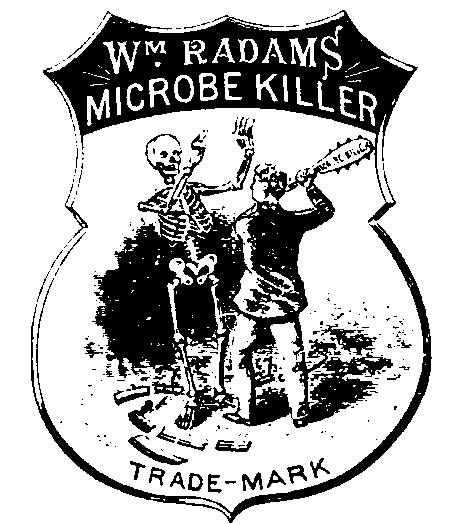
A shield-shaped trademark badge lettered Wm Radam's Microbe Killer above and Trade-Mark below, enclosing a man in a suit swinging a club at a skeleton whose broken scythe lies at its feet.
FIG 1 The registered trademark of Wm. Radam's Microbe Killer: a man clubbing a skeleton (Death) whose scythe lies broken, ringed by the lettering 'Wm RADAM'S MICROBE KILLER' and 'TRADE-MARK'. The same device appeared on the jugs and newspaper advertisements. Wikimedia Commons (File:Radam's Microbe Killer.png); registered as a US trademark (Library of Congress item 2023668939). Public domain. (1887) PUBLIC DOMAIN source

The gardener who killed weeds and disease alike

The man on the label is clubbing a skeleton, its scythe already snapped. The label belonged to William Radam (1845-1902), a Prussian-born gardener and nurseryman in Austin, Texas, with no medical training, who had tended a store and a nursery on some thirty acres for nearly two decades (Barnett) before he became the most famous microbe-slayer in America. His authority rested entirely on a conversion story. After years of his own illness, malaria followed by rheumatism and sciatica, and the death of two of his children, he read of Pasteur and Koch and concluded that microbes had caused every one of his ailments and could be killed inside the body the way pests are killed in a garden. He compounded an acidulated water, called it the Microbe Killer, claimed it had cured him after six months of drinking it, and from 1887 sold himself as the humble gardener who had succeeded where physicians failed. His one-line creed, preserved by the Handbook of Texas, was ‘I treated all my patients with the same medicine, just as in my garden I would treat all weeds alike.’
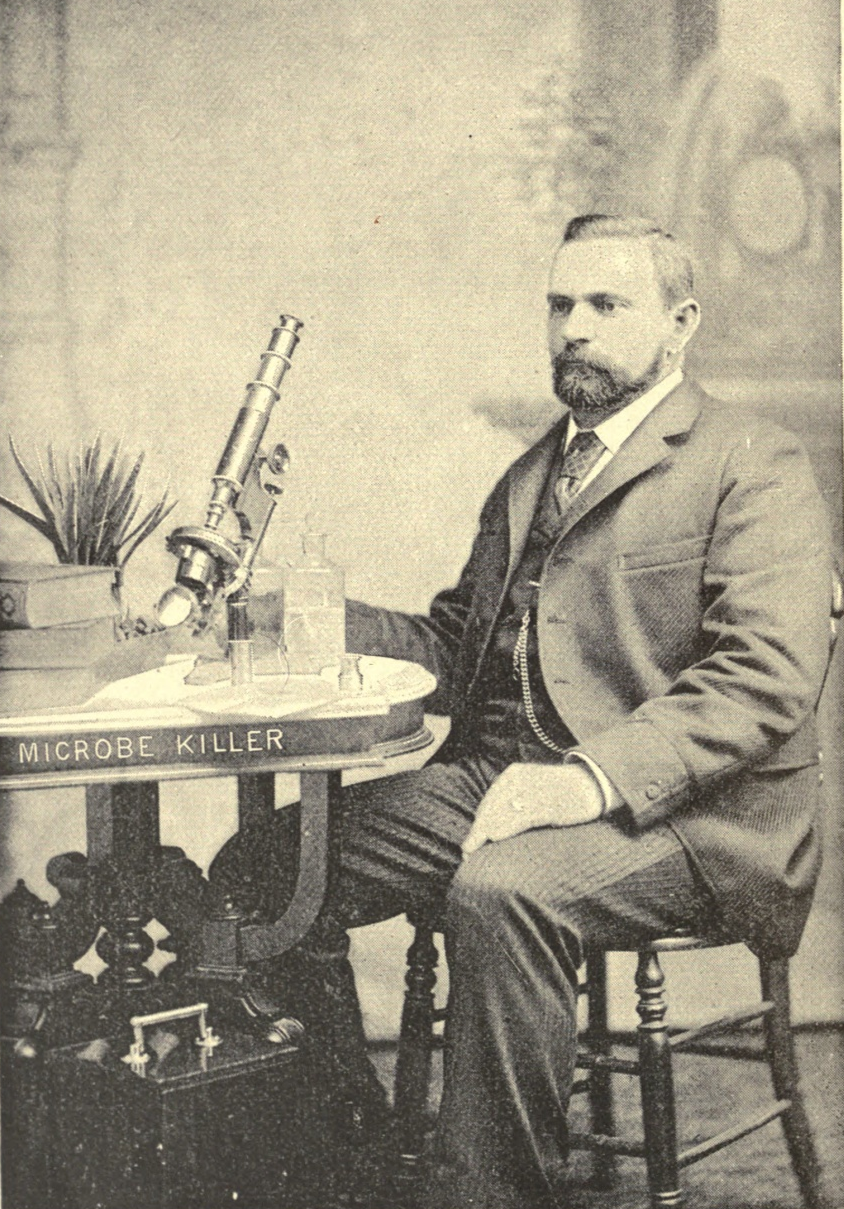
A bearded man in a suit sits beside a small round table holding a microscope and a jug lettered MICROBE KILLER.
FIG 2 William Radam, from his book Microbes and the Microbe Killer (New York, 1890), seated beside a microscope and a jug of his Microbe Killer. Wikimedia Commons (File:William Radam.png). Public domain. (1890) PUBLIC DOMAIN source

Cheap by the jug, but the formula was sealed

What was exclusive was the brand and the proprietary process, not the price. Unlike the elite clinics elsewhere in this archive, the Microbe Killer was a cheap commodity sold to everyone, by the jug, through agents and druggists, with a free glass offered to passers-by at Radam’s Broadway store. The exclusivity was of trademark and secret method: a single named authority, a registered device (the man clubbing a skeleton, secured in 1887), a patented manufacturing apparatus (US 412,664, 1889), and a single liquid in numbered strengths made only by Radam’s proprietary patented process and under his brand, and explained only by his book. Customers bought into a closed system, one inventor, one theory, one remedy, broadcast through a relentless newspaper campaign that ran his advertisements next to news of Koch’s real discoveries.

One microbe, one cure, never measured

The mechanism was a surrogate dressed in new scientific language. Radam reduced all illness to one cause, microbes, and all treatment to one act, drinking a liquid said to kill them. He described the Microbe Killer in his 1890 book as something that ‘cannot be compared with ordinary drugs. It does not contain any of them. It is pure water, permeated with gases which are essential to the nourishment of the system, and in which micro-organisms cannot live and propagate, or fermentation exist,’ to be taken until ‘the tissues shall be thoroughly soaked with it.’ The mechanism was asserted, never measured. It also contradicted itself: a liquid mild enough to drink freely by the glass cannot carry a germicidal dose to the blood and tissues, and the germ theory Radam borrowed had shown that distinct organisms cause distinct diseases, not that one universal microbe causes all.
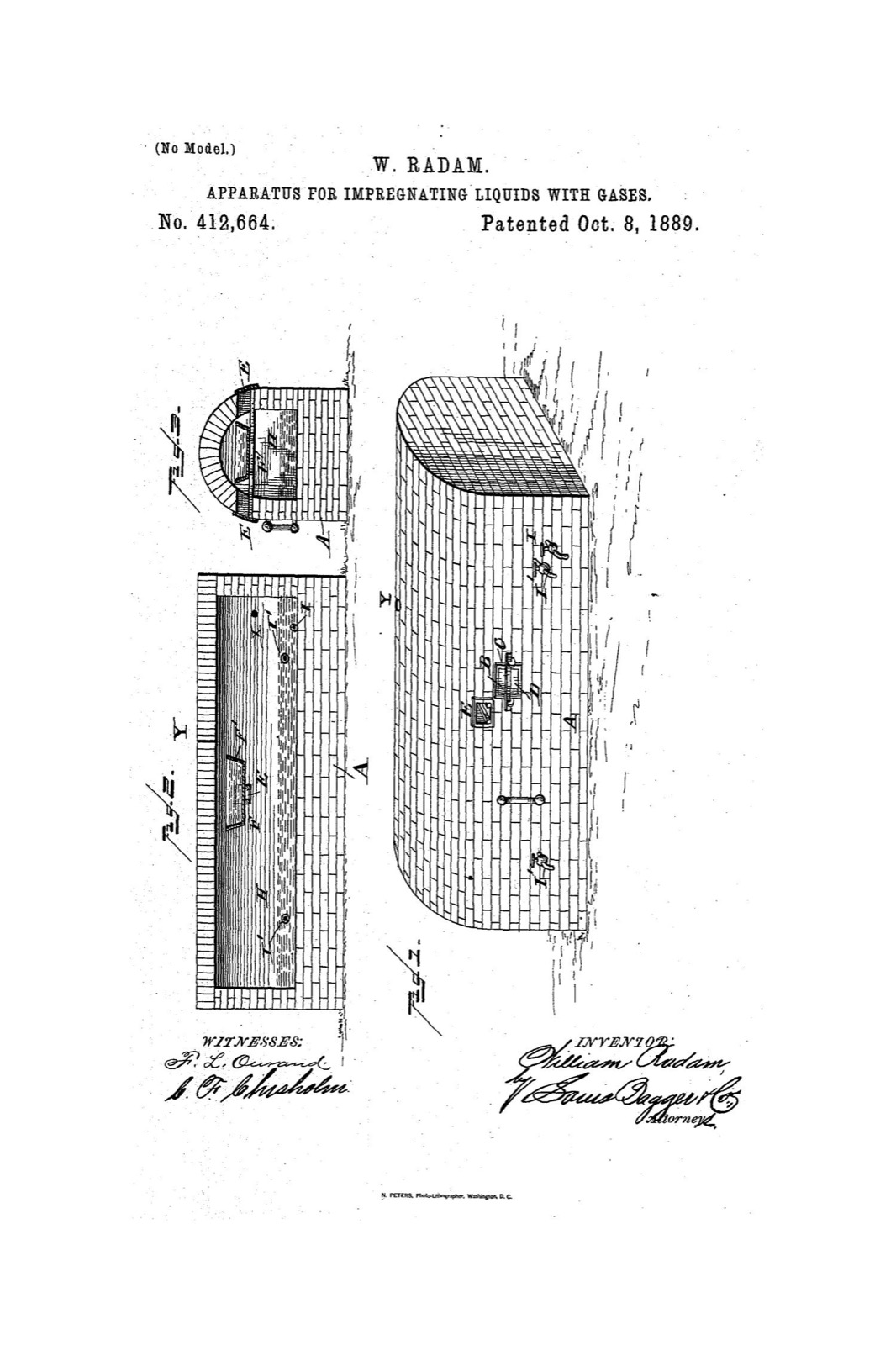
A patent drawing sheet showing perspective and sectional views of a long brick-and-cement tank, headed with the patent title, number, and date and signed by the inventor.
FIG 3 The drawing sheet of William Radam's US Patent No. 412,664, 'Apparatus for Impregnating Liquids with Gases,' patented October 8, 1889: the brick-and-cement tank in which sulphur fumes were passed through water to make the Microbe Killer. Wikimedia Commons via DPLA / University of North Texas Libraries. Public domain (US patent). (1889) PUBLIC DOMAIN source

A 6,000 percent margin on flavored water

The conflict is the developer-vendor pattern, stated on the documented facts and not overstated. Radam was at once the author of the doctrine, the holder of the patents, and the proprietor of the only remedy the doctrine endorsed, and his income depended directly on sales. Barnett records that he built the Koppel Building in Austin in 1888 and by 1890 ran seventeen factories and lived in a Fifth Avenue mansion overlooking Central Park; the Handbook of Texas notes the move from his Austin gardens to that New York mansion. The margin drew the central criticism: R.G. Eccles, who analysed the product as little more than acidulated water, charged that Radam made profits of 6,000 percent, and the government’s 1913 prosecution valued one seized shipment at $5,166 in retail against an estimated $25.82 to produce. The proceeds were not Radam’s alone, since agents, the factories, and licensees at home and abroad shared the trade; the conflict named here is that one man’s fortune tracked the sales of a liquid he proclaimed a universal cure.

The chemist’s bench and a pit in St. Paul

The Microbe Killer was disconfirmed both chemically and legally. R.G. Eccles, a physician and pharmacist, published an analysis finding it to be water with only minute amounts of hydrochloric and sulphuric acid; an analysis attributed to the US Department of Agriculture placed the water content at 99.381 percent; and Radam’s own patent confirms the agent was the fumes of burning sulphur dissolved in water to a ‘sour acid taste.’ The two men sued each other for libel (a Brooklyn jury awarded Eccles $6,000, a Manhattan jury later awarded Radam $500, and the Brooklyn award was afterward reversed), and Samuel Hopkins Adams attacked the product in ‘The Great American Fraud.’ The decisive end was regulatory: under the 1912 Sherley Amendment, which made false and fraudulent curative claims illegal, the Bureau of Chemistry under Carl L. Alsberg prosecuted the Microbe Killer’s labelling, a jury condemned a seized shipment, and the confiscated stock (539 boxes and 322 cartons) was destroyed in a pit, an action Barnett dates to December 1913 and the National Library of Medicine to 1914. The single-microbe theory is obsolete, the liquid had no demonstrated effect, and the federal courts ruled its cure-all claims fraudulent.

Notes

William Radam (1845-1902) sold a cure for everything on a theory simple enough to print under a trademark: there is one disease, caused by microbes, and one cure, a liquid that kills them. A Prussian-born gardener and nurseryman in Austin, Texas, with no medical training, Radam built his authority on a conversion story. After years of illness and the death of two of his children, he read of Pasteur and Koch, decided that microbes were the single cause of all his ailments, and reasoned that they could be killed inside the body as pests are killed in a garden. He compounded an acidulated water, named it the Microbe Killer, claimed it had cured him, and from 1887 sold it as the discovery of a humble gardener who had outdone the doctors. His creed, recorded by the Handbook of Texas, was that he “treated all my patients with the same medicine, just as in my garden I would treat all weeds alike.” This is a patent-medicine case rather than a clinic or a device: a single secret-process liquid, sold cheaply by the jug through agents and druggists, carrying a whole theory of disease and a famous emblem of a suited man clubbing a skeleton whose scythe lies broken.

The business grew enormous. Radam advertised everywhere, often placing his notices beside genuine news of Koch’s bacteriology, registered the club-and-skeleton trademark in 1887, patented his manufacturing apparatus in 1889, put up the Koppel Building in Austin in 1888, and by 1890 had moved to New York to run seventeen factories and live in a Fifth Avenue mansion overlooking Central Park. The conflict of interest is the plain developer-vendor pattern: Radam authored the theory, held the patents, and sold the only remedy the theory endorsed, so his fortune tracked his sales. The proceeds were shared with agents, factories, and licensees rather than his alone, but the record supports the structural claim this archive makes repeatedly, that the man proclaiming a universal cure was the man the cure enriched. The pitch went past cure to prevention: keep the body free of microbes and disease never takes hold, the cheap daily route to lasting health and, by extension, long life. The promise rested on his own description of the Microbe Killer as harmless “pure water, permeated with gases,” which is also where the case turns, because that description is true in a way Radam did not intend.

The disconfirmation came from the chemist’s bench and the federal courtroom. Radam’s own patent (US 412,664, 1889) describes the “medicinal” agent as the fumes of burning sulphur passed through water until it takes “a sour acid taste,” that is, a dilute sulphurous and sulphuric acid solution. R.G. Eccles, a physician and pharmacist, analysed the Microbe Killer and reported it to be water with only minute amounts of hydrochloric and sulphuric acid; an analysis attributed to the US Department of Agriculture put the water content at 99.381 percent. The mechanism fails twice over: a liquid weak enough to be drunk by the glassful, even by infants, is far too weak to sterilize the blood, and the germ theory Radam invoked had in fact shown that different diseases are caused by different organisms, not by one universal microbe. Eccles and Radam sued each other for libel, with Radam retaining the orator Robert Ingersoll and the verdicts running both ways before the award against him was reversed, and Samuel Hopkins Adams later attacked the product in “The Great American Fraud.” The end was regulatory: under the 1912 Sherley Amendment the Bureau of Chemistry prosecuted the cure-all labelling as false and fraudulent, a jury condemned a seized shipment, and the confiscated stock was carted to a pit and destroyed (Barnett dates this to December 1913; the National Library of Medicine to 1914). Radam had died in 1902 and was buried at Oakwood Cemetery in Austin; the federal destruction of 1913 was the effective end of his company about a decade later, though a retailer was still advertising residual bottles as late as 1919. The shape is the one the archive follows. Radam’s single-microbe cure-all, sold on volume, testimonials, and an unproven promise of health and long life, stands beside Morison’s contemporaneous blood-purifying pills and anticipates the electrical and radioactive cure-alls (Abrams’s instruments, Radithor) that would sell the same structure, an unmeasured universal mechanism, into the twentieth century.