Morison's Vegetable Universal Medicine (Hygeian pills)
James Morison, a merchant with no medical training, declared that all disease was impure blood, that purging it cured everything, and that his pills were harmless in any quantity. He sold over a billion of them. They were a drastic gamboge purgative: heavy dosing killed, the best-documented case John MacKenzie in 1836 after a reported 1,000 pills in twenty days, and a consolidating medical profession turned such deaths into a public war on the system.
The merchant who crowned himself the Hygeist
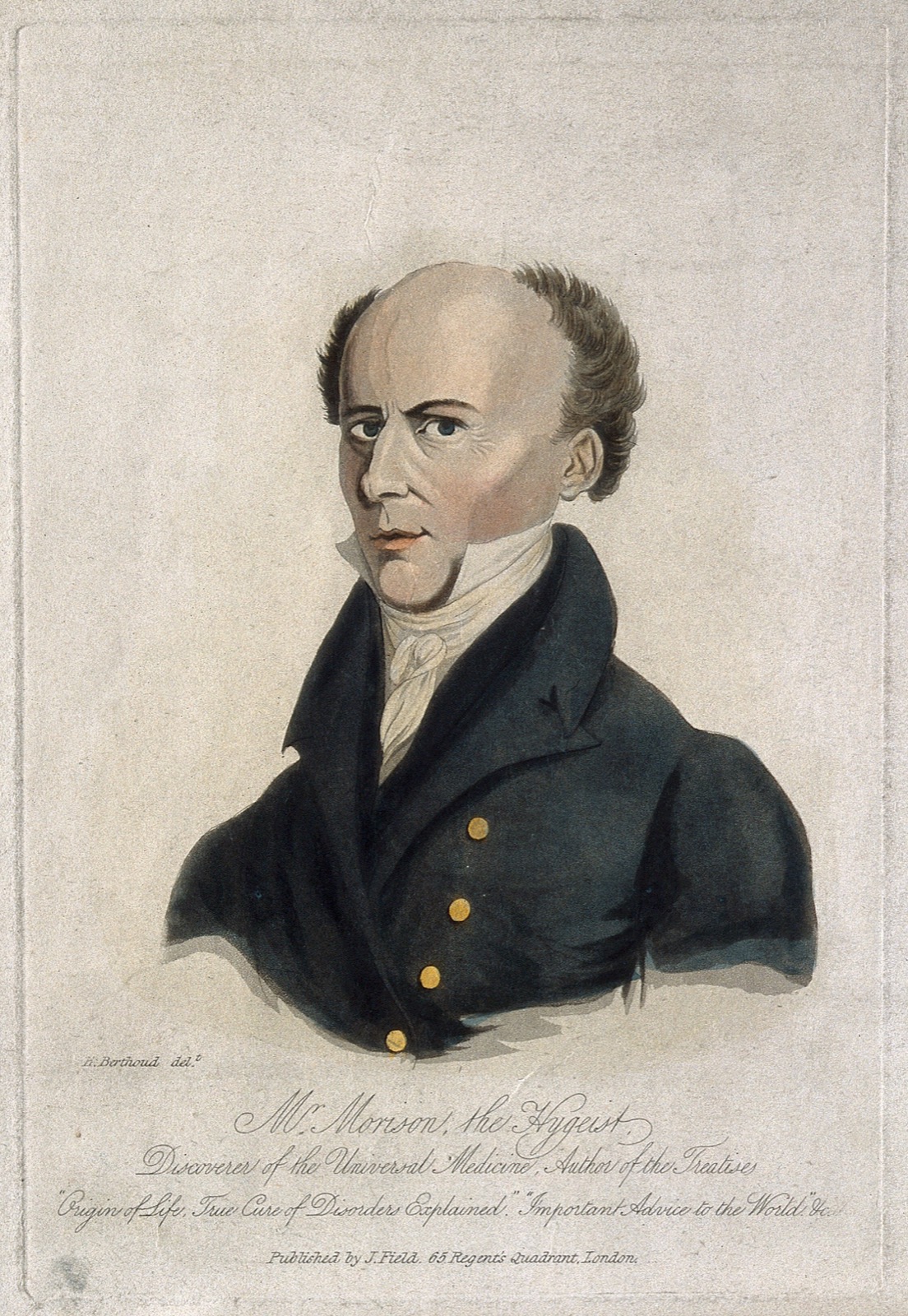
After what the Dictionary of National Biography records as some thirty-five years of ill health and failed orthodox treatment, a merchant named James Morison (1770-1840), born at Bognie in Aberdeenshire, claimed about 1822 to have cured himself with vegetable pills of his own compounding. He had no medical training. He turned that one story into a system and a brand. He styled himself ‘the Hygeist’, after Hygeia, the classical personification of health, and in 1828 opened the British College of Health at Hamilton Place, New Road, London, a commercial establishment dignified with a collegiate name although it taught and examined no one. His authority rested not on credentials but on the conversion story, the institutional title, and a relentless print campaign that set the lay ‘Hygeist’ against the orthodox physician.
Sold to everyone, controlled by one man
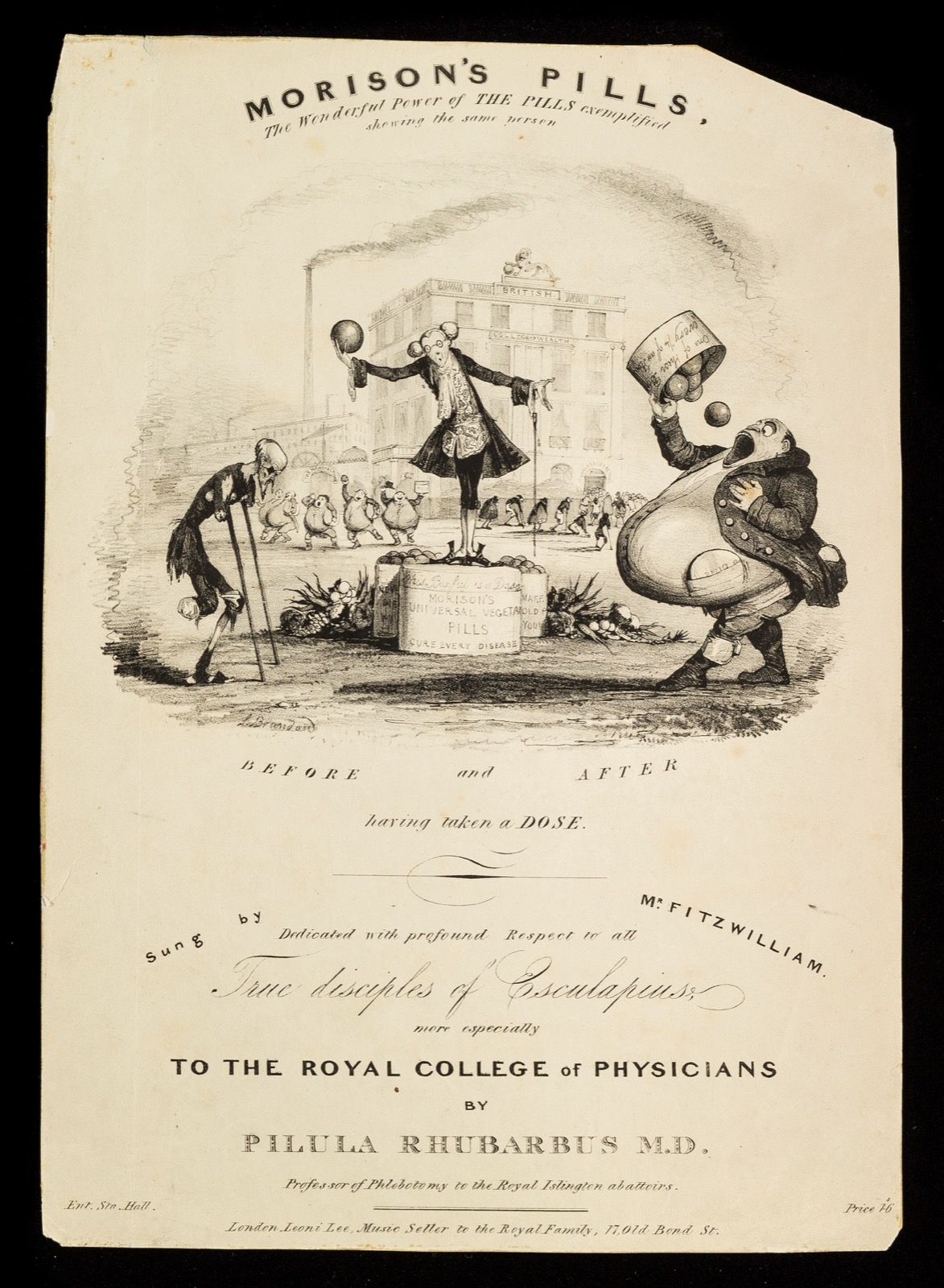
Morison’s medicine was the opposite of the elite-clinic model elsewhere in this archive: its reach was its selling point. The Vegetable Universal Medicine was a cheap pill sold in enormous volume through the British College of Health and a wide network of agents across Britain and its export markets. W.H. Helfand’s study of the medical tax-stamp records yields the figure, repeated in later histories, of over a billion pills sold between 1825 and 1849. What was ‘exclusive’ was not access to the pill but the proprietary system and brand around it: a single secret formula, a single institution, and a single named authority who held that his remedy alone could cure. The exclusivity was of doctrine and trademark, not of price.
One disease, one cure, and a dose that climbed
The Hygeian theory reduced all illness to one cause, the impurity of the blood, and all treatment to one act, purgation. On this account there are not many diseases but one disease, and the pills cure every complaint by evacuating the impure matter through the bowels. The mechanism was asserted, never measured: no controlled demonstration connected purging to any cure, and the single-cause humoral premise was already at odds with the developing pathology of the period. The theory also generated its own dose instruction, since if purgation purifies then more purgation purifies more, which licensed the large and repeated doses that made the pills dangerous.
Author, proprietor, and sole vendor
The conflict is the developer-vendor pattern, named on the documented facts and not overstated. Morison was at once the author of the doctrine, the proprietor of the institution that embodied it (the British College of Health), and the seller of the only remedy the doctrine endorsed. His income depended directly on pill sales: the DNB records that he paid 60,000 pounds in government medicine-stamp duty between 1830 and 1840, and Helfand’s reconstruction from those stamps gives the billion-pill sales figure for 1825-1849. The proceeds were shared rather than his alone (agents, licensees, and his own sons all drew on the trade), so the conflict is stated as his direct financial dependence on the pills he proclaimed a universal cure, not as exclusive enrichment.
The bodies that ended the claim
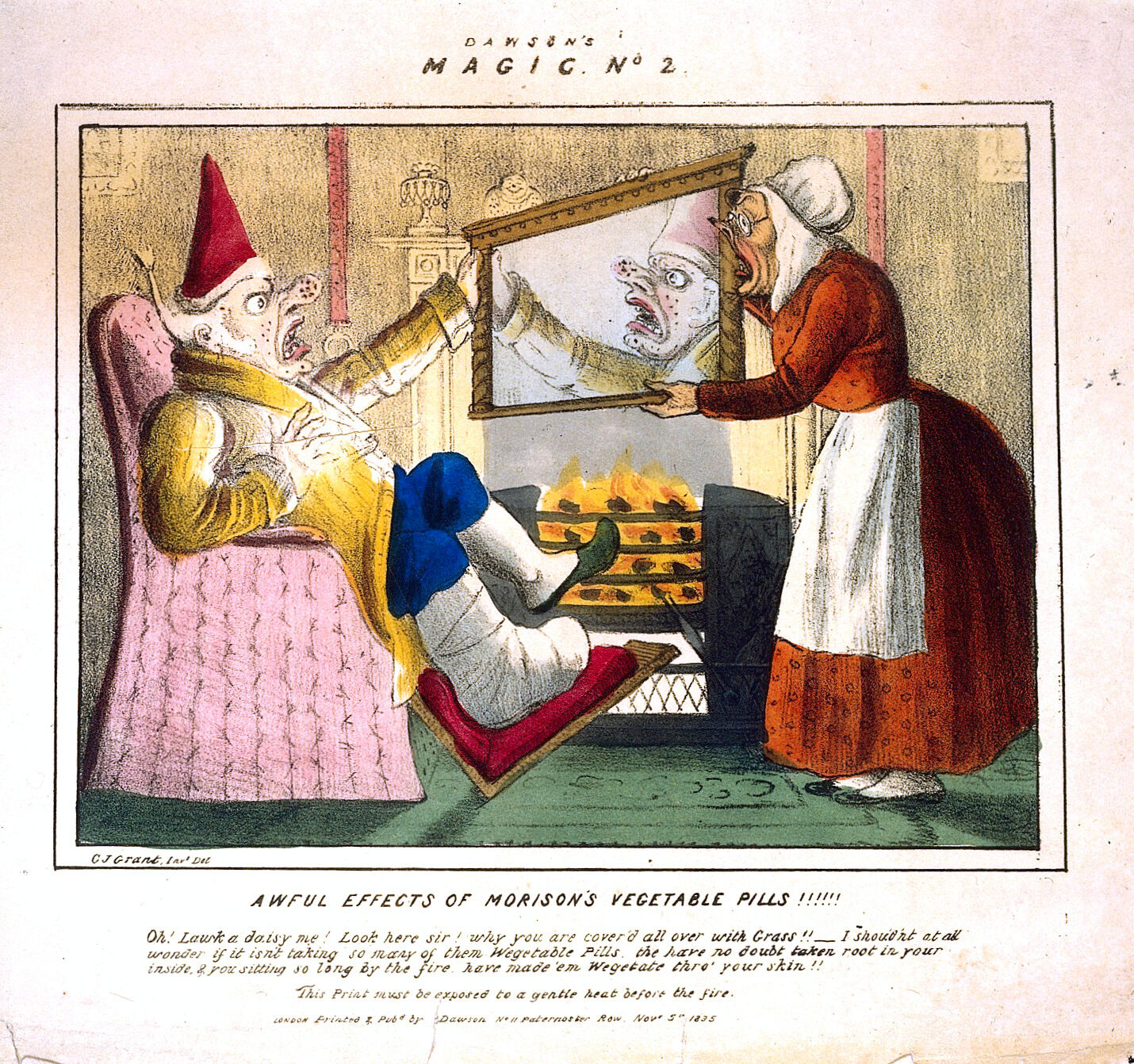
Morison’s pills were not overturned by a single decisive experiment but by accumulating harm and the organized opposition of a consolidating medical profession. The pills were a drastic purgative built around gamboge, and the Hygeian instruction to dose heavily made them dangerous. Deaths were attributed to them in the 1830s: the best-documented is the 1836 death of John MacKenzie, aged 32, after one of Morison’s agents administered a reported 1,000 pills over twenty days, and one account reports a further twelve deaths investigated at York in 1837. Michael Brown’s study (2007) shows how the profession used such cases in its public ‘war’ against the pills as it constructed its own professional identity. Morison himself escaped prosecution and his sons continued the business after 1840, but the verdict on the substance and the theory is settled: the single-cause humoral premise is obsolete, purgation does not purify the blood or preserve health, and the ‘harmless in any quantity’ claim is refuted by the deaths from over-purgation.
The pattern repeats
The same structural machinery appears in different treatments and eras. These cases show the claimed mechanism and how the claim met evidence.
The Hay System (food combining / 'food separation')
Perkins Metallic Tractors
Arsenic slimming and complexion nostrums
Part of the lineage
Evidence · 8 sources
- Morison, James (1770-1840), Dictionary of National Biography (1894)
- James Morison and his pills. A study of the nineteenth century pharmaceutical market (1974)
- Medicine, Quackery and the Free Market: The 'War' Against Morison's Pills and the Construction of the Medical Profession, c.1830-c.1850 (2007)
- Morisoniana; or, Family adviser of the British College of Health: being a collection of the works of Mr Morison, the Hygeist (1829)
- Graphic battles in pharmacy (Wellcome Collection, Stories) (2017)
- James Morison. Coloured aquatint after H. Berthoud (1834)
- Awful effects of Morison's vegetable pills! Coloured satirical print by C.J. Grant (1835)
- Morison's Pills: the wonderful power of the pills exemplified showing the same person before and after (1835)