Cordial Balm of Gilead
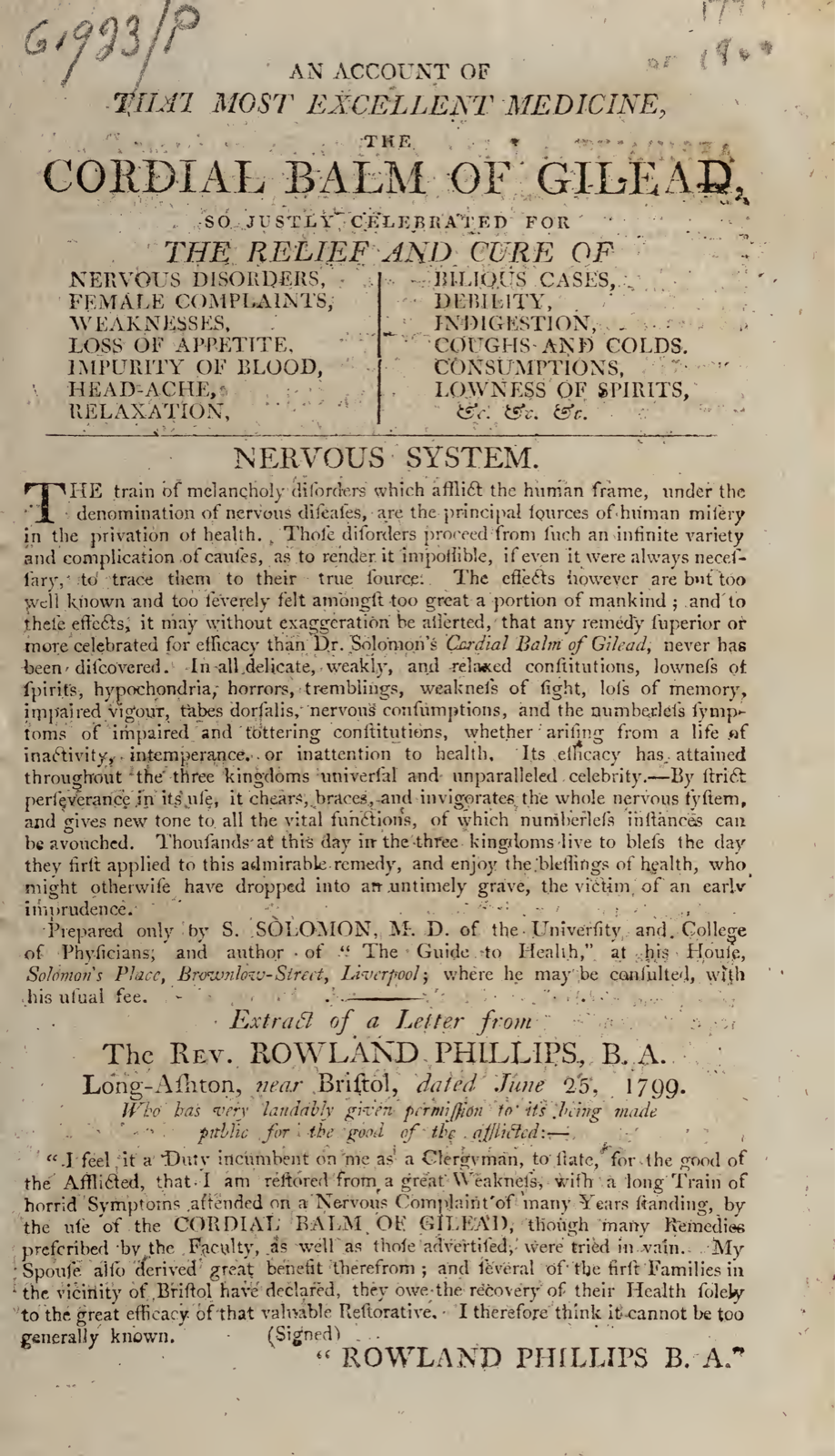
In 1796 a failed Liverpool tradesman restyled himself "Dr Solomon, M.D." and swore an affidavit that he alone knew the recipe of the Cordial Balm of Gilead, making the half-guinea bottle a restorer of vitality no one could examine. No controlled trial ever tested it. John Corry's Detector of Quackery (c.1802) classed Solomon with Brodum and Perkins as empirics, and later scholars reconstructed the cordial as spiced French brandy laced with cantharides (Helfand; McLaren 2007).
The tradesman who awarded himself a doctorate
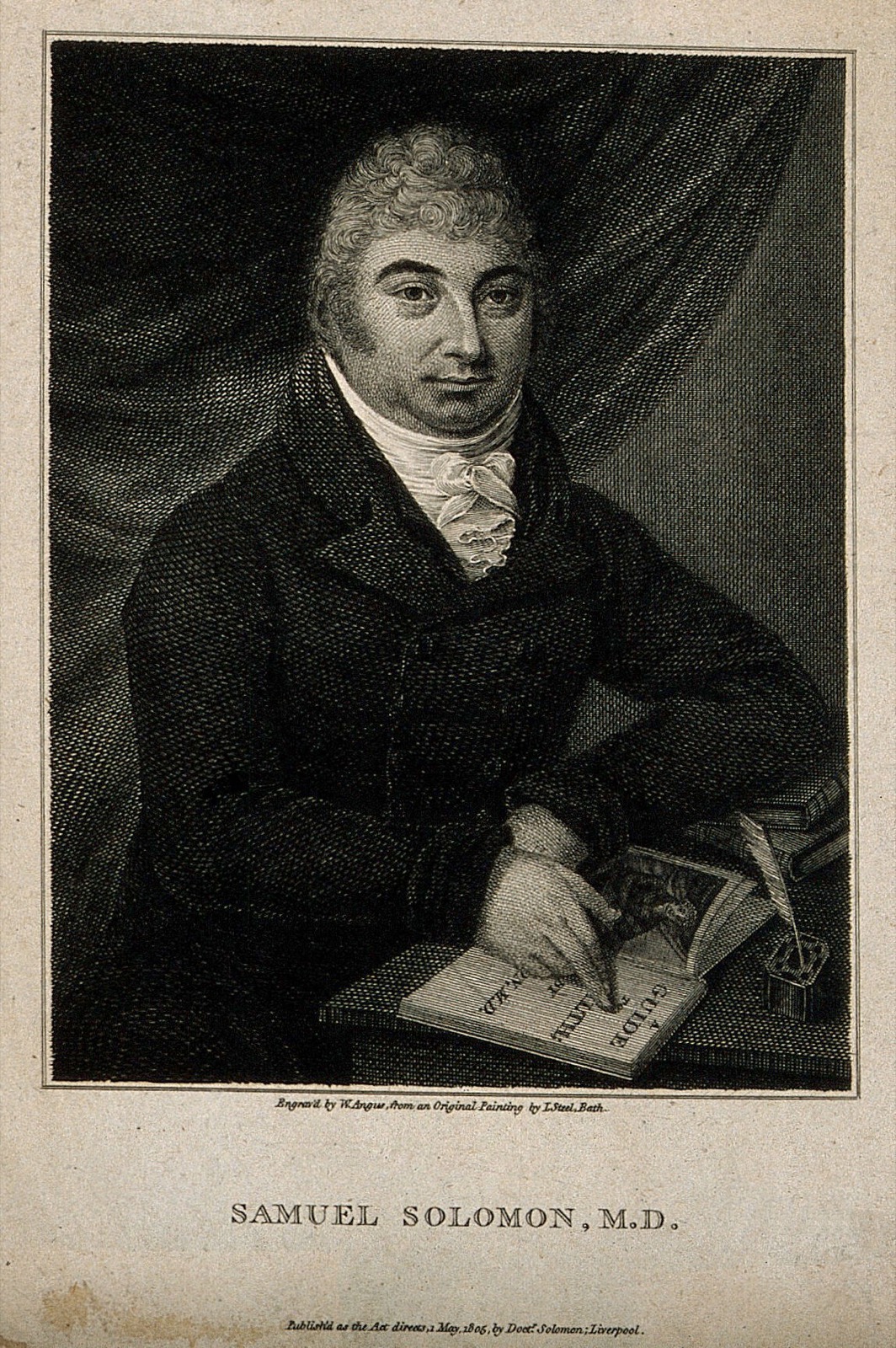
By 1796 a man who had failed in earlier trades was selling medicine in Liverpool under a new name: ‘Dr Solomon, M.D.’ Sivan (2009) records that the MD was conferred that year on the recommendation of two physicians, not earned by study, and contemporaries treated the degree as part of the act. Samuel Solomon (died Bath, 21 May 1819; born around 1745 in Cork by Sivan’s account, c.1768 by Mugglestone’s) built the persona on three props: the unearned title, the book A Guide to Health that ran through many editions and that he holds in his 1805 engraved portrait, and a print campaign that carried the balm into every market town in Britain and Ireland. He presented himself as a learned benefactor offering a precious discovery to suffering humanity.
A biblical name and a half-guinea price
Access was metered by price and by a manufactured aura of singular provenance. A bottle of the Cordial Balm of Gilead sold for half a guinea (10s 6d), an expensive price that Mugglestone (2021) notes was advertised as a bargain only because of the range of ills it claimed to mend. The product was a single secret medicine available from one proprietor, dignified by a biblical name (Gilead, from Jeremiah 8:22) and by claims that the balm descended from an antique recipe. Square bottles with Solomon’s name blown into the glass, sealed certificates, and a fifty-guineas reward against forgery presented the brand and formula as singular; distribution itself was broad, through scores of appointed booksellers and medicine venders nationwide.
A recipe sworn never to be told
The mechanism was deliberately unexaminable. Solomon’s tract described the balm only as a preparation ‘composed of some of the choisest balsams’, made by a long and laborious secret process that had cost him amazing sums, and unequalled by anything in public or private practice. An affidavit sworn before Thomas Golightly JP at Liverpool on 29 August 1796 maintained that he was the sole inventor and had never disclosed the ingredients (Sivan 2009). The secrecy shielded the ingredients from inspection, and no controlled trial of the cordial was ever made, so the advertised action, that it braces and invigorates the nervous system and gives new tone to all the vital functions, was asserted and never measured. Rumour filled the vacuum with tales of dissolved gold.
The man who praised the medicine he alone sold
Solomon was the inventor, sole preparer, proprietor, and advertiser of the remedy whose unequalled efficacy he proclaimed, so his income depended directly on the sales of his own secret cordial. He sold it at half a guinea through his Liverpool warehouse and a national network of vendors, together with A Guide to Health and further nostrums, and Sivan describes the sales as phenomenal and the fortune they built as large enough to raise Gilead House, his Liverpool residence amid gardens and shrubberies. The conflict is stated on those facts and not overstated: the advertising itself names many booksellers and medicine venders who took the trade on commission, and the business employed agents and staff, so the proceeds were shared. The documented conflict is his direct and substantial financial dependence on the secret remedy he alone supplied and praised.
Brandy, cardamom, and a blistering poison
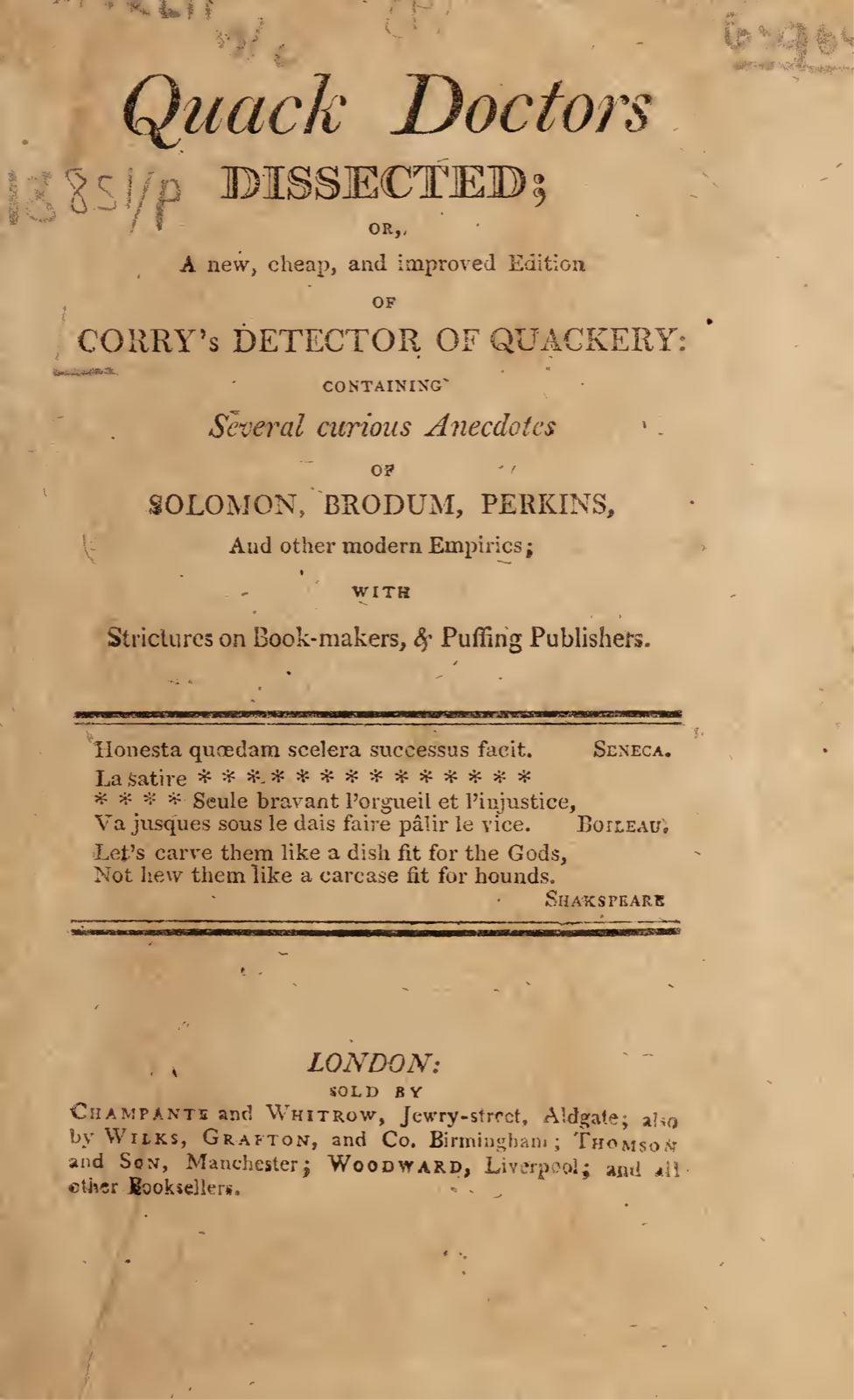
There was no single decisive experiment, because the cordial was never subjected to a controlled trial; the disconfirmation is the combination of informed contemporary judgement and the modern reconstruction of the formula. Solomon’s own contemporaries classed him with the fashionable empirics: John Corry’s Detector of Quackery (Quack Doctors Dissected, circa 1802) named Solomon alongside William Brodum and Elisha Perkins as ‘modern Empirics’ and promised strictures on their puffing publishers. Modern scholarship reconstructs the balm as a high-proof French brandy flavoured with spices, Helfand calling it ‘a few herbs and spices dissolved in a substantial percentage of old French brandy’ (quoted in Mugglestone 2021) and McLaren (2007) giving cardamom, brandy, and cantharides. Ethanol explains the cordial’s cheering effect; it does not restore vigour, renew a failing constitution, or cure consumption, and cantharides is a toxic vesicant rather than a restorative. The verdict is settled: the Cordial Balm of Gilead was a spiced spirit sold at a premium price as a renewer of life, with no health-preserving or life-prolonging power.
The pattern repeats
The same structural machinery appears in different treatments and eras. These cases show the claimed mechanism and how the claim met evidence.
Brodum's Restorative Nervous Cordial and Botanical Syrup
Celestial Bed and Temple of Health
Perkins Metallic Tractors
Part of the lineage
Evidence · 6 sources
- An account of that most excellent medicine, the cordial balm of Gilead (Solomon's advertising tract) (1799)
- Samuel Solomon (1745-1819): quack or entrepreneur? (2009)
- Impotence: A Cultural History (2007)
- Let's buy: Some Cordial Balm of Gilead (John Johnson Collection guest post) (2021)
- Quack Doctors Dissected; or, a New ... Edition of Corry's Detector of Quackery (1802)
- Samuel Solomon, M.D. Stipple engraving by W. Angus after J. Steel (1805)