Turlington's Balsam of Life
In 1743/44, Robert Turlington -- a London weaver with no medical training -- patented a 27-ingredient balsam he claimed cured the stone, gravel, colic, and "inward weakness." An accompanying pamphlet widened the promise to rheumatism, gout, and consumption. Turlington sold it under his own name for over twenty years; a 2025 review in Australian Pharmacist finds it "difficult to say how effective the balsam truly was."
A weaver’s cure for every stone and weakness
In 1743/44, Robert Turlington — a London weaver by trade, with no formal medical training — secured a royal letters patent from George II for a preparation titled A Specifick Balsam, Called the Balsam of Life. Turlington was, per a 2016 archaeological history by Olive Jones and Allen Vegotsky, a weaver, patent medicine vendor, and entrepreneur, one of many sellers in London’s crowded medicine trade who had no formal medical training and sold pre-packed medicines to people they would never meet; Jones and Vegotsky record that sellers of this kind were branded quacks and empirics. His patent specification listed twenty-seven ingredients steeped in rectifying spirits — storax, coriander seed, aloes, fennel, mastic, cardamom, frankincense, aniseed, gum benjamin (benzoin), angelica, gum elemi, cinnamon, guaiacum, cloves, myrrh, nutmeg, araback, winter’s bark, Peru balsam, nettle seed, Tolu balsam, juniper, saffron, mace, oil, St John’s wort, and marsh mallow, per the ingredient list recorded on a period bottle held at Mackinac State Historic Parks — and the patent itself claimed the balsam would cure “stone, gravel, cholick, and inward weakness.” That was only the opening claim.
From kidney stones to nervous disorders, one bottle at a time
Turlington did not stop at the patent’s own wording. He issued an accompanying testimonial pamphlet that widened the list of treatable conditions considerably. A 2025 Australian Pharmacist account describes an undated 46-page pamphlet sold with each bottle; a separate 62-page edition dated 1750 survives on the Internet Archive, and while its full text widens the promise in its own way, it does not contain the wording quoted below, which therefore belongs to some other printing. Quoted directly in that 2025 account, the pamphlet promised the balsam was “a certain relief for the gravel, cholic, rheumatism, gout, and sciatic pains, and all colds, coughs, consumptive, pectoral, asthmatical, and nervous disorders, &c. and for any cut, bruise, or the like, as thousands can testify who have been relieved thereby, in the above and other complaints, after every other resource has failed.” By 1772, a colonial reseller, Thomas Anderton, was advertising the same balsam in the Pennsylvania Packet as “THE TRUE AMERICAN BALSAM,” claiming “true merit, of universal experience, utility and reputation” and superiority to “all the other known Balsams.” In the patent, pamphlet, and colonial advertising examined in this bundle, the mechanism behind this range was never more specific than “balsam”: twenty-seven separately aromatic and resinous ingredients, combined in one alcohol solution and marketed as capable of treating almost any named disease at once, with no distinction drawn between a topical cut and a case of consumption or asthma.
His own name, his own bottle, his own patent
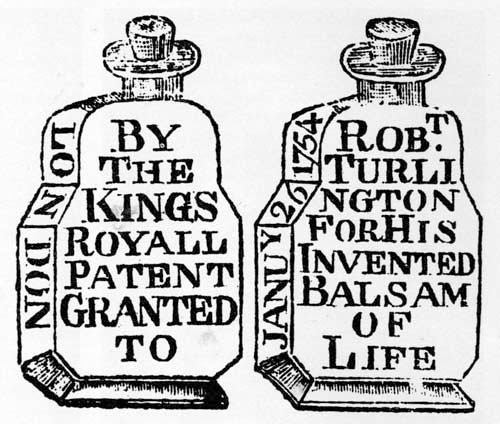
Turlington held the royal patent in his own name and sold the balsam under his own name for the rest of his working life; no source in this bundle documents an independent licensing body, hospital, or tester examining the formula’s composition or effects before sale. He also had a direct financial interest in guarding his exclusive trade. Bottles were being counterfeited by 1754, when Turlington redesigned the bottle into the pear-shaped, embossed form — “By The Kings Royal Patent Granted To Robt. Turlington For His Invented Balsom of Life. London Jany. 26, 1754” — that remained in use, in various sizes, for well over a century; Jones and Vegotsky record the distinctive bottle style was still being made in 1919. Quoted in a 1959 Smithsonian history by George Griffenhagen and James Harvey Young, Turlington explained the redesign was needed “to prevent the villainy of some persons who, buying up my empty bottles, have basely and wickedly put therein a vile spurious counterfeit sort.” Turlington’s branded-bottle strategy sat within a wider trend among British patent-medicine sellers of the period toward distinctively embossed packaging as a defense against imitators, as a surviving private collection of three period bottles — Turlington’s Balsam alongside Daffy’s Elixir and Dalby’s Carminative, each carrying its own distinct patent-style embossing — illustrates; no source in this bundle documents that any specific rival seller copied Turlington’s own pear-shaped design rather than adopting a shape of their own. Turlington’s name and patent claim continued to generate revenue well past his 1766 death: colonial merchants such as Anderton kept advertising under his patent into the 1770s, no source here documents what portion of that colonial trade reached Turlington’s own estate, and the business he founded survived under other hands until 1804. In 1785, Parliament’s Medicine Stamp Act schedule — a tax measure, not a safety or efficacy certification — named “Turlington’s Balsam” specifically among over eighty proprietary preparations subject to the duty.
![Photograph of three antique glass patent-medicine bottles standing side by side, with legible embossed lettering including 'DALBY,' 'TRUE DAFFYS ELIXIR,' and 'BY THE KINGS ROYAL PATENT GRANT[ED].'](/media/turlington-balsam-of-life-1744-1766/three-early-medicine-bottles.jpg)
What history and pharmacology later found
No source in this bundle documents a contemporaneous controlled trial of Turlington’s balsam against any disease it was advertised to treat; the record instead is testimonial (“as thousands can testify”), patent assertion, and retrospective historical and pharmacy-history analysis. The 2016 archaeological history by Jones and Vegotsky offers a measured period-context judgment: in Turlington’s own day, the balsam was consistent with then-current medical practice and would have been considered appropriate for treating many of the disorders his advertising claimed — an observation about eighteenth-century medical norms, not a modern efficacy finding. A 2013 legal-history account of the 1785 stamp duty act, which named Turlington’s Balsam within its taxed schedule, characterizes that entire class of over eighty schedule-listed remedies as “unproven, sometimes useless, frequently dangerous, and they were consumed in prodigious quantities.” The direct modern assessment of what the balsam could do comes from the professional journal Australian Pharmacist, which in 2025 put the question as “Did Turlington’s balsam work?” and answered it with a ceiling: “At best, balsams exhibit anti-inflammatory, antioxidant and antimicrobial effects.” That ceiling sits far below the balsam’s own advertised register — curing the stone and gravel, and relieving consumption, asthma, and nervous disorders — and the same passage adds that, given its many ingredients and the breadth of conditions it claimed to treat, “it’s difficult to say how effective the balsam truly was.” Griffenhagen and Young’s 1959 Smithsonian history traces the balsam’s closest modern pharmacopoeial descendant, U.S.P. Compound Tincture of Benzoin, and quotes the United States Dispensatory’s verdict on its remaining internal use: the tincture is “occasionally employed internally as a stimulating expectorant in chronic bronchitis,” and has also been “recommended in chronic dysentery … but is of doubtful utility.” No source in this bundle documents a regulatory ban or a dramatic contemporaneous prosecution that ended the trade; instead, the historical and pharmacy-history record attached here converges on the same conclusion the patent itself never had to answer to: an alcohol-and-resin mixture was marketed against nearly every named disease of its day, and nothing in this record documents a controlled trial of it or places its plausible effects anywhere near the cures it promised.
The pattern repeats
The same structural machinery appears in different treatments and eras. These cases show the claimed mechanism and how the claim met evidence.
Ward's Pill and Drop
Joanna Stephens's Medicine for the Stone
Morison's Vegetable Universal Medicine (Hygeian pills)
Part of the lineage
External references
Evidence · 9 sources
- Turlington's Balsam of Life (2016)
- Lessons from one of the first medicinal patents (2025)
- Tax and Quacks: The Policy of the Eighteenth Century Medicine Stamp Duty (2013)
- Old English Patent Medicines in America (1959)
- Formula Bottle -- Turlington's Balsam of Life (2023)
- Turlington's Balsam of Life (Thomas Anderton advertisement, Pennsylvania Packet, 17 February 1772) (2022)
- By virtue of the King's patent. Turlington's Balsam of Life is prepared and sold by the patentee (1750)
- Turlington's Balsam of Life bottles as represented in a brochure dated 1755-1757 (1755)
- Three early medicine bottles (2005)