METHUSELAH ARCHIVE CASES / BRODUM-NERVOUS-CORDIAL-1795-1824
Archive case

Brodum's Restorative Nervous Cordial and Botanical Syrup

So famous a quack that a royal masquerade staged a mock "Doctor Brodum's shop"; the title "Dr." rode on an MD bought from Marischal College for 13 guineas.
subjectWilliam Brodum active1795–1824 ● disconfirmed outcomepublicly disconfirmed

In 1802 a masquerade attended by the Prince of Wales staged a mock shop labelled "Doctor Brodum's shop." William Brodum, an itinerant who bought an MD from Marischal College for 13 guineas, sold a secret Nervous Cordial and Botanical Syrup under royal patent, promising health "preserved to extreme old age." The medicines were never tested. Corry's Quack Doctors Dissected listed him with Solomon and Perkins among "modern Empirics," as did the 1805 medical press.
The recurring five-stage cycle
01
Charismatic practitioner
So famous a quack that a royal masquerade staged a mock "Doctor Brodum's shop"; the title "Dr." rode on an MD bought from Marischal College for 13 guineas.
02
Exclusive access
Not scarcity but a branded secret formula, dignified by a royal letters patent and a learned-doctor persona, sold nationally through medicine venders.
03
Vague mechanism
Unexaminable vitalist language about the nerves and "animal spirits," the cordial said to brace the system and give "vigour to the functions of life."
04
Financial conflict
Brodum owned, advertised, and sold the secret medicines he proclaimed, earning an estimated £5,000 a year, with proceeds shared among the vendors his ads list.
05
Disconfirmation / collapse
No trial, just the convergence of contemporary judgement: the 1805 medical press and Corry's "modern Empirics" list both read him as a quack.
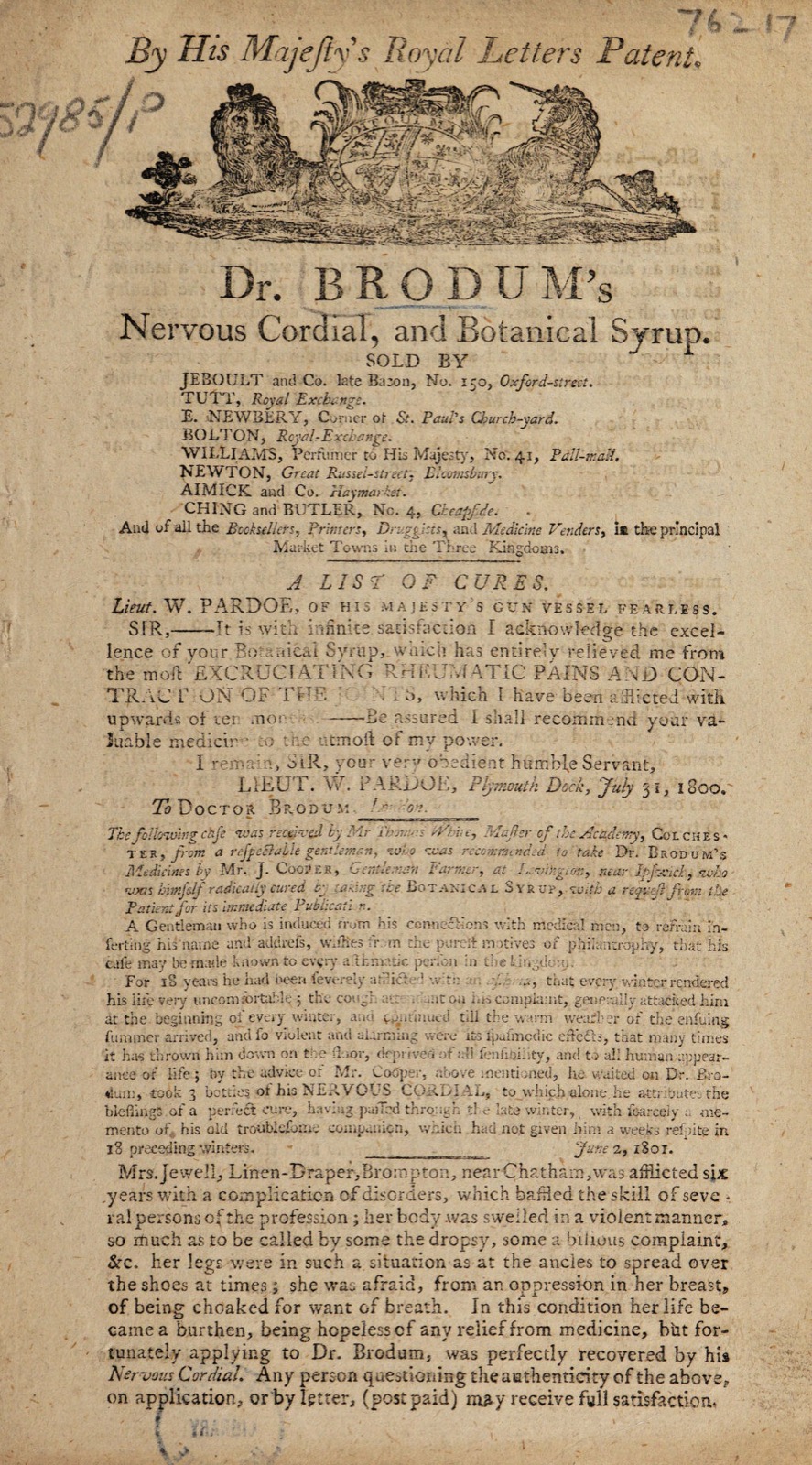
Letterpress advertisement page headed 'By His Majesty's Royal Letters Patent. Dr. Brodum's Nervous Cordial, and Botanical Syrup', with a list of London sellers and provincial venders above a section headed 'A List of Cures' containing testimonial letters
FIG 1 Opening page of William Brodum's royal-patent advertising pamphlet for his Nervous Cordial and Botanical Syrup, headed 'By His Majesty's Royal Letters Patent', listing the London houses and the booksellers, printers, druggists, and medicine venders who sold the medicines, above 'A List of Cures' of testimonial letters dated 1800-1801. Wellcome Collection (work hcza4zdf; digitized copy b30354596). Public Domain Mark. (1801) PUBLIC DOMAIN source

The doctor who had a shop at the Prince’s party

In 1802 a masquerade attended by the Prince of Wales and two of his brothers included, among the costumed amusements, a mock village shop labelled ‘Doctor Brodum’s shop’. That a quack’s storefront was famous enough to parody at a royal entertainment is the measure of the man. William Brodum (died 1824) was, in the patent-medicine historian Alan Mackintosh’s words, ‘the most notorious’ of the irregular medicine owners of late-Georgian England, ‘the owner of two medicines, a nervous cordial and a botanical syrup’ (Mackintosh 2017). He claimed to have trained as a military practitioner in continental Europe but was regarded as an irregular practitioner; ‘often itinerant, he bought an MD from Marischal College, Aberdeen for 13 guineas, and aggressively publicised both himself and his patent medicines.’ That bought degree licensed the title ‘Dr. Brodum’ that fronted his advertising and title pages. His Jewish parentage and an alleged foreign birth drew hostile comment: the 1805 attack ‘Of Quacks and Empiricism’ asserted he was born in Copenhagen, but a defence in the same journal called the claim ‘given on no authority’ and ‘utterly false’, so even his birthplace was contested in his lifetime, and his birth year is uncertain, an estimate of around 1750 resting on a later record of his age.
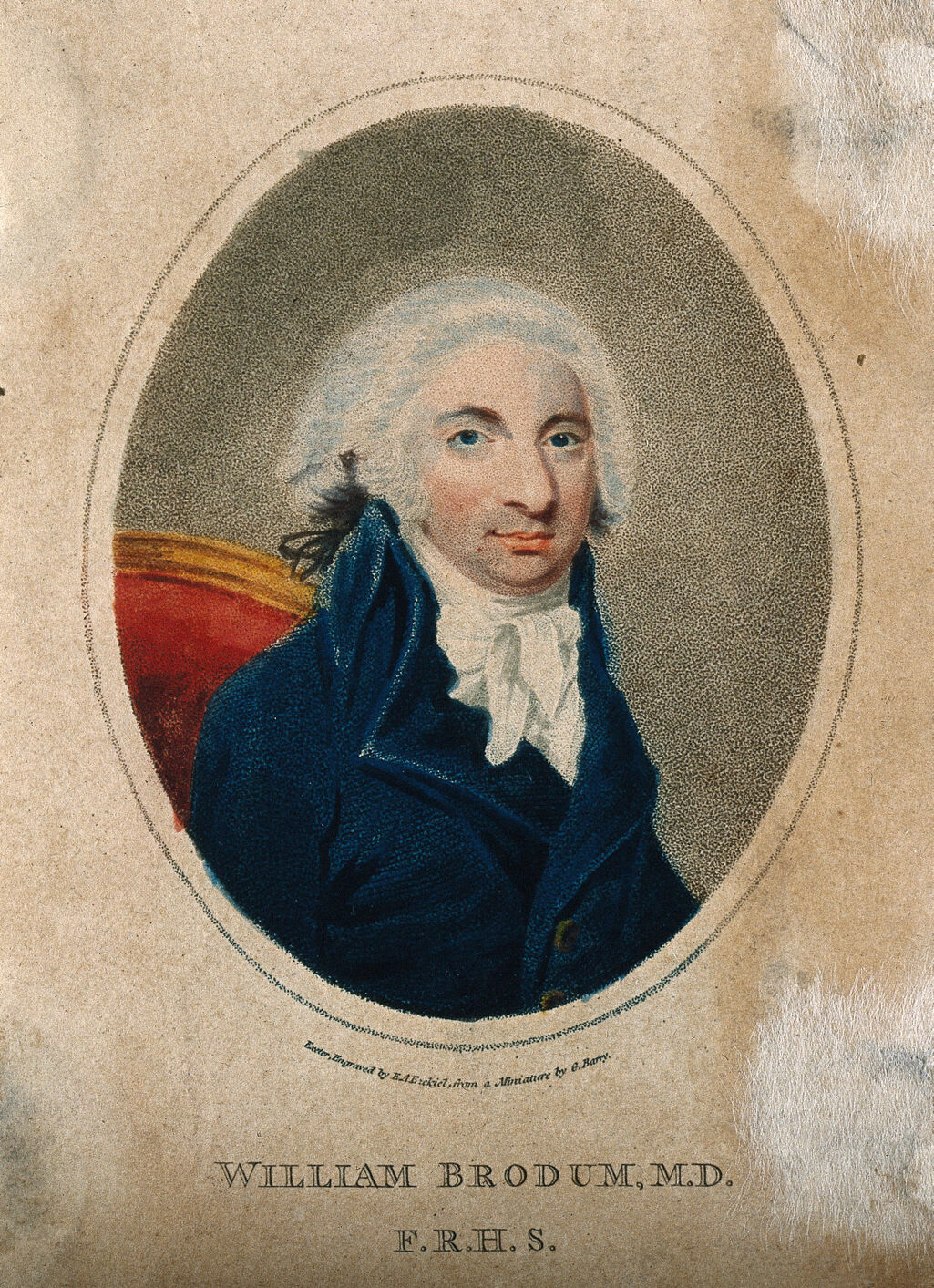
Oval coloured stipple-engraving portrait of a man in a dark blue coat and white cravat, seated against a red chair-back, with the engraved caption 'William Brodum, M.D.' beneath
FIG 2 William Brodum, the proprietor of the Restorative Nervous Cordial and Botanical Syrup. Coloured stipple engraving by E. A. Ezekiel, 1797, after a miniature by G. Barry; the lettering beneath reads 'William Brodum, M.D.' Wellcome Collection (work m55q5yfa; image V0000783). Public Domain Mark. (1797) PUBLIC DOMAIN source

A secret formula, sold in every market town

Access was to a branded secret remedy, dignified by the royal letters patent and a learned-doctor persona, not metered by scarcity. The Nervous Cordial and Botanical Syrup were sold ‘By His Majesty’s Royal Letters Patent’ from Brodum’s premises at No. 9 Albion Street, Blackfriars, and through named London houses and ‘all the Booksellers, Printers, Druggists, and Medicine Venders, in the principal Market Towns in the Three Kingdoms’ (Brodum broadside, [1801?]). What was exclusive was the proprietary formula and the Brodum name: the medicines were secret preparations, their composition not disclosed and not reliably documented today, sold alongside his book A Guide to Old Age (advertised at 3s 6d, with the doctor’s portrait and a dedication to the King). The distribution was national; the secret and the brand were the exclusive article.

‘Vigour to the functions of life’

The advertised mechanism was unexaminable vitalist language about the nerves and the ‘animal spirits’. Brodum’s broadside describes nervous complaints as governed by the mind through the nerves, then asserts that the Nervous Cordial braces the system and gives it ‘vigour to the functions of life’. The medicine was a secret compound never subjected to any controlled test, so the claimed action on the constitution was asserted and never measured. The breadth of the surrounding indication list (delicate and relaxed constitutions, lowness of spirits, weakness of sight, loss of memory, impaired vigour, tabes dorsalis, nervous consumptions, the effects of intemperance) is itself the mark of an unfalsifiable cure-all rather than a defined remedy with a testable mechanism.

Five thousand a year from a bottle he owned

Brodum was the proprietor and the public face of the secret medicines whose efficacy he proclaimed, so his income depended directly on their sale. Mackintosh (2017) reports that he was ‘very successful, earning an estimated £5,000 a year from selling medicines’, and sold his book A Guide to Old Age as part of the same business. The conflict is the owner-vendor pattern stated on the documented facts and not overstated: his own advertisements list numerous London houses and provincial booksellers, printers, druggists, and medicine venders who sold the medicines, so the proceeds were shared. The documented conflict is his direct and substantial financial dependence on the secret medicines he owned and praised, dignified by a bought degree and an advertised royal patent, neither of which was evidence that the medicines worked.
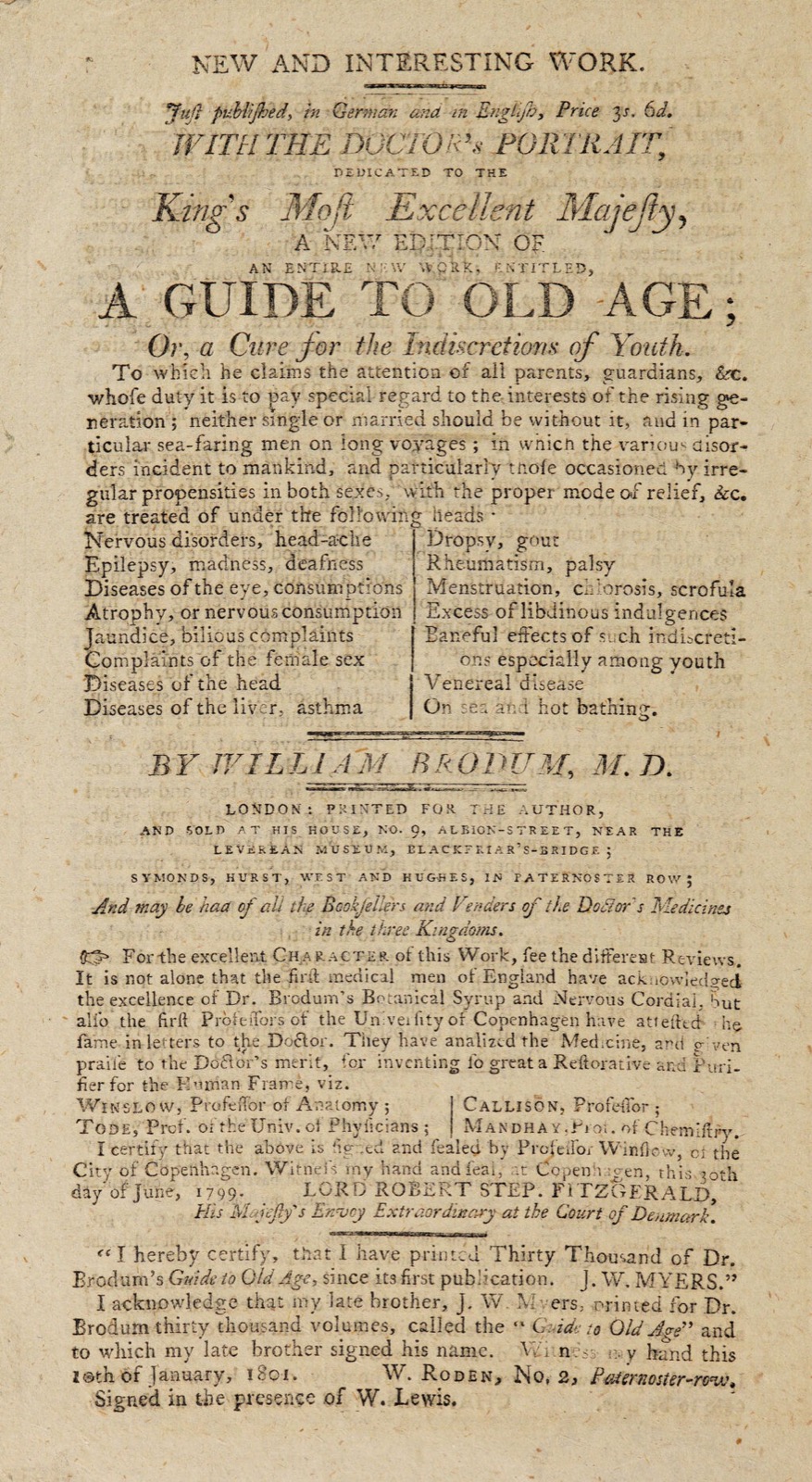
Letterpress advertisement page headed 'New and Interesting Work', promoting the book 'A Guide to Old Age; Or, a Cure for the Indiscretions of Youth. By William Brodum, M.D.', noting the price of 3s 6d, the doctor's portrait, and a dedication to the King, above a list of complaints and testimonials
FIG 3 Advertisement within Brodum's royal-patent pamphlet for his book 'A Guide to Old Age; Or, a Cure for the Indiscretions of Youth. By William Brodum, M.D.', published 'in German and in English, Price 3s. 6d.', 'with the Doctor's portrait', and 'dedicated to the King's Most Excellent Majesty', listing the complaints it treats. Wellcome Collection (work hcza4zdf; digitized copy b30354596). Public Domain Mark. (1801) PUBLIC DOMAIN source

No trial, but a verdict already in

There was no decisive trial, because the secret medicines were never put to a controlled test; the disconfirmation is the convergence of contemporary judgement and the historical verdict. Informed contemporaries classed Brodum among the empirics: John Corry’s Detector of Quackery, in the edition titled Quack Doctors Dissected (circa 1802), named him with Samuel Solomon and Elisha Perkins as ‘modern Empirics’. The medical press attacked his pretensions directly in the Medical and Physical Journal of 1805, which also records that Brodum brought a legal action against the publisher. Mackintosh (2017) records his name ‘repeatedly being used as an exemplar of quackery’. The royal letters patent he advertised was not evidence that the medicines worked. What the record shows is a charismatic irregular practitioner with a bought degree, selling secret proprietary nostrums on testimony and on an unfalsifiable cure-all promise, with no demonstrated power to restore a failing constitution or to preserve health ‘to extreme old age’ as his advertising claimed.

Notes

William Brodum sold two of the best-publicised proprietary medicines of late-Georgian London on a structure that needed no working ingredient: a secret Nervous Cordial and a Botanical Syrup, a royal letters patent, a bought medical degree, and a book that promised to preserve health into old age. Alan Mackintosh’s study of the Georgian patent-medicine trade calls him “the most notorious” of the irregular medicine owners, “(died 1824), the owner of two medicines, a nervous cordial and a botanical syrup”, who, “often itinerant, … bought an MD from Marischal College, Aberdeen for 13 guineas, and aggressively publicised both himself and his patent medicines” (Mackintosh 2017). The medicines were sold “By His Majesty’s Royal Letters Patent” from No. 9 Albion Street, Blackfriars, and through a national network of booksellers and medicine venders, alongside his book A Guide to Old Age, or a Cure for the Indiscretions of Youth (printed by J. W. Myers for the author, 1795), advertised within his broadsides at 3s 6d, with the doctor’s portrait and a dedication to the King. His birth year is not documented; even his Copenhagen origin was disputed in his lifetime, the 1805 Medical and Physical Journal printing both the claim and a defence calling it “given on no authority” and “utterly false”.

The pitch was the renewal of a failing constitution and the preservation of life. Brodum’s broadside markets the Nervous Cordial for “delicate, weakly, and relaxed constitutions, lowness of spirits”, “loss of memory, impaired vigour”, and “nervous consumptions”, asserts that it braces the system and gives it “vigour to the functions of life”, and makes the longevity claim plain: “The grave has lost many a victim, and the health of thousands been preserved to extreme old age, through the fortunate discovery of this invaluable medicine”, the cordial protecting the patient “from the infirmities of old age and a wretched dissolution”. This is the dietetic-vitalist longevity claim in its premium-nostrum form: the restoration of health and vitality sold as the route to a longer, sounder life, the same promise that elsewhere in this archive is sold as an elite regimen or a cheap mass-market pill. The marketing leaned on the late-Georgian panic over the “indiscretions of youth”, addressing debility “arising from the HABITS of SCHOOL BOYS, or the INDULGENCE of MATURE AGE” and assuring the reader that constitutions “destroyed beyond redemption” could yet be recovered. The conflict of interest is the plain owner-vendor pattern. Brodum owned, advertised, and sold the secret remedies he proclaimed, his income (which Mackintosh estimates at £5,000 a year) tracking their sales, with the proceeds shared among the vendors his own advertisements list.

The disconfirmation is not a failed trial, because the secret medicines were never put to a controlled test, but the convergence of contemporary judgement and the historical verdict. John Corry’s Detector of Quackery, in the edition titled Quack Doctors Dissected (circa 1802), named Brodum with Samuel Solomon and Elisha Perkins as “modern Empirics”, so informed contemporaries already read him as a quack, in the same company the archive keeps for Solomon’s Cordial Balm of Gilead and Perkins’s metallic tractors. The medical press attacked his pretensions in the Medical and Physical Journal of 1805, which also records a legal action Brodum brought against the publisher. The royal patent he advertised was no evidence that the medicines worked. The shape is the one the archive follows: an unexaminable secret restorative, sold on price, persona, and an unproven promise of renewed vitality, with no demonstrated power to preserve health “to extreme old age” as it claimed. Brodum stands beside his Liverpool rival Solomon as the late-Georgian premium-nostrum form of a template this archive traces from Graham’s electrical Temple of Health forward to the proprietary cure-alls and rejuvenating tonics of the next century.