Holloway's Pills and Ointment
Thomas Holloway, a former Penzance grocer with no medical training, spent up to 50,000 pounds a year advertising his Pills and Ointment as a near-universal cure, from gout and dropsy to tumours. Royal Holloway's institutional history says the mainly herbal products could not produce the advertised miracle effects; a 1912 British Medical Association analysis identified the pills as aloes, ginger and soap.
The grocer who advertised his way to a college
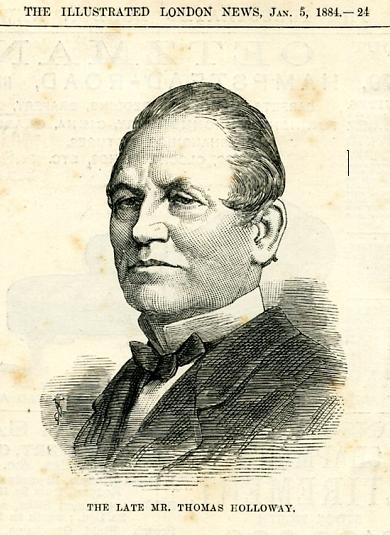
In 1836 a merchant named Thomas Holloway, a grocer’s son from Penzance with no medical training, was working as a foreign commercial agent at 13 Broad Street Buildings in London when a client showed him how a well-advertised ointment might pay. Within a year he had one of his own. Holloway announced his ointment on 15 October 1837, soon added a pill, and staked everything on publicity: the Dictionary of National Biography records that he visited the docks daily to press his preparations on departing captains and passengers, and the Encyclopaedia Britannica judged that his success was owed almost entirely to advertisement. The outlay proves the point. He spent 5,000 pounds on advertising in 1842, 20,000 in 1851, 40,000 in 1864, and about 50,000 pounds a year by his death. The fortune financed the Holloway Sanatorium and the women’s college at Egham that still carries his name.
Sold to the whole world
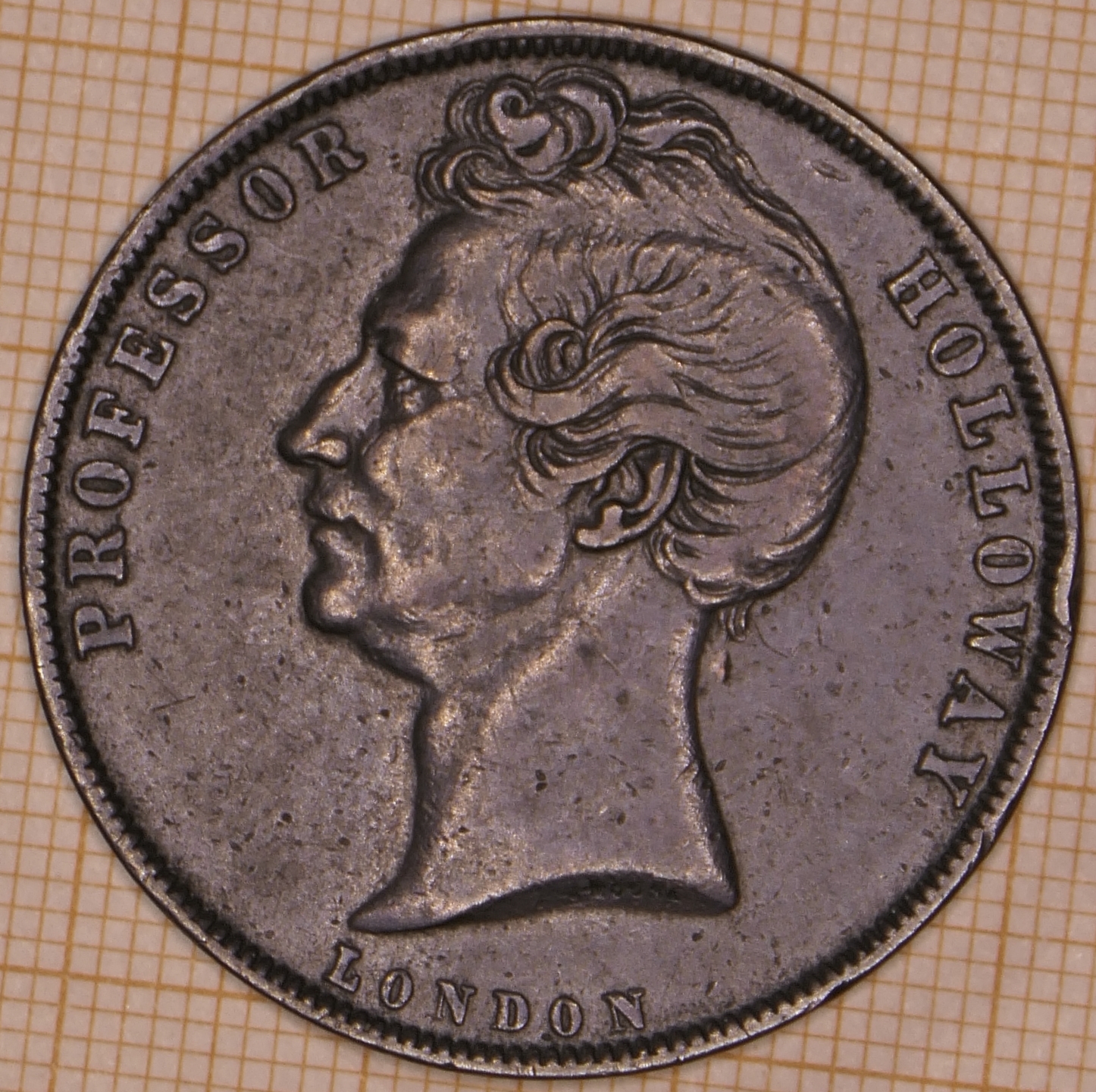
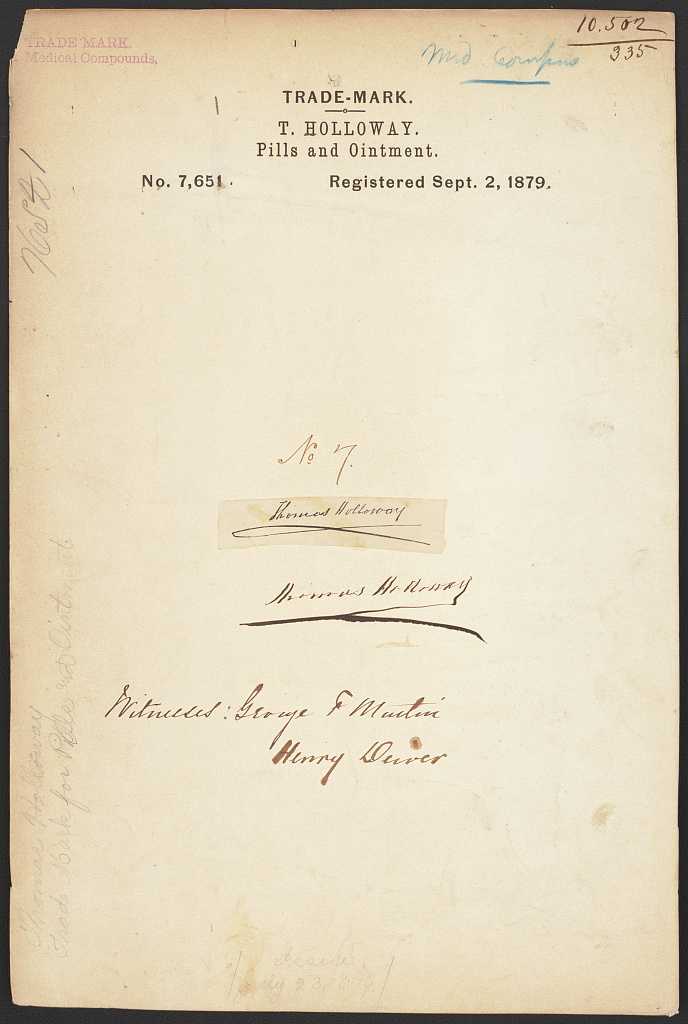
Holloway’s medicine was the opposite of the elite clinic found elsewhere in this archive: its reach was the whole point. The pills and ointment were boxed and sold in enormous volume through his London warehouse (244 Strand, later 533 and then 78 New Oxford Street) and a worldwide network of agents. The Dictionary of National Biography records that the directions were translated into many languages, including Chinese, Turkish, Armenian and Arabic, and that his advertisements ran in newspapers around the world. The brand travelled as money as well as print: in the 1850s copper penny tokens styled “Professor Holloway, London” circulated as small change in colonial Australia, advertising the pills and ointment on a coin. What was proprietary was not access to the remedy but the name: in 1850 Holloway obtained an injunction to stop his own brother Henry from selling imitations under the Holloway name, and in 1879 he registered the trade-mark “T. Holloway. Pills and Ointment.”
One cleansing for some forty diseases
The Hollowayian system reduced treatment to two acts, take the pills and apply the ointment, and promised that between them they answered almost any complaint. Reproduced in the British Medical Association’s 1912 analysis, the advertisement claimed the pills “have positively no equal for thoroughly cleansing the system and putting the liver and kidneys in functional order, without pain or griping,” and the wrapper pamphlet prescribed the pills and ointment for some forty named complaints: gout, rheumatism, sciatica, paralysis, asthma, bronchitis, bad legs, ulcers, tumours, piles, fistulas, dropsies, jaundice, impotency, venereal diseases, erysipelas, scrofula and diarrhoea among them. Royal Holloway’s institutional history describes the products as mainly herbal and says they were incapable of producing the advertised miracle effects.
Author, proprietor, and vendor
The conflict is the developer-vendor pattern, stated on the documented facts and not overstated. Holloway was at once the author of the doctrine (the “Hollowayian System of Medicine” set out in his own pamphlets), the proprietor of the business that made its two remedies, and the seller who grew rich on their volume. His income depended directly on the sale of the pills and ointment whose universal efficacy the pamphlets asserted, and he defended the trade as property, taking his own brother to court in 1850 and registering the brand as a trade-mark in 1879. The proceeds were not his alone: the business employed about a hundred hands and a network of agents who shared in the trade. But the flow of money is clear, and its scale is the striking fact, because from those profits Holloway set apart more than a million pounds to build and endow the Holloway Sanatorium at Virginia Water (opened 1885) and the college for women at Egham (opened by Queen Victoria in 1886).
Aloes, ginger and soap
The disconfirmation is documentary and twofold. First, the foundation of the ointment was borrowed. The earliest traceable advertisement, in June 1838, vouched for the ointment with a testimonial from Herbert Mayo, senior surgeon at the Middlesex Hospital; that August, Felix Albinolo, the leech-seller and ointment-maker who had first employed Holloway’s services, publicly warned that Mayo’s letter had been given for Albinolo’s ointment, not Holloway’s. Second, the advertised effects outran the documented substance. Royal Holloway’s institutional history states that the mainly herbal products were incapable of producing the miracle effects Holloway claimed. The British Medical Association supplied the composition record: when it submitted Holloway’s Pills, still sold under his name, to chemical and microscopical analysis for its 1912 More Secret Remedies (pp. 96-97), it found a box priced 1s. 1.5d. holding 49 pills of average weight 1.4 grain, made of aloes (Barbados), or a preparation of aloes, powdered ginger and soap, with no mercury or calomel present. The BMA analysis was not a clinical trial; it documented what stood behind the sweeping advertising.
The pattern repeats
The same structural machinery appears in different treatments and eras. These cases show the claimed mechanism and how the claim met evidence.
Part of the lineage
Evidence · 9 sources
- Holloway, Thomas (1800-1883), Dictionary of National Biography (1891)
- Holloway, Thomas, Encyclopaedia Britannica, 11th edition (1911)
- Holloway's Pills, in More Secret Remedies: What They Cost and What They Contain (1912)
- Thomas and Jane Holloway - Count Gleichen, c.1883 (2024)
- The late Mr Thomas Holloway, The Illustrated London News (1884)
- Trade-mark registration for T. Holloway, Pills and Ointment (No. 7,651) (1879)
- Penny token, 1857, Professor Holloway, Holloway's Pills and Ointment (obverse) (1857)
- Morison, James (1770-1840), Dictionary of National Biography (1894)
- Medicine, Quackery and the Free Market: The 'War' Against Morison's Pills and the Construction of the Medical Profession, c.1830-c.1850 (2007)