St John Long's Corrosive Liniment and Inhalation
John St John Long, a failed Irish portrait painter, opened a Harley Street practice in 1827 promising to cure consumption by rubbing a secret liniment into the skin until it raised a running sore that let the disease "escape." Two patients died after his treatment; he was convicted of manslaughter in 1830, fined £250, acquitted again in 1831, and died of the tuberculosis he refused to treat by his own method.
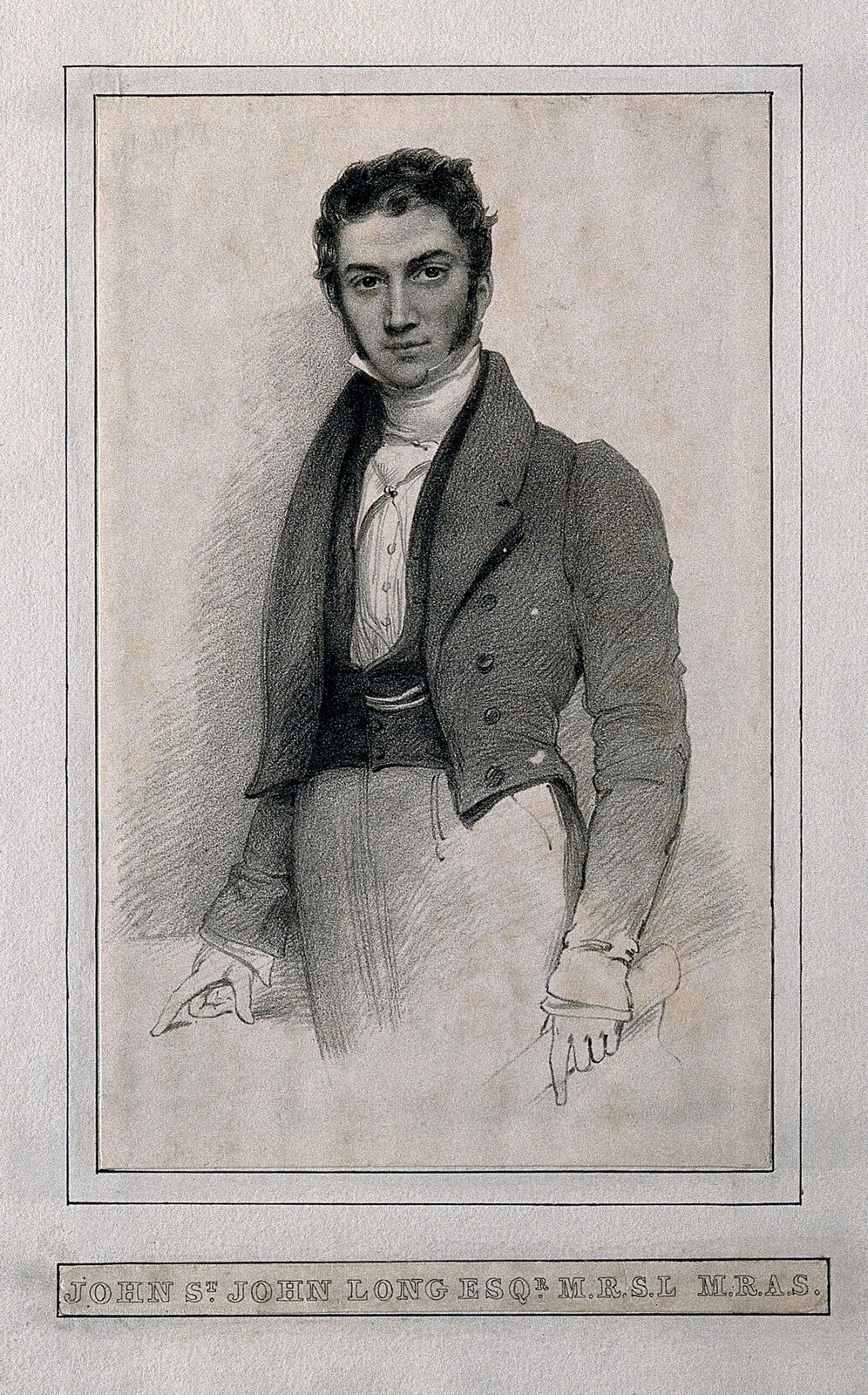
The painter who could not sell a picture
In 1816, some charitable neighbours in Newcastle West, Co. Limerick, paid for a teenage John St John Long to attend the Dublin drawing school. He returned home two years later no better than a competent provincial portraitist, scraping a living on still lifes and drawing lessons. In 1822 he moved to London to try again as a painter, and failed again. What he found instead, in his own words reproduced in the Dictionary of National Biography, was “an entirely original method of treating consumption, rheumatism, and other complaints, viz. the application of corrosive liniments and friction.” He opened a practice in Howland Street, Fitzroy Square, in 1827; within months he could afford 41 Harley Street, and for several years, the DNB records, he was “quite the ‘médecin à la mode.’” He had no medical training of any kind. His entire authority rested on his own claim to have discovered something the rest of medicine had missed, and on a stream of titled patients willing to say, in print and in court, that it had worked for them.
A house full of ladies of the first distinction
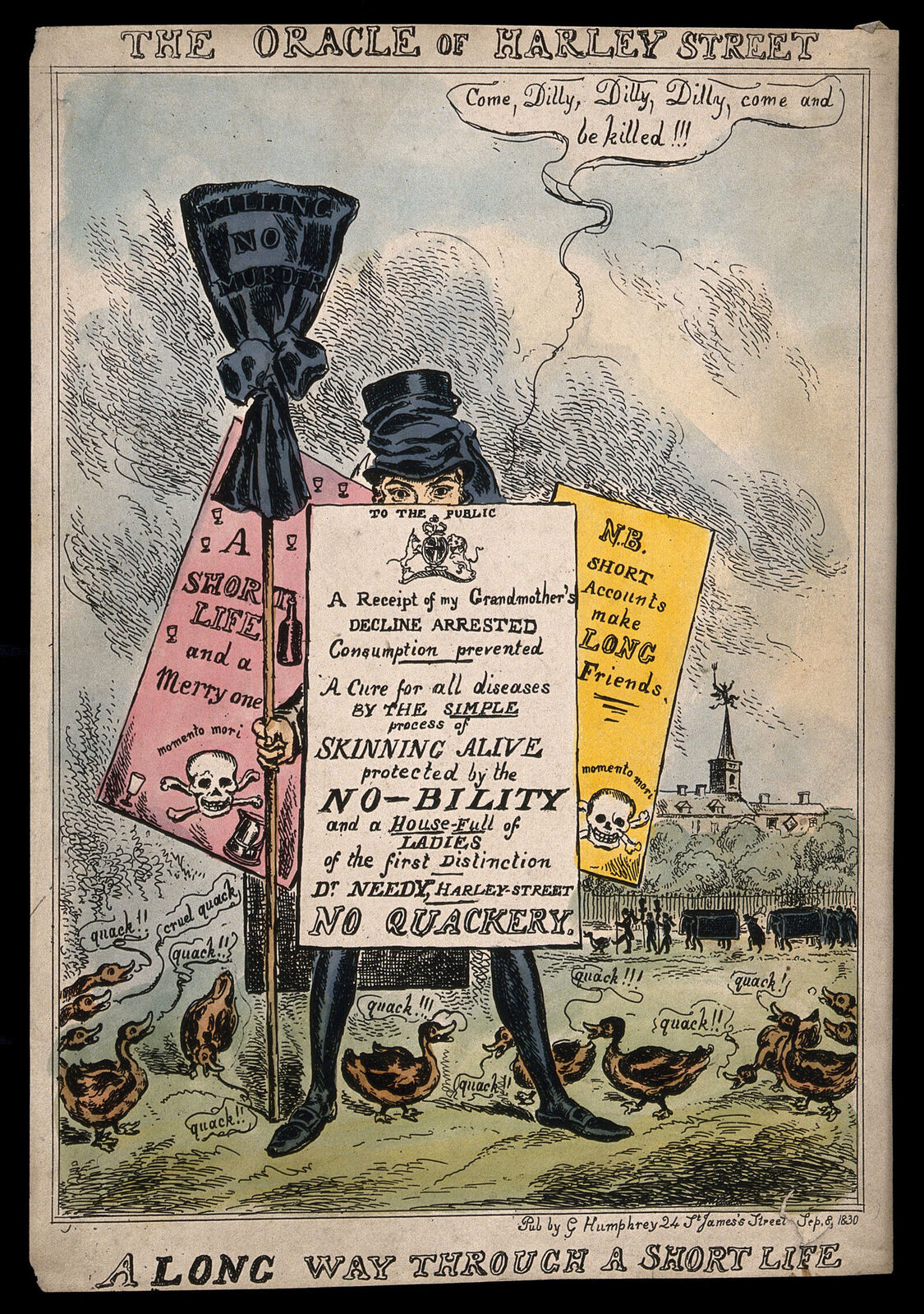
Long’s practice ran on fashion and secrecy together. A satirical print published in September 1830 mocked him with a placard advertising a cure for all diseases by skinning the patient alive, protected, the joke ran, by the nobility and a house full of ladies of the first distinction. The joke worked because it was barely an exaggeration: at his first Old Bailey trial, named witnesses testifying to his skill included Sir Francis Burdett, the Countess of Buckinghamshire, Mr Prendergast, M.P., and Mr Higgs the brewer. Long had moved from a first practice in Howland Street to 41 Harley Street within months of starting in 1827. Access to Long meant a Harley Street appointment, his fee, and his liniment; no formula, no other practitioner, and no published case series stood behind any of it.
A lotion that could tell sound flesh from unsound
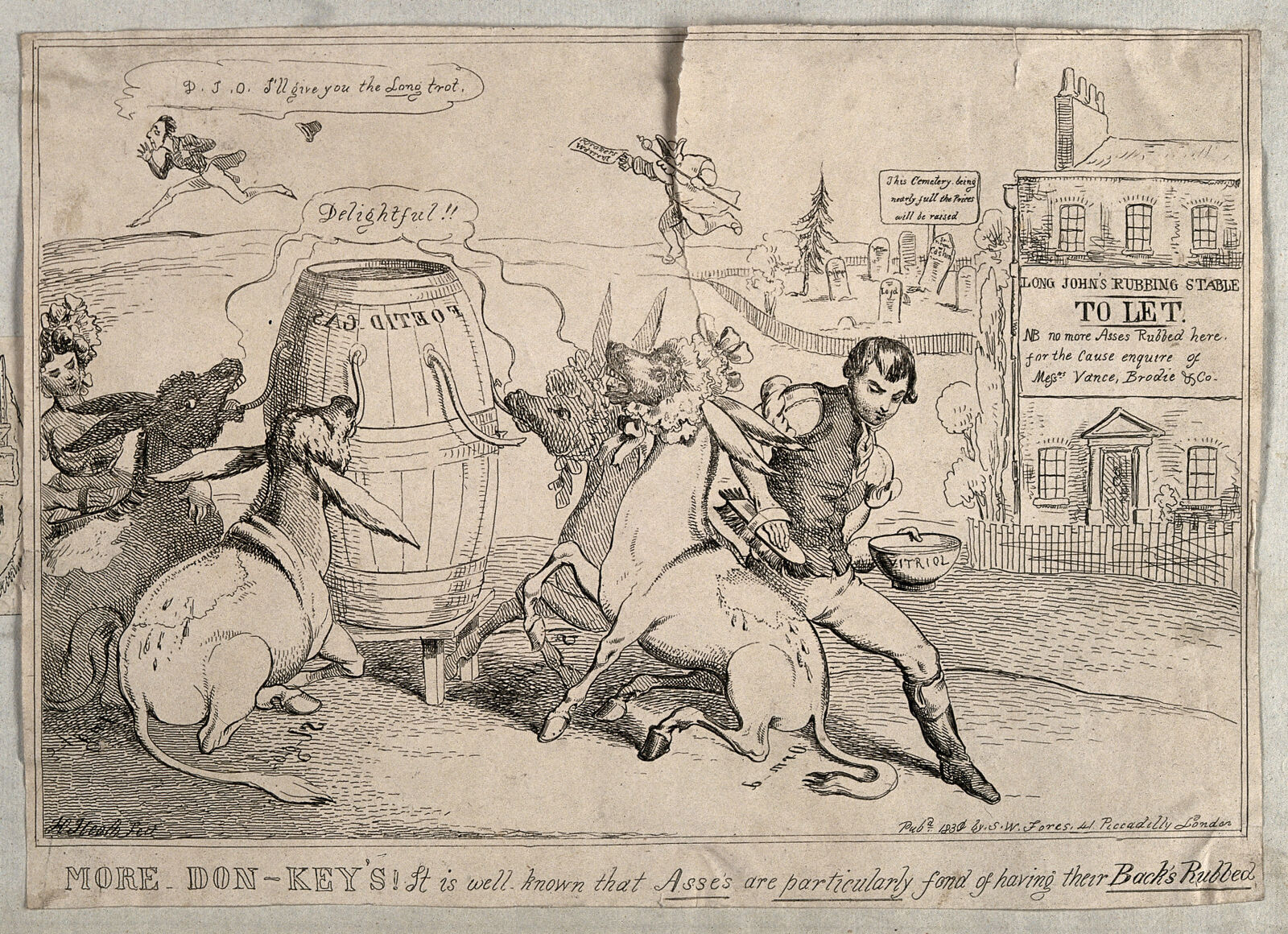
Long’s stated theory, as the Newgate Calendar’s account of his trial evidence records it, was that “in cases of internal disease he proposed, by creating an external wound and a discharge, to carry off the malady.” Applied daily to the skin over a diseased organ for five to ten days, the liniment supposedly raised a running sore, and the discharge from that sore was presented as the disease itself leaving the body. Applied to healthy skin, it was claimed to do nothing at all: a lotion, in effect, that could distinguish sound tissue from unsound. No such selective chemical action exists. Catherine Cashin was, per the Newgate Calendar, “twenty-four years of age and in the full enjoyment of health” when Long applied the liniment to her purely as a preventive measure; it produced an ordinary, severe chemical burn that became infected and killed her within days. Per Wikipedia’s biography, Long’s practice ran on two such secret formulas throughout, one inhaled and the other rubbed on the skin; which formula was used in any single case is not always specified in the sources reviewed for this bundle. The Medico-chirurgical Review had already dismissed the underlying theory in a January 1829 notice, more than a year before either death, and dismissed it again in a second notice on 1 October 1830, three weeks before Long’s Old Bailey conviction that same month.
No formula, no trial, no one else in the room
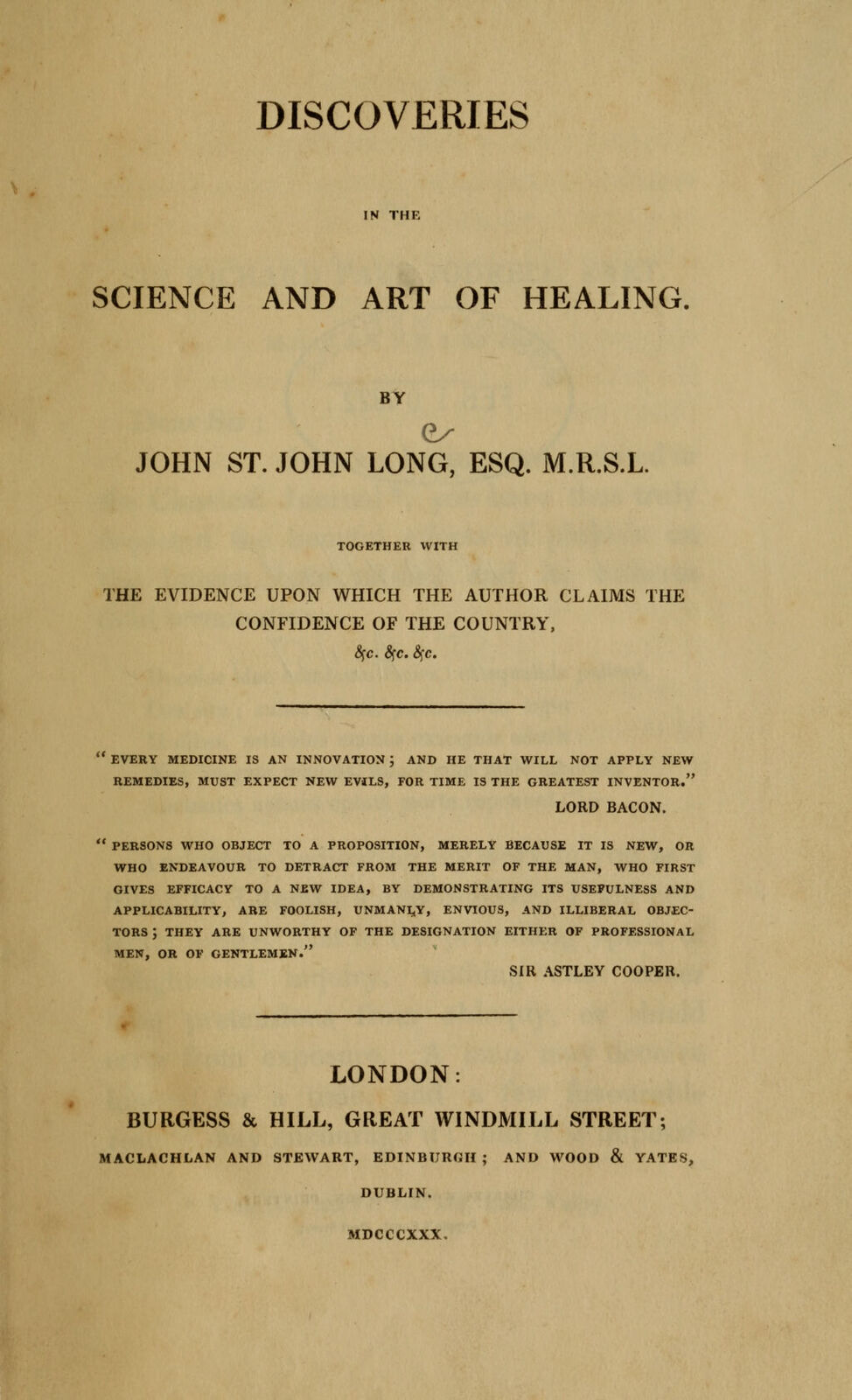
Long devised the liniment and administered it himself, and charged for every consultation at his own Harley Street practice. When critics pressed him, he answered in two pamphlets he wrote in his own defence: Discoveries in the Science and Art of Healing (1830, published by Burgess & Hill, with a second edition in 1831) and A Critical Exposure of the Ignorance and Mal-practice of Certain Medical Practitioners (1831), the second reprinting testimony from the Cashin and Lloyd cases arranged in his own favour. He never disclosed the liniment’s composition, and never submitted a case series, a comparison against ordinary treatment, or any outcome data for outside review. When he died in 1834 he left the “secret,” which the DNB records he valued at £10,000, to his brother William, rather than to medicine. Favourable testimonials from other patients ran throughout this period alongside, not instead of, two women’s deaths after his treatment.
Convicted once, acquitted once, dead of the disease he wouldn’t treat
Catherine Cashin died the morning after the surgeon Benjamin Brodie was finally called in, over Long’s objections; Brodie testified at the coroner’s inquest, and again at the Old Bailey, that he was “at a loss to imagine how the production of such a wound could be supposed to have any effect in curing a patient of consumption, or in preventing such a disease.” A coroner’s jury returned a manslaughter verdict; Long was tried at the Old Bailey on 23 October 1830, convicted, and fined £250, which he paid on the spot. A second fatal case followed within weeks: Mrs Colin Campbell Lloyd, the wife of a Royal Navy captain, died shortly before a coroner’s inquest convened on 10 November 1830, and the jury again found manslaughter, its foreman citing “the ground of gross ignorance, and on other considerations.” At the Old Bailey on 19 February 1831, Long was acquitted, cheered by the same fashionable clientele that had defended him the first time. He never faced a third trial. He died of tuberculosis, the disease his liniment claimed to cure, on 2 July 1834, having refused to treat himself by his own method; former patients raised a monument over his grave. No later investigation vindicated the liniment, and the case remains a citable reference point in the medical-historical literature, revisited as a dedicated retrospective by medical historian Sandra Hempel in The Lancet in 2014.
The pattern repeats
The same structural machinery appears in different treatments and eras. These cases show the claimed mechanism and how the claim met evidence.
Morison's Vegetable Universal Medicine (Hygeian pills)
Celestial Bed and Temple of Health
Homeopathy (Hahnemann's system of medicine)
More related cases · 2
Part of the lineage
Evidence · 11 sources
- Long, John St. John (Dictionary of National Biography, 1885-1900, Vol. 34) (1893)
- John St John Long: quackery and manslaughter (2014)
- Long, John St John (Dictionary of Irish Biography) (2009)
- John St. John Long (English Wikipedia) (2026)
- John St John Long (The Complete Newgate Calendar, Vol. 3) (1926)
- St. John Long and His Disciples (1830)
- Pulmonary Consumption—Quackeries of St. John Long (1829)
- John St John Long. Lithograph. (Wellcome V0003691) (1830)
- J. St. John Long dressed as a funeral mourner (Wellcome V0016227) (1830)
- Four donkeys inhaling foetid gas (Wellcome V0010988) (1830)
- Discoveries in the Science and Art of Healing (1830)