Joanna Stephens's Medicine for the Stone
Joanna Stephens's medicine promised to dissolve the stone -- bladder calculi -- without surgery -- and in 1739 Parliament paid her 5,000 pounds to make the secret public. England and France both then tested it; the modern verdict is blunt: the recipe 'turned out to be entirely useless,' though its one alkaline ingredient held a narrow, real chemistry underneath.
The gentleman’s daughter who cracked the stone
In 1738, an article in the Gentleman’s Magazine extolled the virtues of a new cure for the stone — the agonizing bladder calculi whose only established treatment, open lithotomy, was cut without anesthesia. Its promoter was Joanna Stephens, described in the BAUS Virtual Museum of the History of Urology’s own account as the daughter of a “Gentleman of good estate and family in Berkshire.” No source in this bundle documents any medical degree, apothecary’s license, or hospital appointment for her. By the BAUS museum’s account she had reportedly distributed remedies to the poor earlier in life and turned to treating stone disease specifically after a close friend died of it. No source in this bundle documents how she came to possess her recipe.
What she had, instead of credentials, was a result people wanted badly enough to fund sight unseen. Among the believers was David Hartley, a physician who suffered from the stone himself and who — decades before he would be remembered as the philosopher-founder of associationist psychology — became the medicine’s most visible public defender. Hartley published pamphlets in Stephens’s support starting in 1738 and eventually compiled 155 case reports of the medicine’s use, entering his own case as the 123rd, and his advocacy helped move Parliament toward paying her price. Her public authority rested on other people’s willingness to vouch for a result, not on any institutional standing of her own.
Eggshells, snails, and soap
Stephens’s recipe, published only after Parliament paid for it, had three parts. A powder was made from calcined eggshells and snails. A decoction was boiled from herbs, soap, swine’s cress, and honey. Pills were compounded from snails, wild carrot seeds, burdock seeds, ash keys, hips, haws, soap, and honey. No source in this bundle documents any contemporary medical theory behind the recipe — why a stone formed, or why these particular ingredients should dissolve one; it was empirical in the most literal sense, a formula defended by testimonials rather than mechanism.
Only one component had any real chemical claim to a dissolving action: the soap, an alkali. A 2013 professional urological assessment attributes urate-stone dissolution specifically to this alkaline soap; modern nephrology independently confirms that alkali therapy in general, by raising urine pH, can dissolve an existing pure uric-acid (kidney or bladder) stone, though no source in this bundle establishes that Stephens’s particular undosed preparation achieved that effect in any documented patient. But stones are not one substance. Alexander Marcet’s later chemical analyses of calculi distinguished several distinct types by composition — uric acid among them, but also calcium oxalate, cystine, calcium carbonate, and phosphate stones — and an alkali has no dissolving action on a calcium-containing stone. Stephens’s recipe was marketed and paid for as a solvent for “the stone” without any such distinction. Even on Goddard’s own attribution, its one candidate ingredient could only ever have addressed a fraction of the condition it claimed to cure.
The price of a secret
Stephens set her price at 5,000 pounds — by one modern urologist’s estimate, roughly 650,000 pounds today. A private subscription raised through the Gentleman’s Magazine reached only 1,356 pounds 3 shillings, short of her asking price, so she petitioned Parliament directly. A committee of 22 doctors, politicians, and scientists examined four stone-sufferers before and after treatment, judged them cured, and Parliament voted her the full reward. She published her formula in the London Gazette on 16 June 1739.
The structure of that payment sets Stephens apart from a promoter who profits from repeat sales under a proprietary name. Once Parliament paid, the recipe was public and anyone could compound it; so far as sources document, Stephens received no further payment from it. No source in this bundle documents her promoting any medicine again after 1739; she is recorded only as having purchased a house in Brookgreen, Hammersmith. A contemporary in the same decade, Joshua Ward, took the opposite route: he sold his own pill and drop under his own name for decades, and when Parliament considered an apothecaries bill in 1748 that would have restricted unlicensed compounders like him, it exempted Ward by name rather than regulate him. Stephens’s financial conflict was a single, government-brokered payment for total disclosure; Ward’s was an ongoing, personally retained trade that outlasted the one regulatory attempt to touch it.
Two inquiries, one verdict
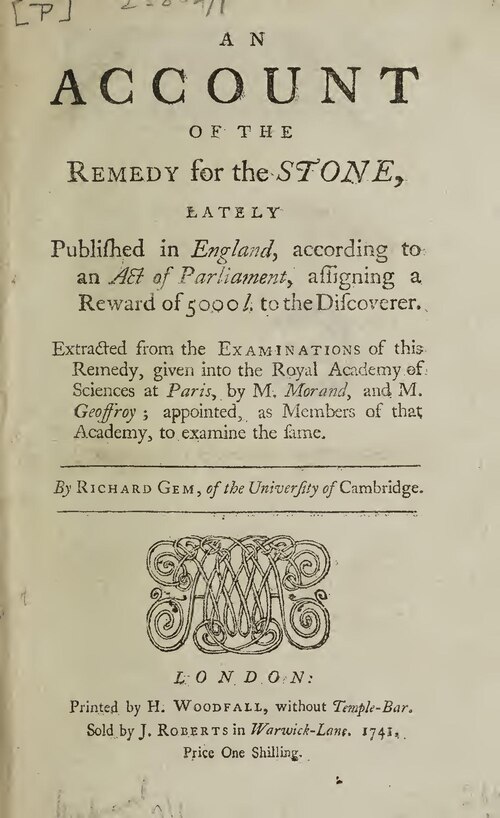
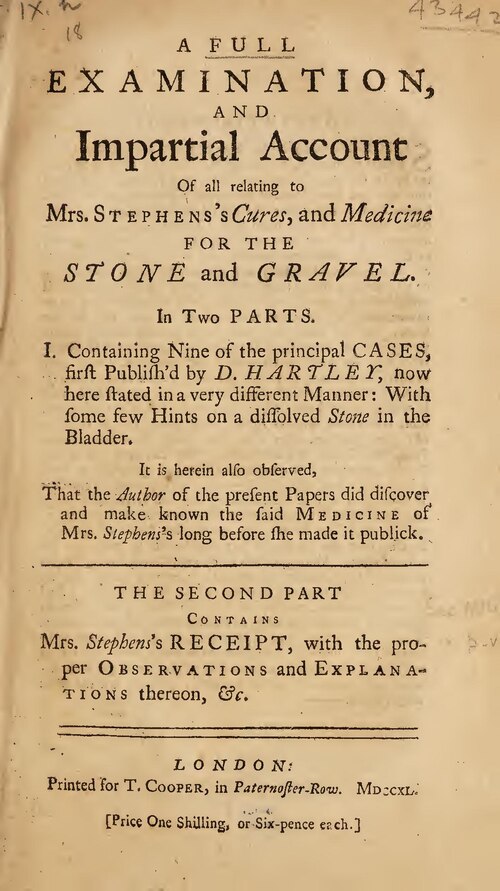
Scientific and public scrutiny followed the 1739 disclosure. Stephen Hales published a dedicated 1740 examination of the medicine’s actual “dissolving power,” independent of the parliamentary committee’s clinical judgment. In Paris, the Royal Academy of Sciences conducted its own investigation, and in 1741 Richard Gem of the University of Cambridge published an English account extracted from the examinations of M. Morand and M. Geoffroy, appointed by that Academy to examine the remedy. In 1739, a separate London tract appeared with the express purpose, stated on its own title page, “to prove that it cannot be a specific for the stone,” and in 1740 another “Full Examination, and Impartial Account” re-stated David Hartley’s original nine case reports “in a very different Manner” and claimed that its own anonymous author had discovered the medicine before Stephens made it public.
The retrospective assessments gathered here reach one consistent verdict. The Wellcome Collection’s own 2019 institutional account states plainly that the recipe “turned out to be entirely useless.” Writing for the Bulletin of the New York Academy of Medicine in 1942, the urologist Edward Keyes titled his retrospective on the whole episode “A Faith That Failed.” A 2013 assessment from a practicing Consultant Urological Surgeon and curator of the BAUS Virtual Museum of the History of Urology is more measured but reaches the same structural conclusion: the remedy “would have worked for some patients” because its alkaline soap could dissolve urate stones, but the marketed claim — a cure for the stone in general — was never chemically sound, since a stone is not always made of urate. Modern nephrology bears this out directly: alkali therapy can dissolve an existing pure uric-acid stone, but has no effect on a calcium-containing stone. Parliament had paid for a universal solvent. On Goddard’s own attribution, what it got was one candidate narrow mechanism, sold as something it was never capable of being.
The pattern repeats
The same structural machinery appears in different treatments and eras. These cases show the claimed mechanism and how the claim met evidence.
More related cases · 1
External references
Evidence · 13 sources
- Joanna Stephens's Cure for Bladder Stones (2013)
- Joanna Stephens (2026)
- The extraction of the excruciating bladder stones (2019)
- The Joanna Stephens Medicines for the Stone: A Faith That Failed (1942)
- Joanna Stephens and the Stone: Credibility Economy in the History of Medicine (2023)
- Uric Acid Nephrolithiasis: A Systemic Metabolic Disorder (2011)
- A New Treatise on the Stone (1739)
- An Account of the Remedy for the Stone Lately Published in England (1741)
- A Full Examination, and Impartial Account of All Relating to Mrs. Stephens's Cures, and Medicine for the Stone and Gravel (1740)
- An Account of Some Experiments and Observations on Mrs. Stephen's Medicines for Dissolving the Stone (1740)
- Stephens, Joanna, -1774 (1993)
- Ward, Joshua (1685-1761) (1899)
- Hartley, David (1705-1757) (1899)