The Kuhne friction sitz bath and 'New Science of Healing'
Louis Kuhne, a Leipzig lay healer with no medical degree, taught that all disease is accumulated "foreign matter," cured by sitting in cold water and rubbing the genitals with a cloth. He defined the disease, prescribed the cure, published the book that sold it, and charged the fees, measuring no endpoint. The single-cause doctrine was a form of intestinal autointoxication, which medicine abandoned after 1910s experiments found gut putrefaction is not absorbed in harmful quantity.
The self-cured man who found the one disease
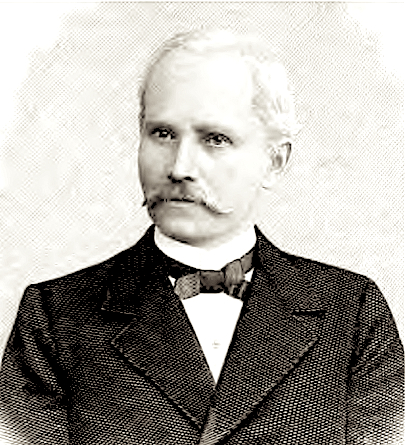
Louis Kuhne held no medical degree, and on that footing he announced that all disease is a single thing and has a single cure. His authority was the oldest kind in this archive: he said he had cured himself. From a treatment practice in Leipzig he built a system he called the new science of healing, and the credential he offered the public was his own recovery, written up under his own name.
Kuhne (14 March 1835 to 4 April 1901) was a self-taught lay healer; the German records list him as a Naturheilkundler, a lay nature-cure healer (Deutsche Digitale Bibliothek), and the Deutsche Biographie authority record (GND 1166088235) gives his life dates. He worked in the German hydrotherapy tradition that ran from Vincenz Priessnitz through Theodor Hahn, a contemporary of Sebastian Kneipp, but where Priessnitz published nothing, Kuhne built his authority on books written in his own name and on the claim to have cured himself. His standing was that of the untutored healer who succeeded where physicians failed: the naturopathic literature still treats him as a founding figure of nature cure (Czeranko, Integr Med (Encinitas) 2019, a celebratory trade-press biography used here only as a marker of his standing, not as evidence his methods worked). Unlike the credentialed promoters elsewhere in this archive (Hufeland the royal physician, Brown-Sequard the academician), Kuhne drew his charisma from being the lay outsider with a single, simple doctrine that promised to explain and cure all disease.
The secret was a book you ran on yourself
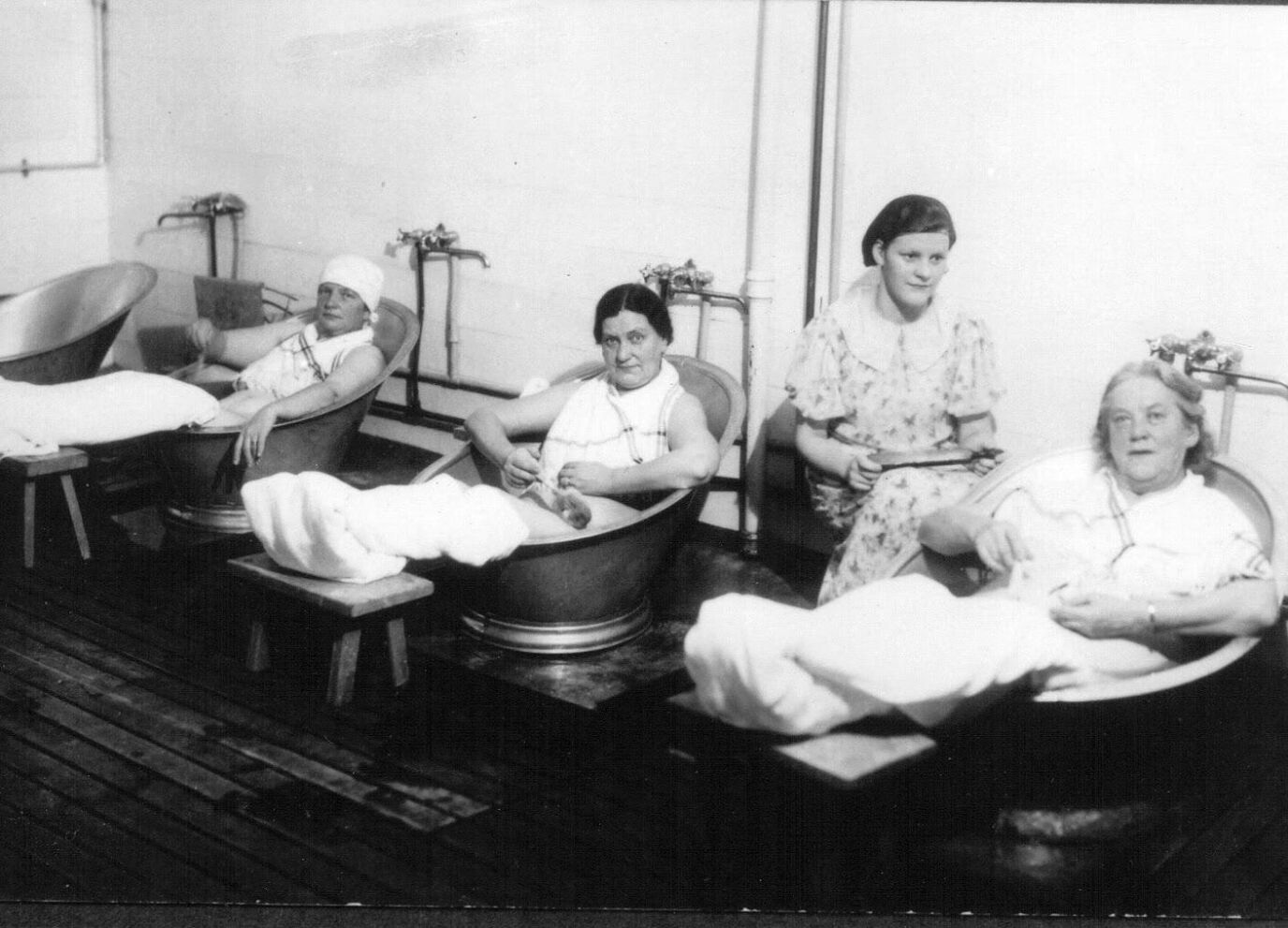
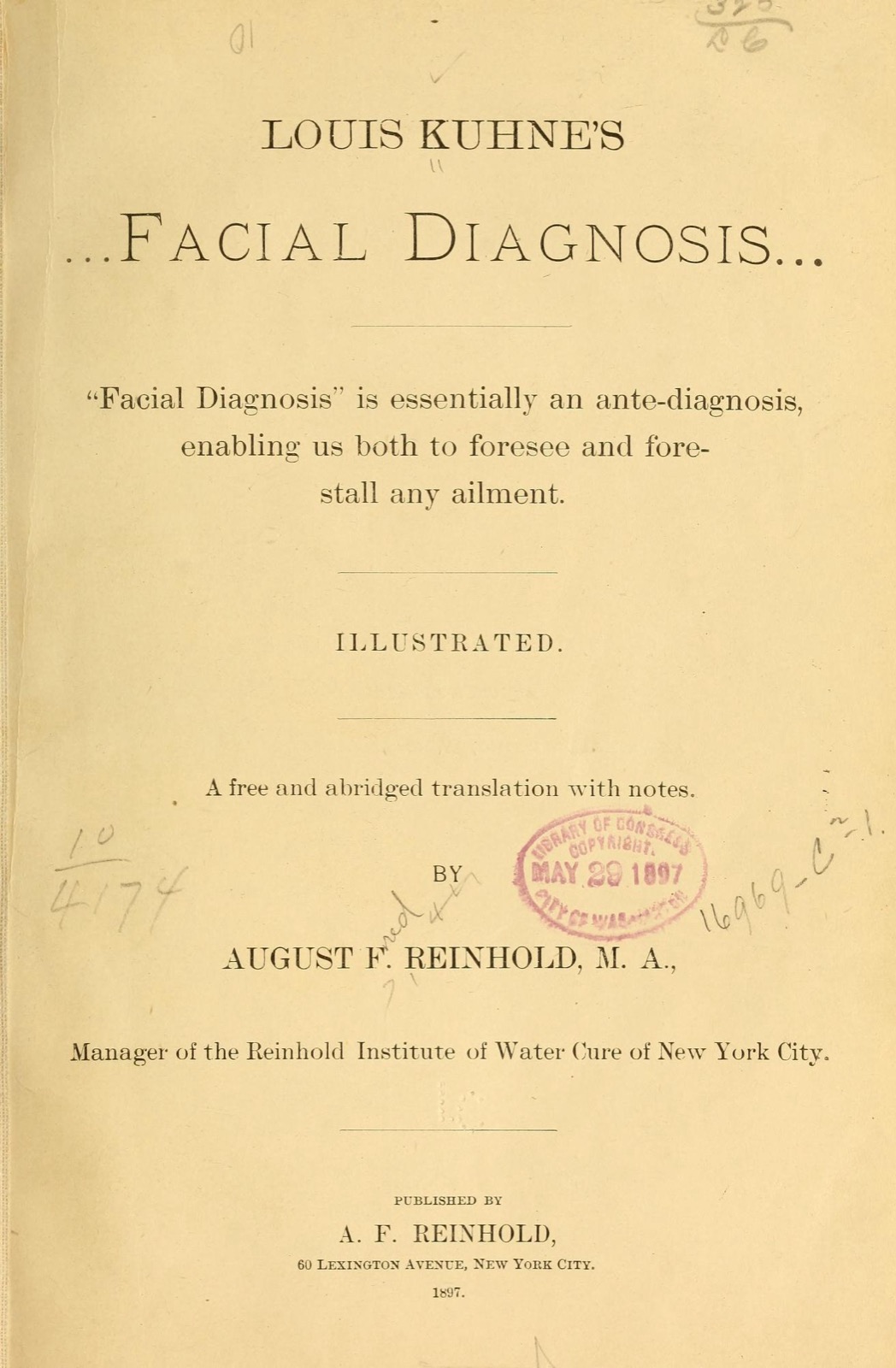
Access ran through three channels rather than a single exclusive clinic. Kuhne treated paying patients at his nature-cure practice in Leipzig; he sold the method in books published through his own house, Verlag von Louis Kuhne; and the system spread to water-cure establishments abroad that took up his method. The books were the principal vehicle and the opposite of exclusive: Die neue Heilwissenschaft (The New Science of Healing) and the 1897 Facial Diagnosis were translated into English and reached a broad international readership who applied the regimen at home. What was sold as privileged was not a scarce treatment but proprietary knowledge: a named diagnostic skill (facial diagnosis) and a named procedure (the friction sitz bath) available chiefly through Kuhne’s books and through establishments that took up his method, such as the Reinhold Institute of Water Cure in New York, whose manager translated and published the 1897 edition, and later nature-cure sanatoria such as Kirvun luonnonparantola in Finland (founded 1911), photographed with patients in cold-water bathtubs.
One disease, one cure, no measurement
The mechanism was a doctrine of unity. Kuhne held that all disease has one cause, the accumulation of ‘foreign matter’ in the body (a self-poisoning, which the period also called toxemia), and therefore one cure. The full title of his treatise states it: ‘the doctrine of the unity of diseases forming the basis of a uniform method of cure, without medicines and without operations.’ The friction sitz bath was the means: sitting in cold water and gently rubbing the external genitals with a cloth for ten minutes to an hour was said to dissolve the foreign matter and move it toward the bowel for excretion, restoring health and ‘Increasing the Vitality’ (Facial Diagnosis contents page). The diagnostic adjunct, facial diagnosis, claimed to read the seat and degree of disease from swellings and ‘encumbrances’ of the face and body, an ‘ante-diagnosis’ enabling one ‘to foresee and forestall any ailment’ (1897 title page). No endpoint was ever measured; every claim is mechanism-only. The single-cause framing is a form of the intestinal-autointoxication theory, and the ‘morbid matter’ image behind it is classical humoral pathology (Encyclopaedia Britannica, ‘Humour’), a pre-modern doctrine, not a finding of scientific medicine.
Author, publisher, and proprietor in one man
The conflict is the author-publisher-proprietor structure, named from documented facts and not overstated. Kuhne was at once the author of the doctrine, the publisher of the books that sold it (the German editions of Die neue Heilwissenschaft carry the imprint Verlag von Louis Kuhne, his own Leipzig house), and the proprietor of the fee-charging Leipzig practice that delivered it, so the same person defined the disease, prescribed the cure, sold the book, and collected the treatment fees. He was not the only party paid: the method also travelled through water-cure establishments abroad that took up his method and ran on their own account, including the Reinhold Institute of Water Cure in New York and nature-cure sanatoria abroad, so translators, publishers of foreign editions, and the proprietors of those establishments also profited. What the sources support is that Kuhne held all the central roles at once and that the doctrine he authored was the very thing that created the demand for the books he published and the treatment he sold.
No trial to lose, only a theory that fell
There was no single disconfirming experiment of the kind the 1784 royal commission ran against Mesmer or Haygarth’s 1799 sham tractors ran against Perkins; Kuhne died in 1901 esteemed within the nature-cure movement, and his books continued to be reprinted and translated. The disconfirmation has three strands. First, the enabling theory has no standing: the single-cause ‘foreign matter’ / self-poisoning doctrine is a form of intestinal autointoxication, which medicine examined and abandoned, experimental work in the 1910s finding that putrefactive products are not absorbed from the gut in harmful quantity and the theory fading from professional acceptance through the 1920s (Whorton, BMJ 2000; Sullivan-Fowler, J Hist Med Allied Sci 1995), with Walter C. Alvarez characterizing autointoxication as a label applied where the real cause was unknown (Bested et al., Gut Pathogens 2013); the ‘morbid matter’ image is pre-modern humoral pathology (Encyclopaedia Britannica, ‘Humour’). Second, the evidence was never sufficient and is labelled insufficient: the claims are mechanism-only, no endpoint was ever measured, and testimonial recoveries cannot be attributed to the friction sitz bath rather than to the natural course of illness, rest, a plainer diet, or abstention from the harsh drugging of the period. Third, the specific mechanisms fail on their own terms: cold-water bathing has a real but transient and non-specific physiological effect and cannot dissolve a material disease-cause, and facial diagnosis is a physiognomic method the book itself relates to phrenology, an abandoned pseudoscience. As with Priessnitz’s cold-water cure and Hufeland’s macrobiotics, the case is atypical for this archive in that parts of the surrounding regimen (a plain vegetarian diet, bathing, abstention from period drugging) were harmless or mildly sound, so what was disconfirmed was the single-cause doctrine, the friction-sitz-bath mechanism, and the facial-diagnosis method, not every component of the daily routine.
The pattern repeats
The same structural machinery appears in different treatments and eras. These cases show the claimed mechanism and how the claim met evidence.
Kneipp Cure (hydrotherapy, herbalism, and the 'five pillars')
Bennett's rejuvenation system (muscular contractions and self-massage)
The cold-water cure (Gräfenberg hydropathy)
More related cases · 9
Part of the lineage
Evidence · 9 sources
- Kuhne, Louis (Deutsche Biographie / GND authority record) (2024)
- Louis Kuhne (Deutsche Digitale Bibliothek person record) (2024)
- Louis Kuhne (1835-1901) (2019)
- The New Science of Healing (Die neue Heilwissenschaft) (1901)
- Louis Kuhne's Facial Diagnosis (Gesichtsausdruckskunde) (1897)
- Civilisation and the colon: constipation as the "disease of diseases" (2000)
- Doubtful Theories, Drastic Therapies: Autointoxication and Faddism in the Late Nineteenth and Early Twentieth Centuries (1995)
- Intestinal microbiota, probiotics and mental health: from Metchnikoff to modern advances: Part I - autointoxication revisited (2013)
- Humour (ancient physiology), Encyclopaedia Britannica (2024)