Macrobiotics (Hufeland's art of prolonging life)
In 1797 Christoph Wilhelm Hufeland, royal physician in Berlin and the foremost German doctor of his generation, gave longevity medicine its name and its first program: husband your innate vital force through moderation, sleep, air, and calm, and you prolong your life. Kant endorsed it; the book sold for decades. But the vital force was never measurable, no outcome study was ever run, and 19th-century physiology retired the idea. Hufeland died at 74.
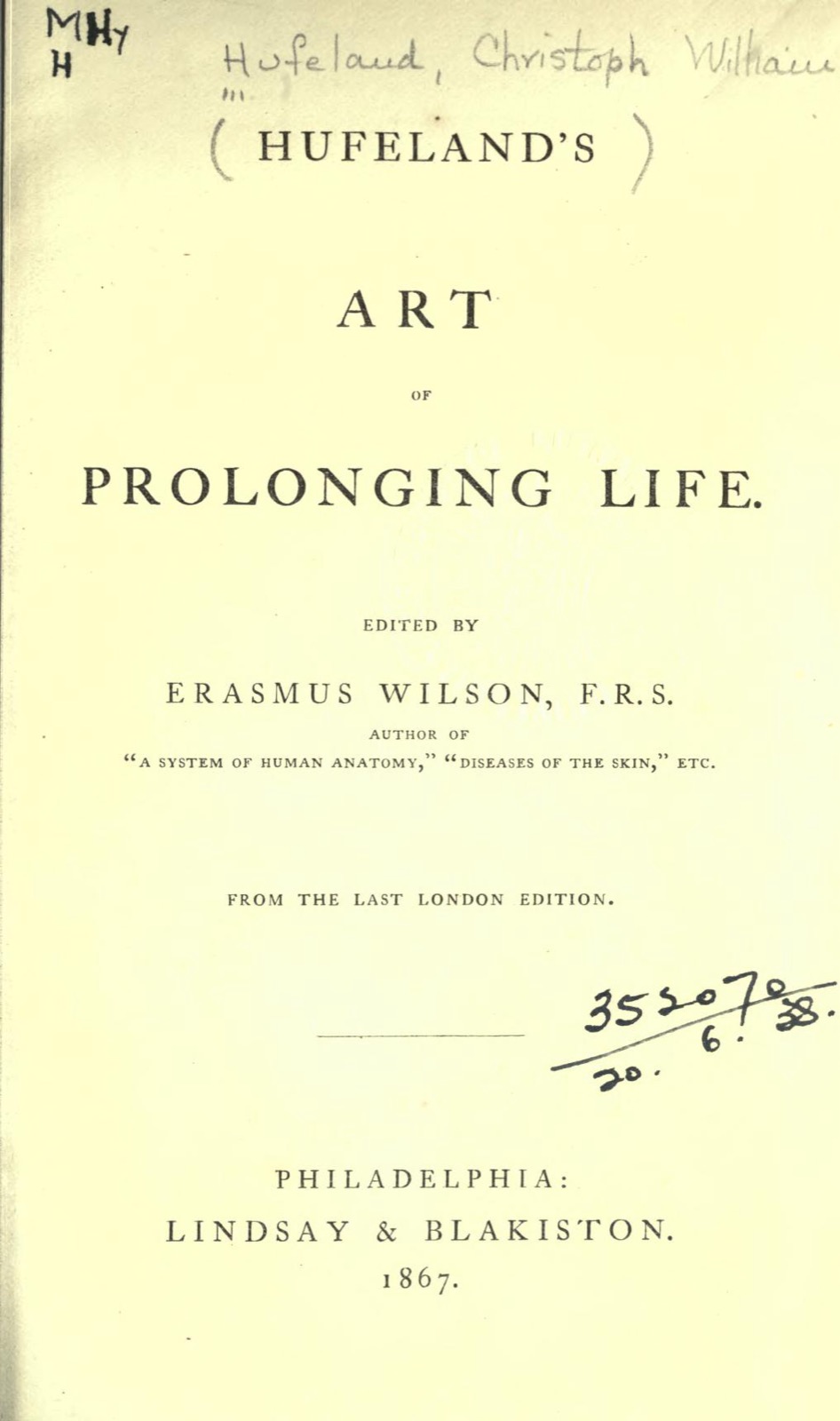
The doctor whose name was the medicine
In 1797, at Jena, the most trusted physician in the German states published a book that promised to teach readers how to prolong their own lives, and gave the new field a name from the Greek for long life: macrobiotics. The author had the standing to make the promise stick. Christoph Wilhelm Hufeland (1762-1836), born in Langensalza, was the foremost German physician of his generation. He practised at Weimar, where the Neue Deutsche Biographie records that he attended the leading figures of Weimar classicism (Wieland, Herder, Goethe, and Schiller) as their physician. He was called to a professorship of medicine at Jena in 1793, and in 1801 to Berlin as royal physician (Leibarzt) to the family of King Friedrich Wilhelm III, director of the Collegium Medicum, and first physician at the Charité, succeeding C.G. Selle; in 1810 he became professor and first dean of the medical faculty at the new Berlin university. He founded and edited the leading German medical periodical, the Journal der practischen Arzneykunde, from 1795. It was this authority, not a clinic or a proprietary substance, that carried the doctrine. Hufeland gave the field its name and, in Die Kunst, das menschliche Leben zu verlängern (Jena, 1797), its program.
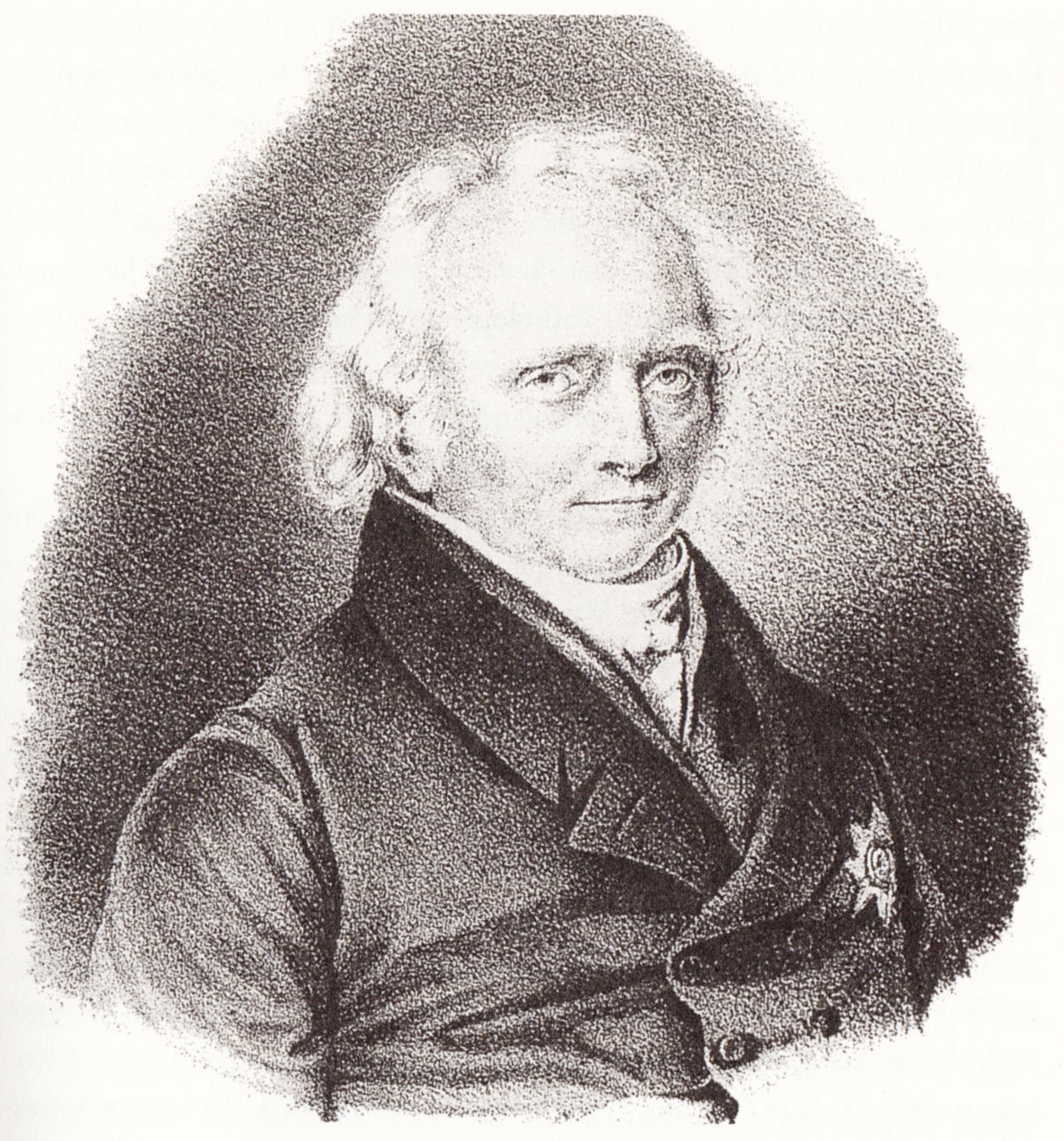
The advice was free; the name on it was not
Unlike most cases in this archive, the intervention itself was inexpensive and broadly available: a regimen of living, published in a treatise that ran through many German editions across four decades and was translated into numerous languages. Exclusivity attached to authority and clientele rather than to the product. Hufeland was physician to the Saxe-Weimar court and to the most celebrated cultural figures of the age, and from 1801 royal physician to the Prussian royal family. The macrobiotic doctrine drew the prestige of the elite end of medicine while the book democratized the advice. The reception extended to the intellectual elite as well: Hufeland sent the treatise to Immanuel Kant, who answered with an open letter that engaged the project approvingly and that Hufeland published in his journal before Kant collected it as the third part of The Conflict of the Faculties (1798). What commanded a premium was the imprimatur of the foremost German physician and the names attached to him, not the cost of moderation and sleep. This is the same structure recorded for Metchnikoff’s sour milk a century later, where the base product was cheap and the scientific endorsement was the monetized asset.
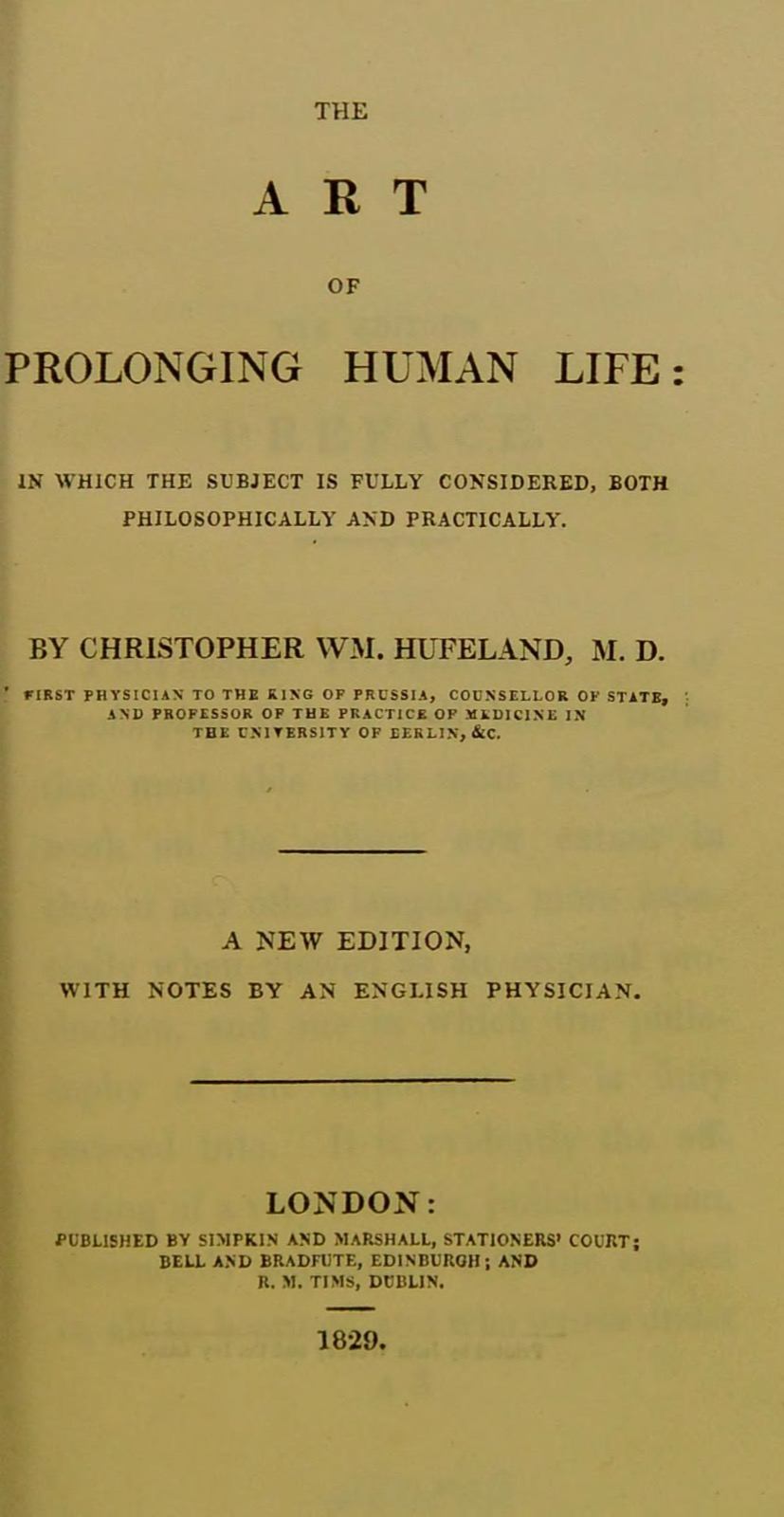
A force you could spend but never measure
The mechanism was the vital force (Lebenskraft), a concept Hufeland drew from Blumenbach’s biology. Life is the operation of an innate vital power; vital operation consumes that power; the term of life is set by the original quantity of the power and the rate at which it is spent; and a regimen that retards the consumption prolongs life. The English edition states the doctrine in its chapter headings: an ‘Inquiry into the nature of the vital power, and the duration of life in general’ is followed by ‘Vital consumption inseparable consequence of vital operation. Term of life’ and then ‘Retardation of vital consumption. Possibility of prolonging life.’ No endpoint was measured. Neither a surrogate nor a hard endpoint was used; the claim was mechanism-only. The supporting evidence Hufeland offered was the posited force, physiological analogy, and longevity anecdote (chiefly the spare fixed diet of the Venetian Luigi Cornaro and reports of long-lived populations). The step from a non-measurable vital force to a measured human lifespan was asserted, not demonstrated.
When the bestseller and the journal are both yours
The conflict is authorial and reputational rather than the developer-vendor pattern seen elsewhere in this archive, and is named as such from documented facts. Hufeland was the author of a commercial success, a treatise that ran through many editions over four decades and numerous translations, in which he held a direct authorial and financial interest. He founded and edited the leading German medical periodical (the Journal der practischen Arzneykunde, from 1795 into the 1830s), a platform that carried material in the macrobiotic register, including Kant’s open letter. And he held the most prestigious court and state medical appointments of the period. The conflict named here is that the foremost medical authority of the German states authored and promoted, through a bestselling book and a journal he controlled, a life-extension doctrine whose central mechanism rested on no controlled evidence. This is the inverse of the Bailey and Voronoff developer-vendor pattern and a near-match to the Metchnikoff pattern, in which scientific authority itself was the asset that monetized the claim.
Not refuted in a test, but quietly retired
Macrobiotics faced no single disconfirming experiment of the kind the 1784 royal commission ran against Mesmer; its mechanism was abandoned rather than refuted in a public test. The disconfirmation has three strands. First, the enabling theory lost its standing: vitalism, the doctrine of a special life-principle not reducible to physics and chemistry, was progressively displaced through the 19th and early 20th centuries as mechanistic and physico-chemical physiology accounted for more and more vital phenomena, and it has no place in mainstream modern biology (De Klerk, Acta Biotheoretica 1979; Encyclopaedia Britannica, ‘Vitalism’), so the finite vital force whose consumption Hufeland held to set the term of life is not recognized to exist. Second, the evidence was never sufficient and is labelled insufficient: no controlled human outcome study of the regimen’s effect on lifespan was ever conducted, and mechanism plus anecdote cannot establish a lifespan effect. Third, the promoter’s own case did not bear out an extraordinary claim: Hufeland died in 1836 at the age of 74, a good age for the period but not the extended span the doctrine implied. The archive records the atypical feature plainly: several of the hygienic components of the regimen (moderation, sleep, exercise, clean air) overlap with measures later associated with health, so what was disconfirmed was the vital-force mechanism and the specific life-extension claim, not the harmless advice. Modern preventive medicine is a separately evidenced field and does not vindicate the vital-force framework as Hufeland stated it.
The pattern repeats
The same structural machinery appears in different treatments and eras. These cases show the claimed mechanism and how the claim met evidence.
Bennett's rejuvenation system (muscular contractions and self-massage)
The Hay System (food combining / 'food separation')
Order-energy raw-food regimen (Bircher-Benner's 'Lebendige Kraft' nutrition)
More related cases · 12
Part of the lineage
Evidence · 13 sources
- Die Kunst, das menschliche Leben zu verlängern (first edition) (1797)
- The Art of Prolonging Life (Erasmus Wilson edition) (1867)
- Hufeland, Christoph Wilhelm (Neue Deutsche Biographie / Allgemeine Deutsche Biographie) (1974)
- Christoph Wilhelm Hufeland (1762-1836) (1995)
- The macrobiotics of Christopher William Hufeland (175th anniversary note) (1972)
- The Conflict of the Faculties (Der Streit der Fakultäten), part three (1798)
- Hufeland, Christoph Wilhelm (Kant in the Classroom) (2006)
- Mechanism and vitalism. A history of the controversy (1979)
- Vitalism (Encyclopaedia Britannica) (2026)
- History of Slimming Diets up to the Late 1950s (2022)
- Christoph Wilhelm Hufeland portrait (1995)
- The Art of Prolonging Life, Erasmus Wilson edition title page (1867)
- The Art of Prolonging Human Life, London edition title page (1829)