Kneipp Cure (hydrotherapy, herbalism, and the 'five pillars')
In 1886, a Bavarian priest published a book claiming that brief cold-water 'shocks' cured or prevented an enormous range of unrelated diseases. By 1891 he had personally granted a Würzburg pharmacist the exclusive right to sell products bearing his name and portrait — the company, now Kneipp GmbH, trades under the Kneipp name today. A 2023 systematic review of 20 clinical trials found the underlying method's evidence too biased and inconsistent to draw firm conclusions.
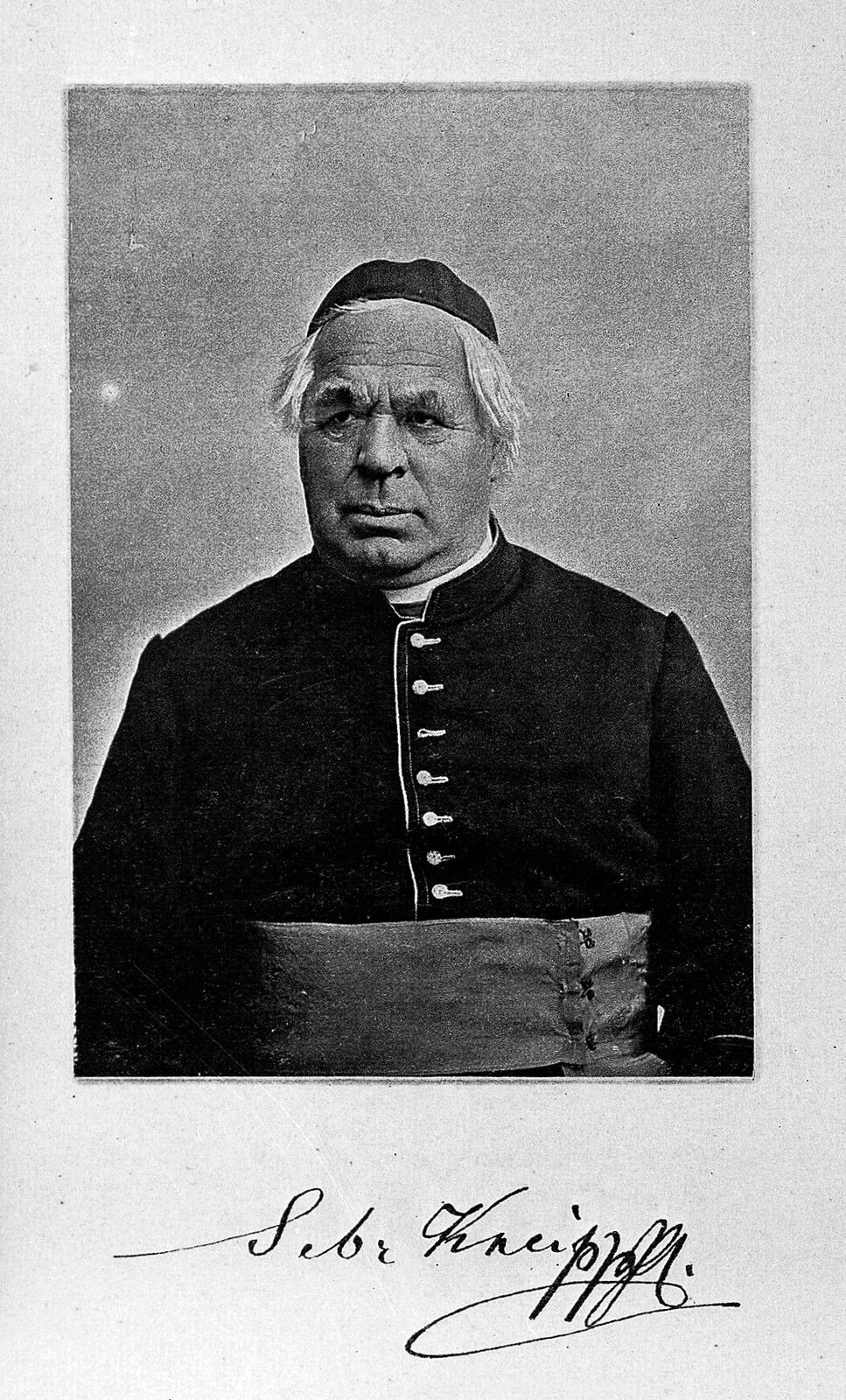
The chaplain who cured himself with a garden watering can
As a young seminary student in the 1840s, Sebastian Kneipp contracted tuberculosis — at the time “often synonymous with death” (Czeranko, 2019). He treated himself using cold-water immersions described in a small book by Dr. Johann Siegmund Hahn, later crediting that book with saving his life (Czeranko, 2019). Ordained a Catholic priest in 1852, Kneipp became confessor to the Dominican convent at Wörishofen in 1855 and its parish priest by around 1880, treating parishioners with cold-water pours administered, in the earliest accounts, with an ordinary garden watering can. His method might have stayed a local curiosity had he not written it down: Meine Wasserkur (My Water Cure), published in 1886, made him a national and then international figure. The book went through dozens of editions and, by 1904, had been translated into 52 languages (Czeranko, 2019). Bad Wörishofen’s own official history credits the book directly: “The foundation stone of the health resort in Wörishofen has been laid.” Kneipp died at Wörishofen on 17 June 1897, by then one of the best-known healers in Europe.
A parish that became a pilgrimage
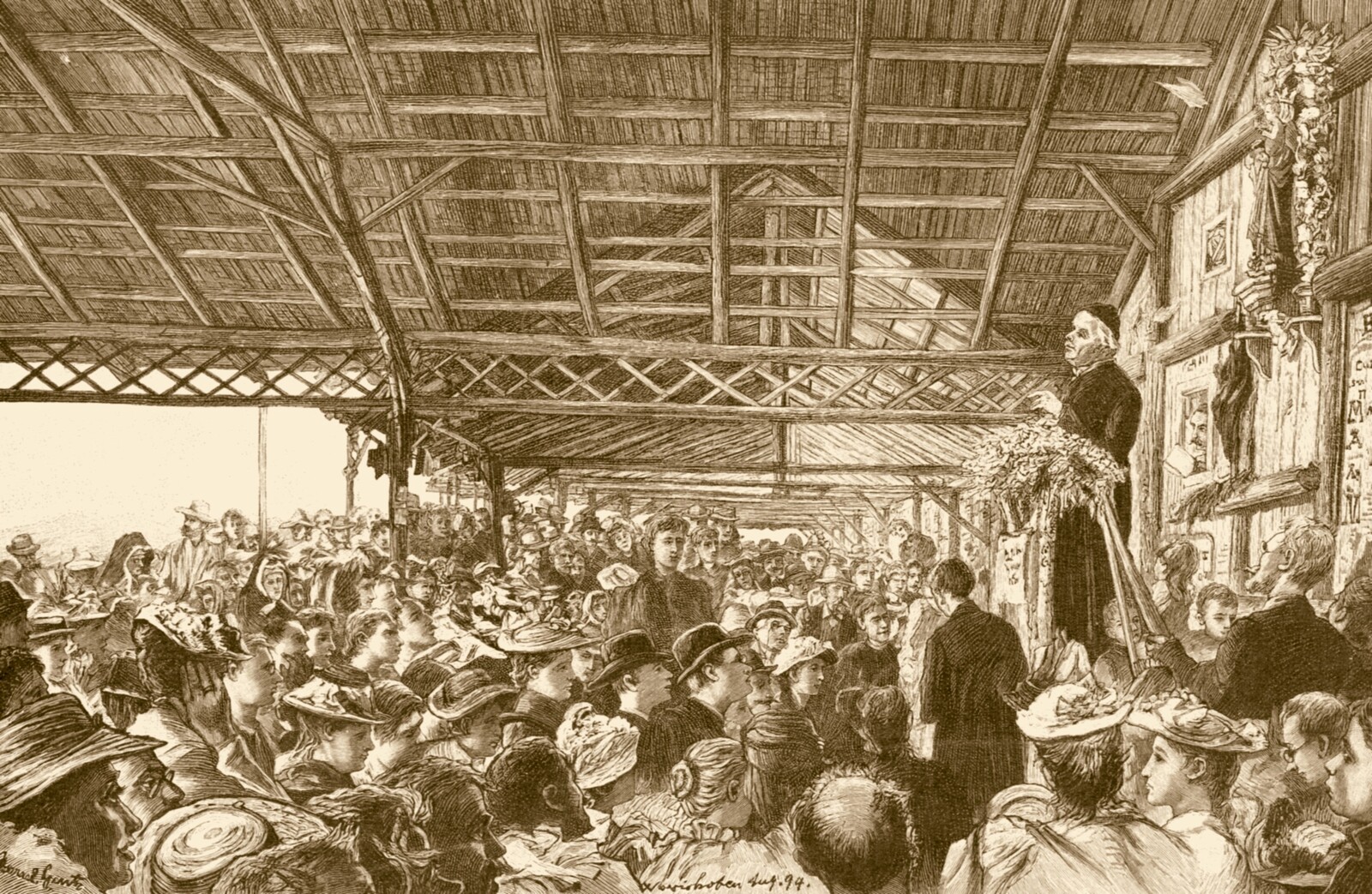
Demand outgrew what one priest could personally deliver. A commercial infrastructure of Kurhäuser and boarding houses grew up around the village to house the cure-seekers who traveled there from across Europe. A wood engraving published in Die Gartenlaube — a widely circulated German illustrated family magazine — shows Kneipp addressing a packed open-air pavilion in August 1894, a scene of mass demand rather than a single bedside consultation. The clientele reached the top of European society: BBC Travel’s 2023 profile describes Kneipp as attracting “a glitzy list of celebrity clients who sought out his expertise.” It names Archduke Franz Ferdinand of Austria and Pope Leo XIII among those who came for treatment. Access to Kneipp himself, and the prestige of being treated at Wörishofen, became a status marker independent of the water itself. Crucially, the sources do not support treating this as wealth-only gatekeeping: the Catholic Encyclopedia’s 1910 entry states plainly that “the rich as well as the poor came to be treated, and his fame spread throughout Germany”. The BBC profile adds that “his motivation was to treat the poor and he did not turn away those who could not pay.” The exclusivity here was not who Kneipp would see — it was the sheer difficulty of being one of the thousands competing for a healer whose reputation now spanned a continent, feeding a paid resort economy of hotels, physicians, and licensed practitioners that outlasted him.
One cold shock, a hundred diagnoses
The mechanism Kneipp proposed was deliberately general. A brief application of cold water provoked a “reaction” — a rush of circulation as the body rewarmed itself — and that single physiological event was offered as the explanation for treating or preventing an enormous, medically unrelated range of conditions: digestive complaints, nervous disorders, skin disease, and, per Kneipp’s own account, the tuberculosis that had nearly killed him as a young man. No comparison against untreated patients or standard medical care was conducted in his lifetime; the claim rested on his personal case history and the testimonials of patients at Wörishofen. Kneipp folded in a large personal herbal apothecary — roughly 50 plants, by his own count — alongside the water treatments, and modern accounts of the “Kneipp method” describe it as five pillars: water, plants, movement, nutrition, and balance (Ko, 2016).
A version of this story does have modern, replicated support — but a much narrower one than Kneipp claimed, and for a different intervention. A Cochrane systematic review of generic post-exercise cold-water immersion (cryotherapy, not the Kneipp-branded regimen) found real, if modest, evidence that it reduces delayed-onset muscle soreness at 24 to 96 hours, compared with rest or no treatment (Bleakley et al., 2012). That is a genuine surrogate effect on a short-term symptom in a related but distinct practice — not evidence that Kneipp’s own cold-water method cures or prevents disease broadly, and not the kind of claim that supports marketing a lifelong health regimen, let alone a longevity one.
The priest who franchised his own face
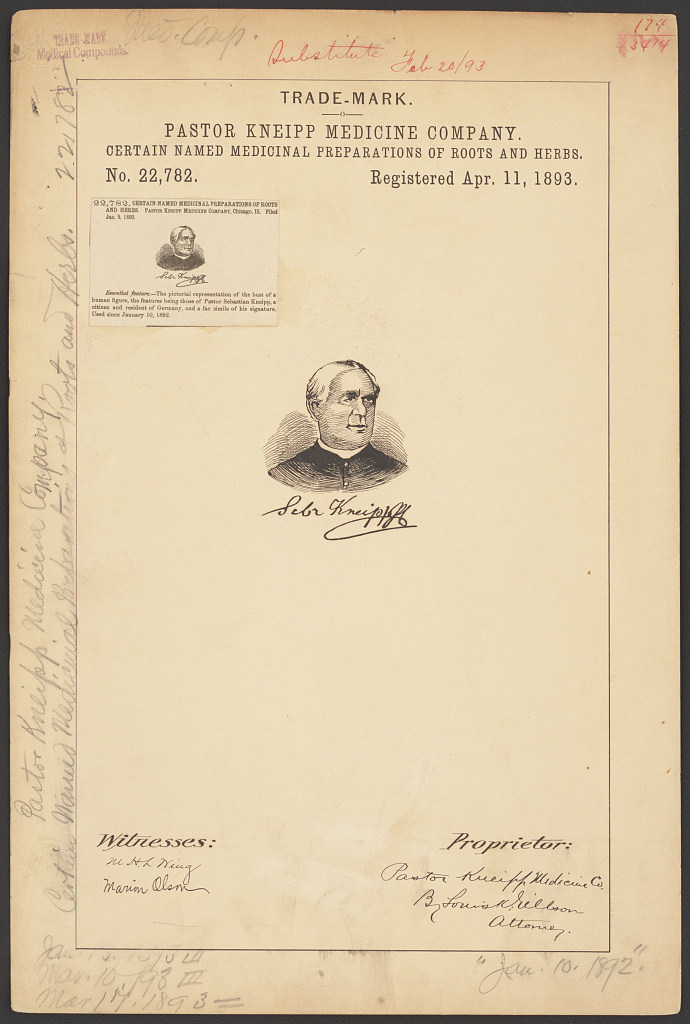
Kneipp’s fame became a commercial asset well before his death — with his own signature on the deal. On 25 February 1891, he signed a contract granting Würzburg pharmacist Leonhard Oberhäußer the exclusive, worldwide, perpetual right to develop, manufacture, and sell pharmaceutical, cosmetic, and dietetic products “mit dem Namen und dem Bilde des Herrn Pfarrer Sebastian Kneipp” — with the name and image of Father Sebastian Kneipp. The company’s own history is direct about what this was: “Mit diesem Vertrag legten die beiden den Grundstein für die Marke Kneipp®” — with this contract, the two of them laid the foundation stone of the Kneipp® brand. The first product, pills marketed against intestinal sluggishness, sold through Oberhäußer’s pharmacy in Würzburg while Kneipp was still alive; further confirming and expanding agreements followed through 1897, the year he died. His name proved exploitable well beyond that one licensed arrangement: a Chicago outfit calling itself the “Pastor Kneipp Medicine Company” registered a US trademark on 11 April 1893 for its own medicinal preparations of roots and herbs, using Kneipp’s portrait on the filing — a separate, seemingly unconnected use of his image that the historical record does not tie back to the German operation, but that shows how quickly Kneipp’s name became a marketable brand independent of his own free treatment of the poor.
The German enterprise persisted long after both men were dead. On 20 May 1948, Oberhäußer’s successors formally registered it as an independent partnership in the Würzburg commercial register, separating it from the pharmacy that had incubated it. Today it trades as Kneipp GmbH, headquartered in Würzburg with a production site in nearby Ochsenfurt-Hohestadt and, per a company profile hosted by a naturopathic-medicine nonprofit, roughly 450 employees worldwide (BRMI). It manufactures and sells bath, body-care, and wellness products under Kneipp’s name, more than a century after he personally authorized commercial products bearing his name and portrait and 130-plus years after the contract that started it.
Twenty trials, forty-six wins, eighty-one draws
The most direct modern test of Kneipp hydrotherapy as therapy, rather than as brand, is a 2023 systematic review in BMJ Open covering 20 randomized controlled trials and 4,247 patients (Ortiz et al.). Across 132 individual outcome comparisons, 46 favored Kneipp hydrotherapy, 81 showed no difference, and 5 favored the control condition; scattered positive results turned up for specific conditions — chronic venous insufficiency, menopausal symptoms, fever in children, sick-day reduction after respiratory infection — but no meta-analysis was possible because the trials were too methodologically inconsistent to pool. The review’s own conclusion: “Although RCTs on Kneipp hydrotherapy seem to show positive effects in some conditions and outcomes, it remains difficult to ascertain treatment effects due to the high risk of bias and heterogeneity of most of the considered studies. Further high-quality RCTs on Kneipp hydrotherapy are urgently warranted.” That is an “insufficient evidence” verdict, not a validated one — and it is worth naming plainly that one of the review’s eight authors “was supported by the Kneipp Association in the context of his professorship at the Charité,” a disclosed conflict the review itself reports; the other seven authors report none.
Nearly a century and a half after Meine Wasserkur promised a single cold-water reaction could treat or prevent an enormous range of disease, the best available modern evidence has not confirmed that promise — and the enterprise built on Kneipp’s name is still selling products under that name while the evidence remains unsettled. Kneipp GmbH’s own current marketing frames its retail line as general well-being and body-care products (kneipp.com, 2026) rather than a repeat of Kneipp’s original 1886 disease-cure claims, but the BMJ Open review above remains the clearest available evidence assessment of the underlying cold-water method that both the retail marketing and the still-operating Kneipp health-resort network trace their positioning to.
The pattern repeats
The same structural machinery appears in different treatments and eras. These cases show the claimed mechanism and how the claim met evidence.
Jackson's Psycho Hygienic Method (Our Home on the Hillside water cure)
The cold-water cure (Gräfenberg hydropathy)
Lahmann's Physiatric Regimen (dietetic blood-dyscrasia cure)
Part of the lineage
External references
Evidence · 14 sources
- Father Sebastian Kneipp (1821-1897) (2019)
- Sebastian Kneipp and the Natural Cure Movement of Germany: Between Naturalism and Modern Medicine (2016)
- Sebastian Kneipp (1910)
- A simple idea for staying healthy (2023)
- Sebastian Kneipp - My Life (2026)
- Unternehmensgeschichte (Company History) (2026)
- [Trademark registration by Pastor Kneipp Medicine Company for [Portrait of Pastor Sebastian Kneipp Logo] brand Certain Named Medicinal Preparations Of Roots and Herbs] (1893)
- Cold-water immersion (cryotherapy) for preventing and treating muscle soreness after exercise (2012)
- Clinical effects of Kneipp hydrotherapy: a systematic review of randomised controlled trials (2023)
- My water-cure: tested for more than 35 years and published for the cure of diseases and the preservation of health (1898)
- Sebastian Kneipp (2026)
- Speech of Sebastian Kneipp at the open hall in Wörishofen (1895)
- Kneipp worldwide | Kneipp (2026)
- Health and the Kneipp cure in Bad Wörishofen (2026)