The cold-water cure (Gräfenberg hydropathy)
A Silesian farmer's son with no medical training, Vincenz Priessnitz turned cold water into a cure that drew an archduchess, ten princes and princesses, and over 100 counts and barons to Gräfenberg. He sold it on a humoral "crisis" in which a boil, a fever, or diarrhoea all counted as the cure working, measured no endpoint, and published nothing. The water techniques outlived him; the morbid-matter mechanism did not, and Winternitz built scientific hydrotherapy separately.
The peasant who healed himself
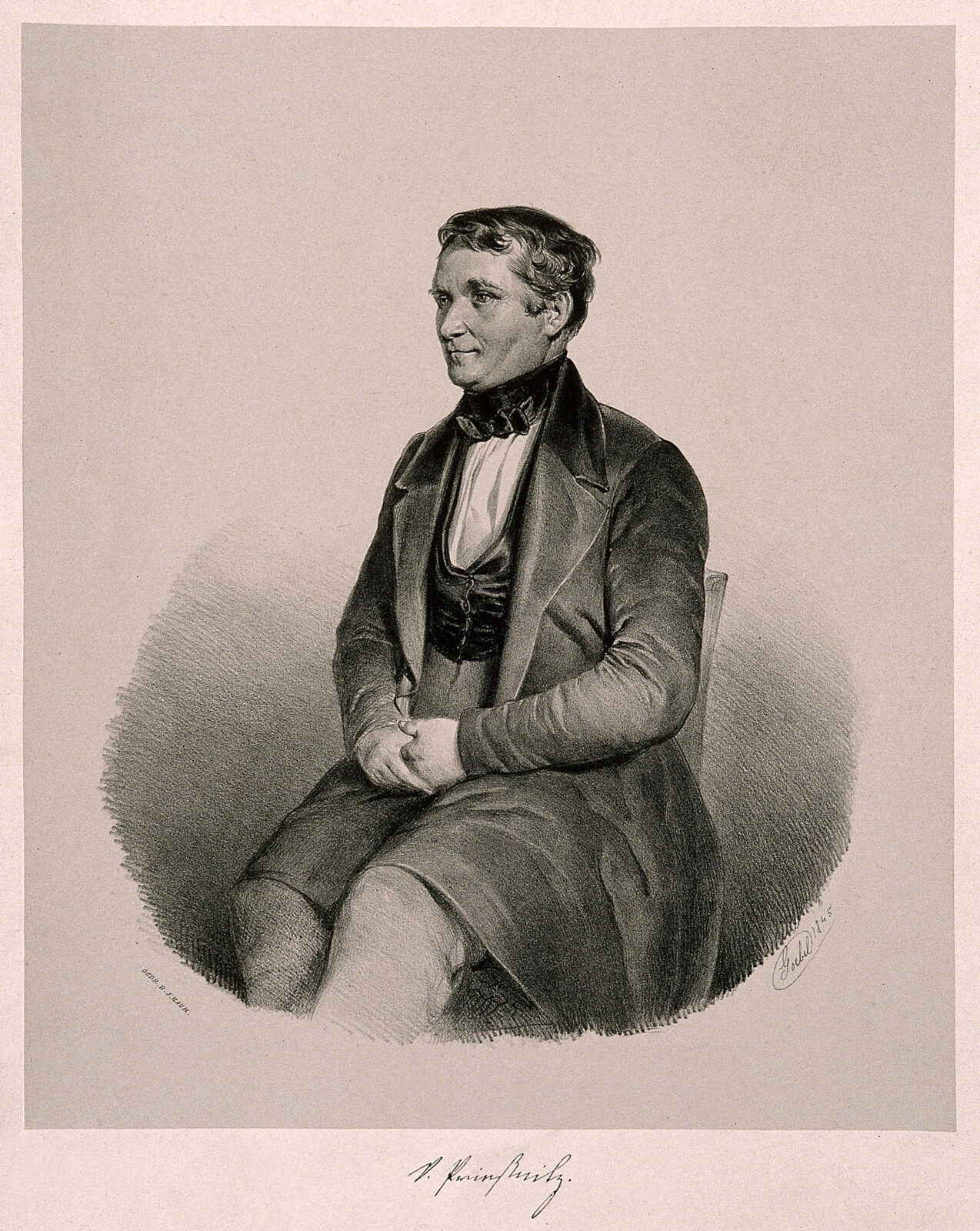
At about thirteen he held an injured wrist under a cold-water pump; at about seventeen, ribs broken in an accident, he bound them with wet bandages (Czeranko). Vincenz Priessnitz (4 October 1799 to 28 November 1851) was a farmer’s son from Gräfenberg, near Freiwaldau in Austrian Silesia (now Lázně Jeseník, Czech Republic), with no medical training. The Deutsche Biographie records that his father lost his sight and that Priessnitz attended the town school only briefly before the farm fell to him. Out of those two homemade cures he built a practice that drew the world: the Vienna medical historian M. Skopec describes him as ‘a small-scale farmer from Gräfenberg’ who ‘from the 1820’s on aroused worldwide interest in hydrotherapy, on the basis of purely empirical observations.’ Unlike the credentialed promoters elsewhere in this archive (Hufeland the royal physician, Brown-Séquard the academician), Priessnitz drew his charisma from being the untutored peasant healer who succeeded where physicians had failed, and the Deutsche Biographie notes that he published no writings of his own, so the method was carried entirely by his person and by visiting disciples.
An archduchess climbs the mountain
Patients travelled to a Silesian mountain colony that Czeranko describes as ‘a small colony of some twenty houses’ half-way up a mountain, and lodged there for weeks or months under Priessnitz’s personal direction. The Deutsche Biographie records the growth of his annual clientele from 49 patients in 1829 to 1,780 by 1839, with a lifetime total near 36,000. The clientele reached the top of European society: R. T. Claridge’s 1842 treatise records that in 1841 the patients under treatment at Graefenberg and Freiwaldau included ‘an archduchess, ten princes and princesses, at least 100 counts and barons, military men of all grades, several medical men, professors, advocates, &c., in all about 500.’ Exclusivity here attached to Priessnitz’s person and to the cachet of the aristocratic colony rather than to a high price: the water itself was free and the fees were modest, so what commanded a premium was access to the one healer who, in the period’s telling, could not fail. Physicians came to Gräfenberg to learn his methods and then carried them abroad.
A crisis you were taught to welcome
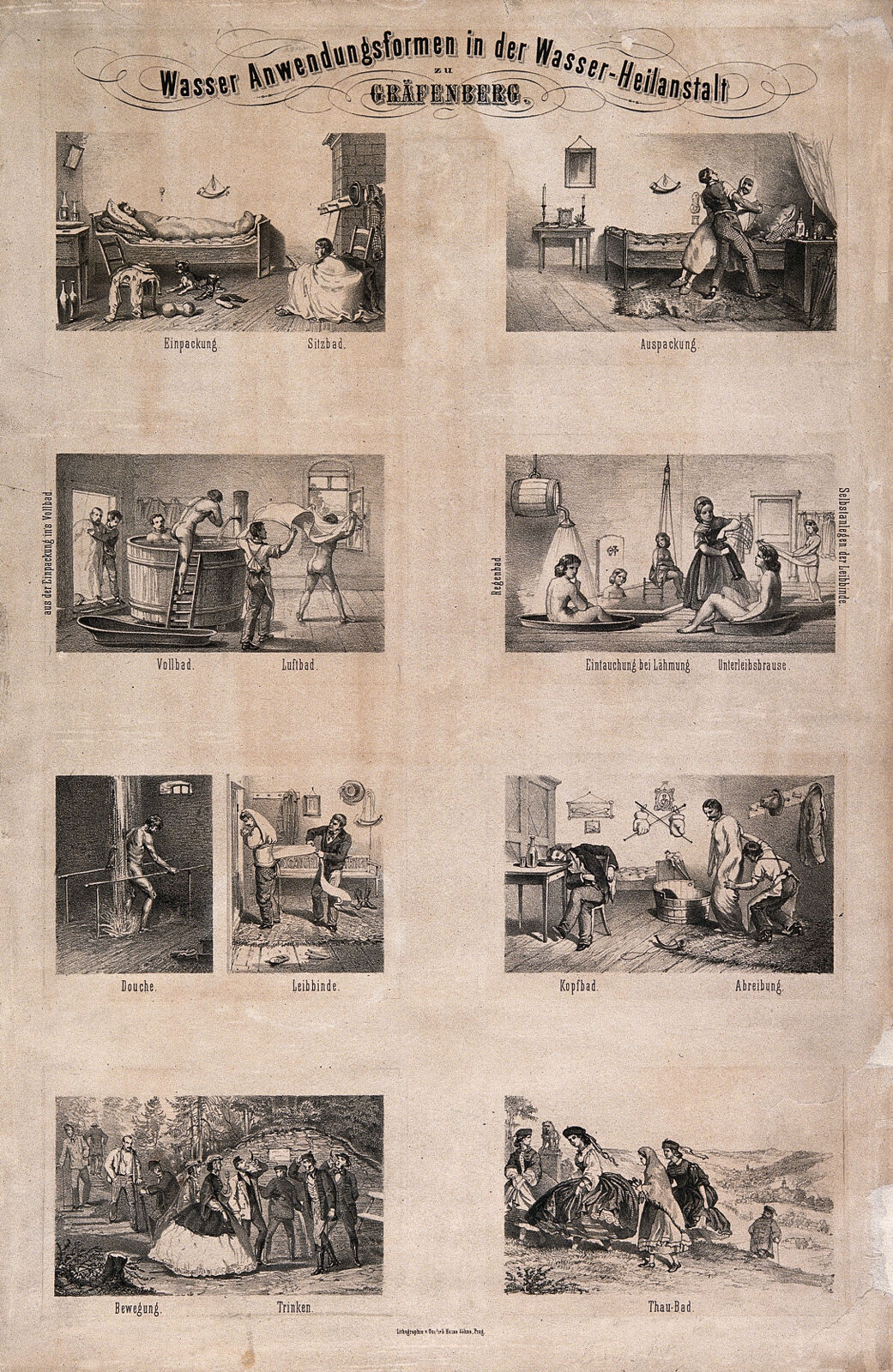
The mechanism was humoral. Disease was held to be morbid or ‘peccant’ matter lodged in the body, and the action of cold water (applied as compresses, wet-sheet packs, douches, sitz and full baths, and the sweating pack, and drunk in quantity) was to mobilize that matter and drive it out through a ‘crisis.’ Claridge’s 1842 account describes the crisis as the point at which the disease ‘comes to a head’ and the morbid material makes ‘their exit by some means or other; by diarrhoea, by urine, by boils or ulcers, or fever,’ an event ‘hailed with the greatest joy as the harbinger of health.’ The Deutsche Biographie records that Priessnitz worked from humoral-pathological views. No endpoint was measured. Neither a surrogate nor a hard clinical endpoint was used; the claim was mechanism-only, and the crisis doctrine was unfalsifiable, since any acute symptom (a boil, a fever, a bout of diarrhoea) was read as proof that the disease was leaving the body. The morbid-matter framing belongs to the classical four-humours theory (Encyclopaedia Britannica, ‘Humour’), a pre-modern doctrine and not a finding of scientific medicine.
Paid by the week to judge his own success
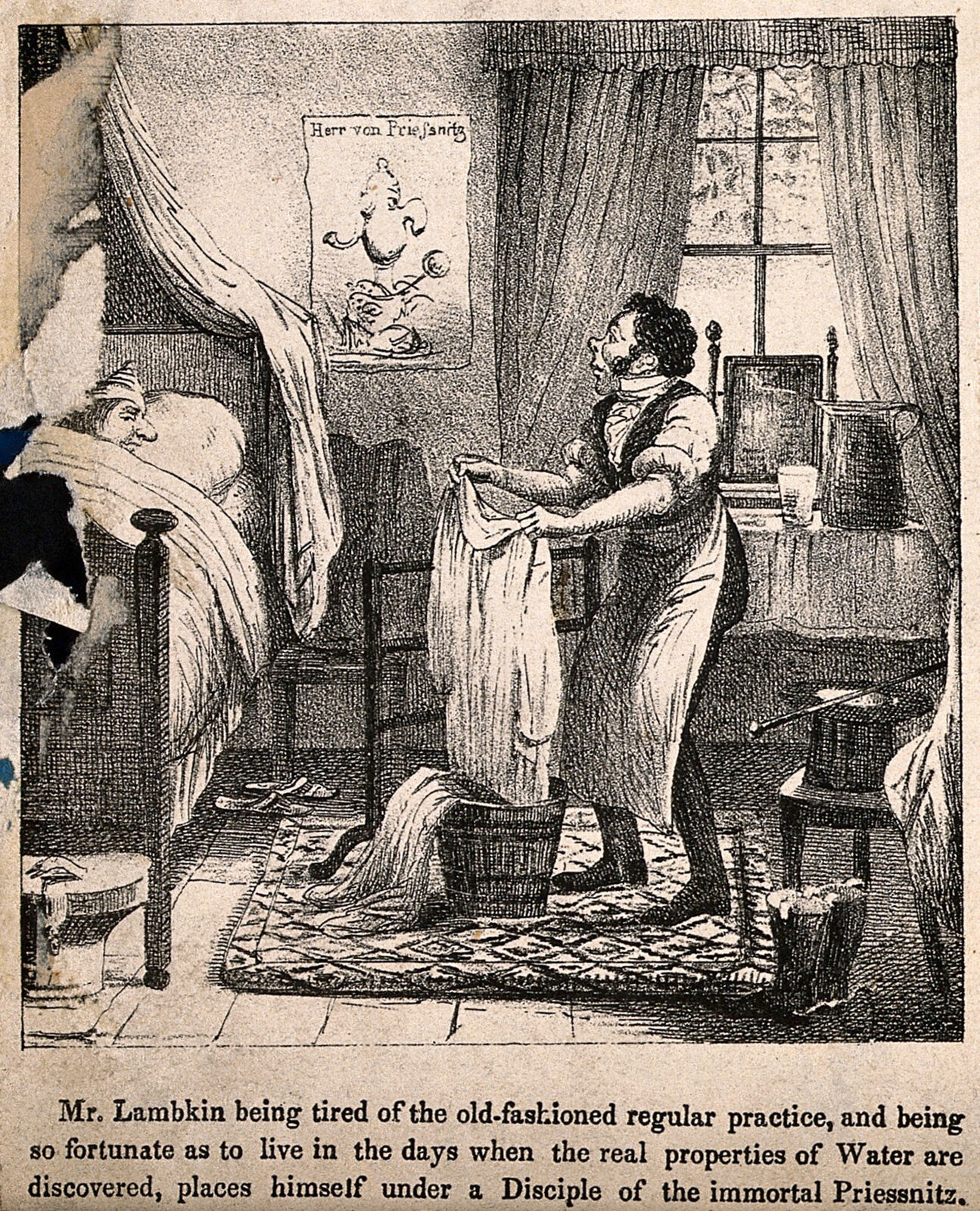
The conflict is the developer-vendor structure in residential form, named from documented facts. Priessnitz built and owned the fee-charging establishment at Gräfenberg (the first bathhouse in 1826; government permission to run a cold-water cure establishment in 1831, per the Neue Deutsche Biographie) and was its sole healer. He was not the only party paid: Claridge’s 1842 account shows board, lodging, and a bath-servant billed on top of his fee, so lodging-keepers and servants at the resort shared in the receipts. But the medical-attendance fees were paid to Priessnitz personally, a minimum of 2 florins (4 shillings) a week, with ‘many increase it to double that sum, and others make handsome presents,’ and a residence with attendance ran to about one pound sterling a week, levied on a clientele that in 1841 numbered about 500 including the high nobility. Because the central therapeutic event he sold (the unfalsifiable crisis, in which any acute symptom counted as the cure working) prolonged residential stays, the structure rewarded extended treatment. The conflict named here is that the owner and sole healer of a high-volume residential cure also defined, on no measured evidence and with nothing published for scrutiny, the unfalsifiable standard by which his own cure was judged to be working.
What outlived him, and what did not
Priessnitz faced no single disconfirming experiment of the kind the 1784 royal commission ran against Mesmer or Haygarth’s 1799 sham tractors ran against Perkins. He died esteemed in 1851, having received the large gold medal of merit from the Austrian Emperor in 1846 (Deutsche Biographie). The disconfirmation has three strands. First, the enabling theory has no standing: the morbid-matter and crisis mechanism is humoral pathology (Encyclopaedia Britannica, ‘Humour’), the pre-modern doctrine that scientific medicine displaced; disease is not a material substance discharged through boils and diarrhoea, and the crisis doctrine is in any case unfalsifiable. Second, the evidence was never sufficient and is labelled insufficient: Priessnitz worked from ‘purely empirical observations’ (Skopec, 1991) and published nothing (Deutsche Biographie), no endpoint was ever measured, and testimonial recoveries cannot be attributed to the water cure rather than to the natural course of illness, rest, exercise, abstention from the harsh drugging of the period, or expectation. Third, the field was re-founded elsewhere on different grounds: scientific hydrotherapy was placed on a physiological footing later and by another man, Wilhelm Winternitz, a lecturer in hydrotherapy at Vienna from 1864 and called the ‘father of scientific hydrotherapy’ (Skopec, 1991), which retained some water-application techniques while discarding the morbid-matter mechanism. As with Hufeland’s macrobiotics, the case is atypical for this archive: several hygienic components (cold water, exercise, open air, a spare diet, abstention from period drugging) overlap with measures later associated with health, so what was disconfirmed was the humoral mechanism and the general-cure claim, not the harmless parts of the regimen.
The pattern repeats
The same structural machinery appears in different treatments and eras. These cases show the claimed mechanism and how the claim met evidence.
Kneipp Cure (hydrotherapy, herbalism, and the 'five pillars')
Gully's Water Cure (Malvern hydropathy)
The Hay System (food combining / 'food separation')
More related cases · 11
Evidence · 6 sources
- Prießnitz, Vincenz (Allgemeine Deutsche Biographie / Deutsche Biographie) (1888)
- [Vincent Priessnitz and the Vienna Medical School] (1991)
- Vincent Priessnitz (1799-1851) (2019)
- Hungern und Diät nach dem Vinzenz Prießnitz'schen Familien-Wasserbuch von 1847 (2007)
- Hydropathy; or, The Cold Water Cure, as practised by Vincent Priessnitz, at Graefenberg, Silesia, Austria (1842)
- Humour (ancient physiology), Encyclopaedia Britannica (2024)