J.B.L. ('Joy, Beauty, Life') Cascade internal bath
Charles Alfred Tyrrell sold a rubber bag shaped like a hot-water bottle as the cure for all disease: J.B.L., for "Joy, Beauty, Life," flush the colon and live longer. The self-styled "Professor" took his diploma at 57 and captioned his own portrait "Inventor." The theory was refuted in his lifetime (Alvarez 1919; later Ernst 1997, Sullivan-Fowler 1995), and the AMA found Henry M. Guild had patented the device in 1903, calling it salt and borax.
The Professor who graduated at fifty-seven
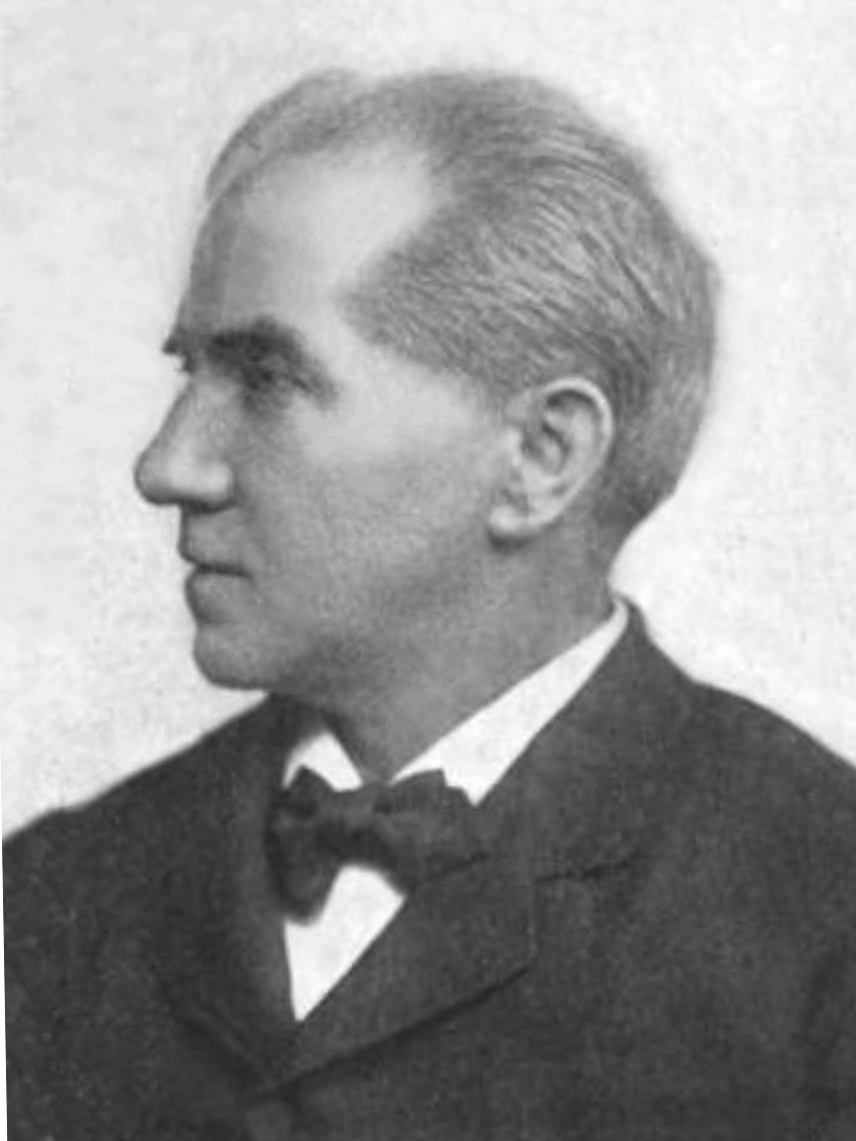
In 1900, at the age of 57, Charles Alfred Tyrrell collected a diploma from the Eclectic Medical College of New York and began signing himself ‘Professor’ and ‘M.D.’ (Nostrums and Quackery, pp. 697-700). The credential was late and thin, but it did its work: from his Hygienic Institute in New York City he built authority almost entirely out of print, chiefly the book The Royal Road to Health (first edition 1894), which ran through many editions, and a magazine called Health that he published and edited. Born in 1843, he kept the enterprise running until his death in 1918 (Ferry 1986).
A complete system, mailed to your door
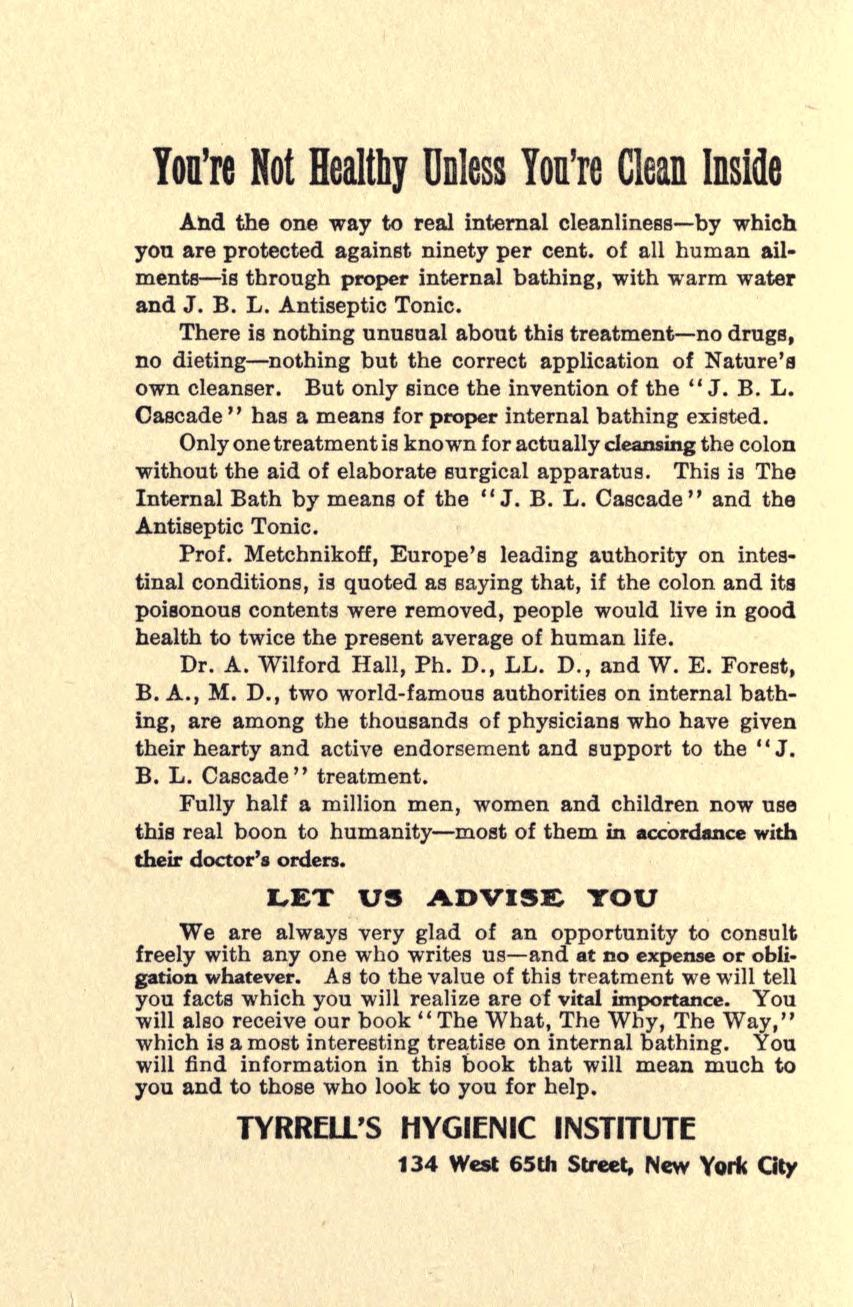
The exclusivity was proprietary rather than social. The intervention was a branded home appliance, the J.B.L. Cascade, sold mail-order as a ‘complete system’ (the appliance, a ‘J.B.L. Antiseptic Tonic,’ and a rectal soap) through Tyrrell’s Hygienic Institute and advertised in popular magazines. What the buyer paid for was the named, supposedly unique apparatus and Tyrrell’s ‘direction,’ marketed as a way to ‘treat any form of disease … without the expense of consulting a physician’ (AMA, Nostrums and Quackery). The device’s name was the pitch: J.B.L. stands for ‘Joy, Beauty, Life,’ which Tyrrell wrote the appliance would ‘infallibly confer’ (The Royal Road to Health, 1894).
One disease, one cause, one remedy
The mechanism was intestinal autointoxication, reduced to a single-cause doctrine. Tyrrell held that ‘there is only one disease, although its manifestations are various, and there is only one cause for it, and that is the retention of waste matters in the system’ (The Royal Road to Health, 1894). On this theory the colon is the body’s principal source of self-poisoning, and regularly flushing it with the Cascade removes the cause of disease and preserves health and vitality. No human outcome was measured. The inference ran from a sweeping premise about waste retention straight to a universal remedy, with the appliance positioned as the one safe means of delivering it. The disease-prevention and restored-vitality promise, sold as the route to a longer and healthier life, is this case’s life-extension claim.
The vendor who invented his own theory
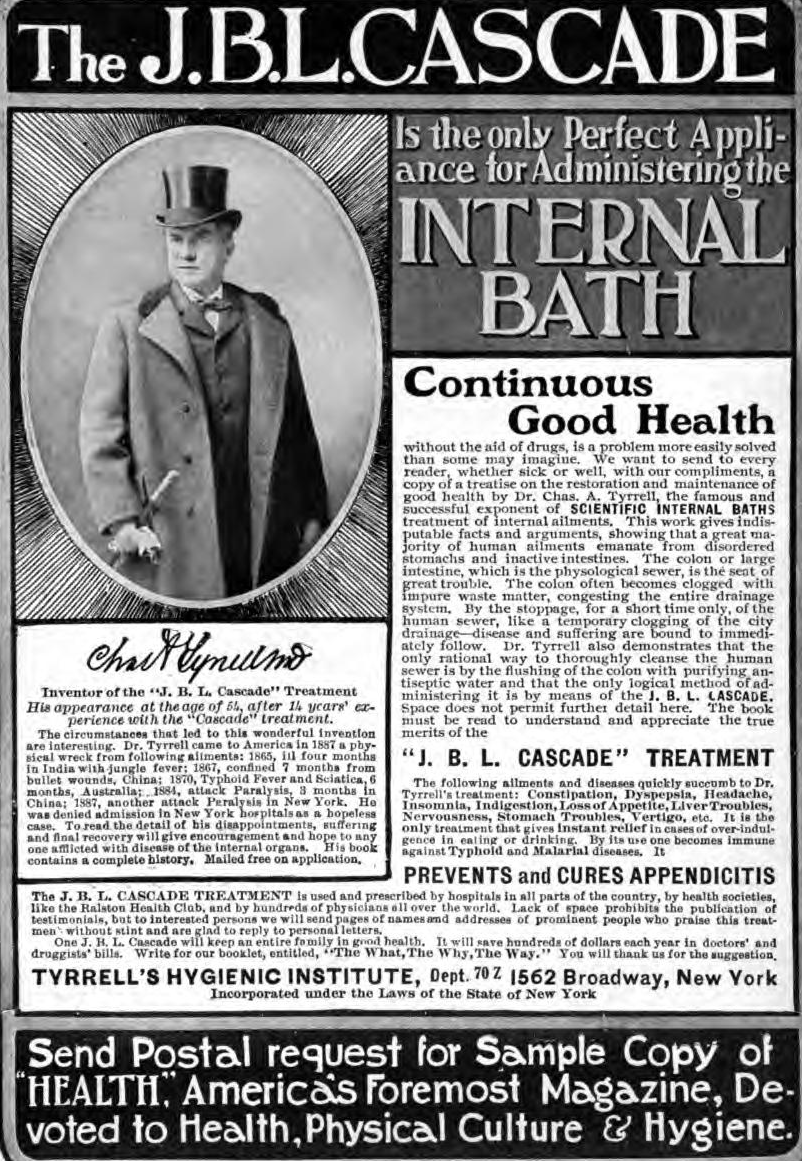
Tyrrell was president of the concern that sold the appliance, the recurring antiseptic tonic, the soap, and the book, so the promoter of the theory was also the vendor of its remedy (AMA, Nostrums and Quackery). The conflict is stated as the sources support it: his income depended on selling the remedy for a theory he taught, though the record does not quantify his personal share of an operation that also paid for printing, advertising, staff, and mail-order fulfilment. The sharpest documented conflict is over inventorship: Tyrrell advertised himself as the inventor of the Cascade (the 1905 advertisement captions his portrait ‘Inventor of the J.B.L. Cascade Treatment’), but the AMA established from United States patent records that Henry M. Guild invented and patented the device in 1903, with a modified form patented in 1904, and that both patents were assigned to the Tyrrell concern. The sources reviewed do not establish the device’s retail price or Tyrrell’s revenue, so no figure is asserted.
Undone on the theory and the patent
The case was undone on theory and on device. The enabling theory of intestinal autointoxication was refuted in the early 20th century: Walter C. Alvarez argued in 1919 (JAMA) that putrefactive products are not absorbed from the bowel in the harmful quantities the theory required, and later clinical-historical reviews treat autointoxication and the colonic-irrigation practices built on it as discredited, with Ernst (1997) naming Tyrrell an exemplary proponent and Sullivan-Fowler (1995) documenting the wider faddism. The device itself was investigated and condemned by the American Medical Association, which exposed the false inventorship claim (Guild’s 1903 patent), described the appliance as an ordinary rubber-bag enema delivering a saline-borax solution, and ridiculed the proposition that a syringe, soap, and salt could ‘treat any form of disease.’ No controlled outcome data were ever produced; the evidence base was testimonial throughout.
The pattern repeats
The same structural machinery appears in different treatments and eras. These cases show the claimed mechanism and how the claim met evidence.
Soured-milk ('Bulgarian bacillus') longevity therapy
Biologic living (the Battle Creek Idea)
Morison's Vegetable Universal Medicine (Hygeian pills)
Part of the lineage
Evidence · 7 sources
- The Royal Road to Health, or, The Secret of Health Without Drugs (1894)
- Nostrums and Quackery (American Medical Association): 'J.B.L. Cascade' (1911)
- Origin of the So-Called Auto-Intoxication Symptoms (1919)
- Colonic Irrigation and the Theory of Autointoxication: A Triumph of Ignorance over Science (1997)
- Doubtful Theories, Drastic Therapies: Autointoxication and Faddism in the Late Nineteenth and Early Twentieth Centuries (1995)
- Autointoxication and historical precursors of the microbiome-gut-brain axis (2018)
- 'Professor' Charles Tyrrell and His Ideal Sight Restorer (1986)