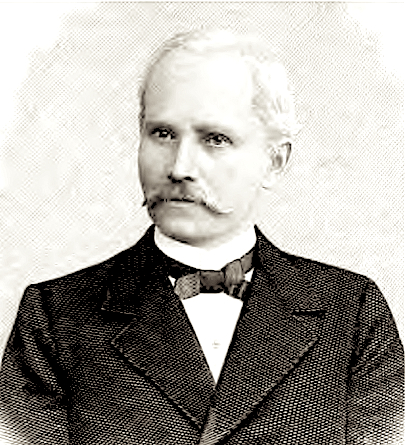
Louis Kuhne
Louis Kuhne was born on 14 March 1835 in Lössen, in the Landkreis Nordsachsen, and died on 4 April 1901 at Leipzig (Deutsche Biographie, GND 1166088235). He held no medical qualification; the German records describe him as a Naturheilkundler, a lay nature-cure healer (Deutsche Digitale Bibliothek), in the German hydrotherapy tradition that ran from Vincenz Priessnitz through Theodor Hahn and that Kuhne’s contemporary Sebastian Kneipp also worked in. From a treatment practice based in Leipzig he built a system he called the new science of healing, resting on a single doctrine: that all disease is the accumulation of “foreign matter” in the body, a self-poisoning, and that it has therefore one cure.
His authority was that of the self-taught healer who claimed to have cured himself. He set out the system in Die neue Heilwissenschaft (translated as The New Science of Healing), whose subtitle promised “the unity of diseases forming the basis of a uniform method of cure, without medicines and without operations,” and in Gesichtsausdruckskunde (translated as Facial Diagnosis, 1897), which sold a method of reading internal disease from the face and body. The signature procedure was the friction sitz bath (Sitzreibebad), a cold-water rubbing bath he is credited with devising. Kuhne published the books through his own Leipzig house, Verlag von Louis Kuhne, and the works were translated into English and reached an international readership, carrying the method across Europe and beyond into water-cure establishments that took it up.
The status is recorded as quietly faded. Kuhne died in 1901 esteemed within the nature-cure movement, and his books continued to be reprinted and translated; the doctrine, however, was never put on a controlled-evidence footing, and the foreign-matter / self-poisoning framework on which it rested is a form of the intestinal-autointoxication theory that scientific medicine examined and abandoned during the early twentieth century (Whorton, 2000; Sullivan-Fowler, 1995). What survived was a set of cold-water and dietary practices within naturopathy, not the universal-cure claim or the facial-diagnosis method.