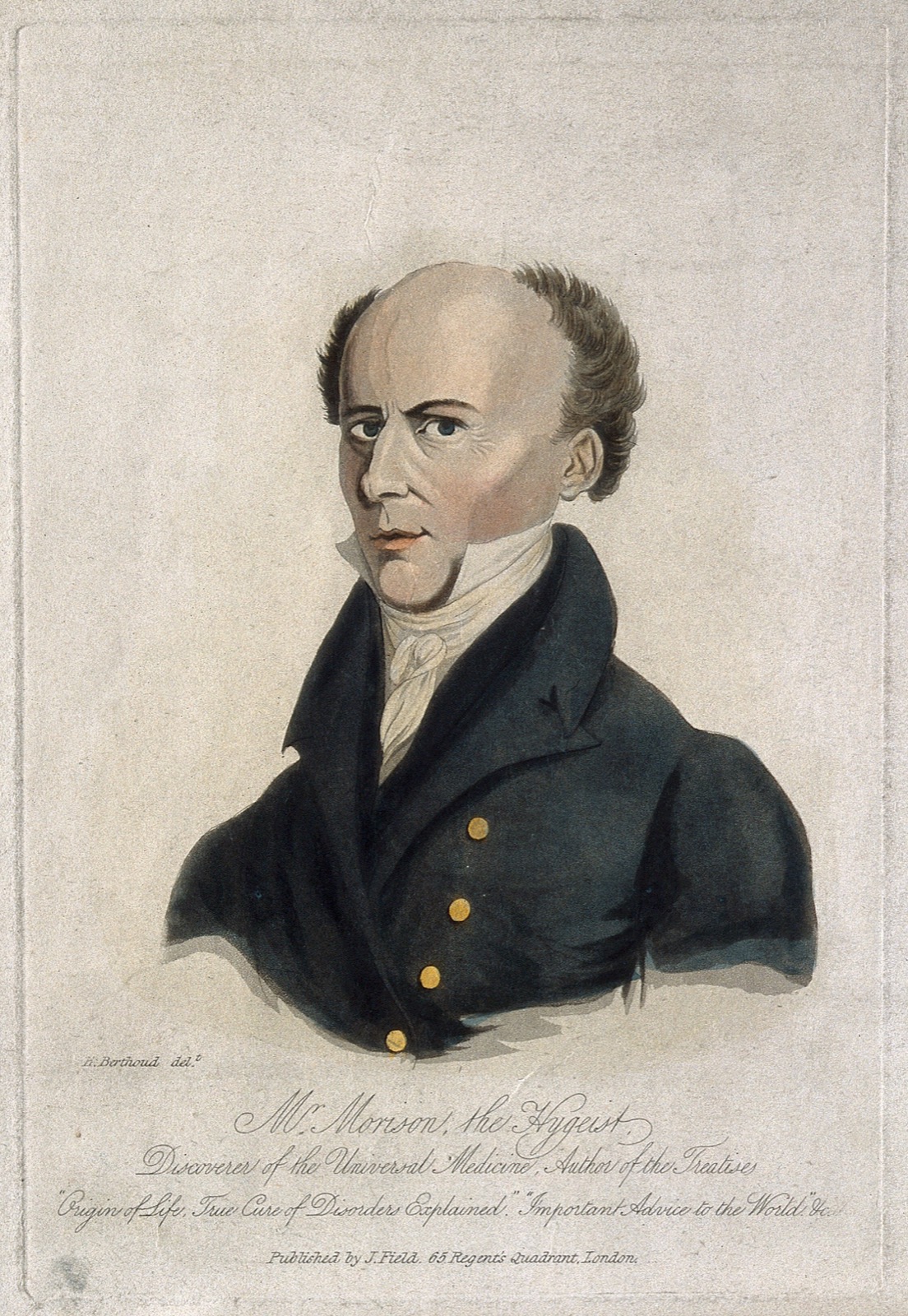
James Morison
James Morison (1770-1840) was born at Bognie, Aberdeenshire, and died in Paris on 3 May 1840. The Dictionary of National Biography records that after about thirty-five years of ill health, during which orthodox treatment failed him, he claimed around 1822 to have cured himself with vegetable pills of his own compounding. He began selling this Vegetable Universal Medicine in 1825 and in 1828 opened the British College of Health at Hamilton Place, New Road, London, a commercial establishment he dignified with a collegiate title although it trained and examined no one. He styled himself “the Hygeist,” after Hygeia, the classical personification of health.
Morison’s doctrine, the Hygeian system, held that all disease arises from impurity of the blood and that the only cure is to purge that impurity through the bowels with his pills. The orthodox profession was, on this account, unnecessary, and Morison’s literature campaigned against doctors directly. The remedy was a commercial success on a very large scale: the DNB states that he paid 60,000 pounds in medicine stamp duty between 1830 and 1840, and the pharmacy historian W.H. Helfand later calculated from the stamp records that over a billion pills were sold between 1825 and 1849. The publicly_disconfirmed status attaches to the Hygeian theory and the safety claim, not merely to commercial decline: the humoral premise that disease is impure blood removed by purgation is not recognized by modern physiology, the pills were a drastic purgative rather than a harmless universal medicine, and deaths from heavy dosing were attributed to them in the 1830s, including the 1836 death of John MacKenzie after one of Morison’s agents administered a reported 1,000 pills over twenty days. Morison himself escaped prosecution; his sons continued the British College of Health and the pill trade after his death.