Liebig's Extractum Carnis (LEMCO)
Every jar of Liebig's Extract of Meat carried the signature of the man called the greatest chemist alive, sold as 34 pounds of beef concentrated into one pound of restorative paste. Justus von Liebig had genuinely isolated meat's water-soluble fraction but mistook it for the nutritive one. Almen found it salts and waste creatine of "almost nil" value; in 1868 Kemmerich fed dogs nothing else and all died. It survived only as flavouring, now OXO.
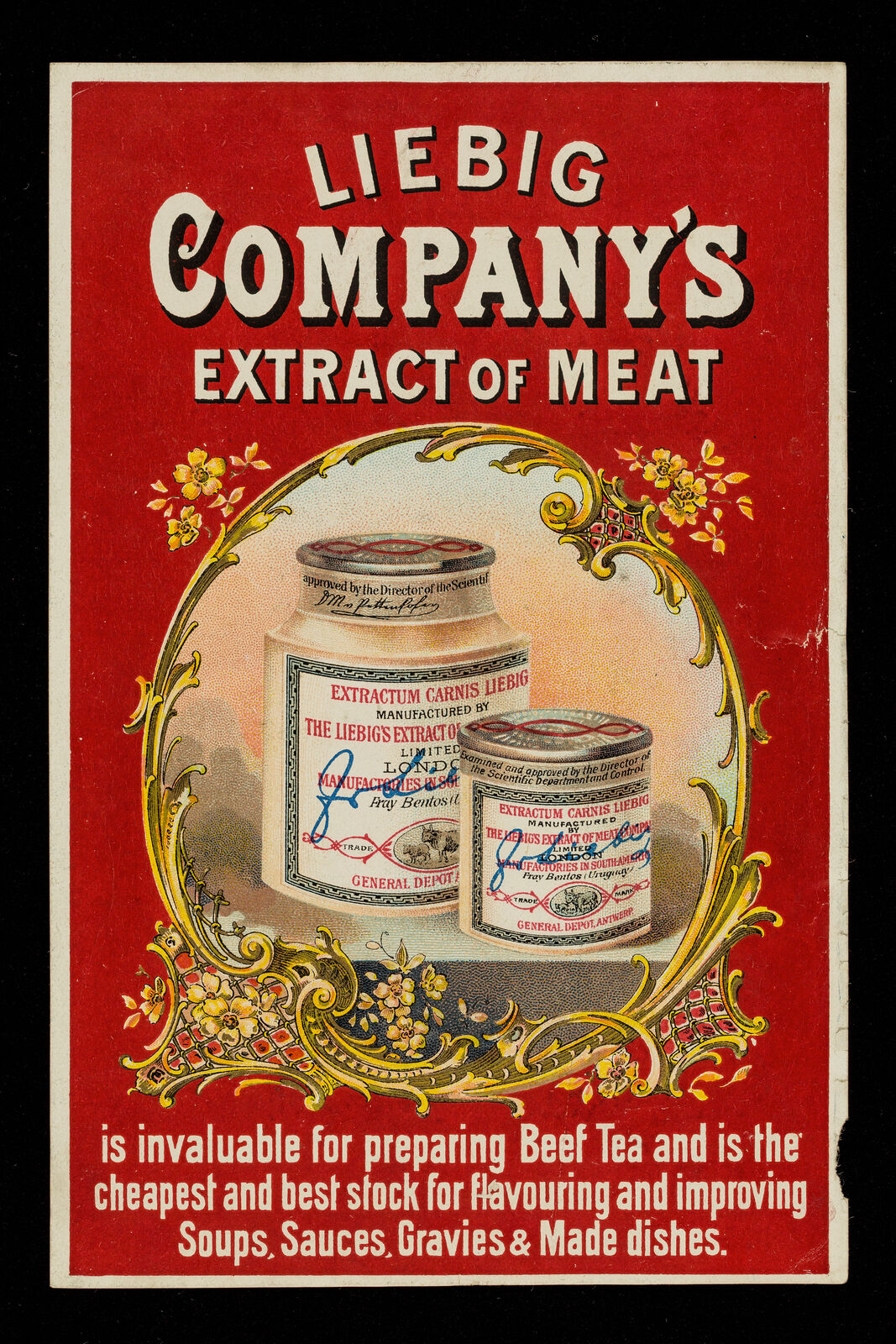
The name on every jar
Printed on every jar of Liebig’s Extract of Meat was the signature of Justus von Liebig (1803-1873), and that signature was the product. Liebig, Freiherr (Baron) von Liebig from 1845, held the chemistry chair at Giessen from 1824 and at Munich from 1852, and was universally regarded as the greatest chemist of his era. He had built the first systematic university teaching laboratory in Europe, trained virtually every prominent mid-century organic chemist, and published the foundational texts of agricultural and animal chemistry. His authority was not merely reputational: it was institutionally embedded in the research universities of Germany and the scientific societies of Britain, France, and the United States. When Liebig endorsed a nutritional product, it carried the weight of what his contemporaries would have recognized as the best chemistry in the world.
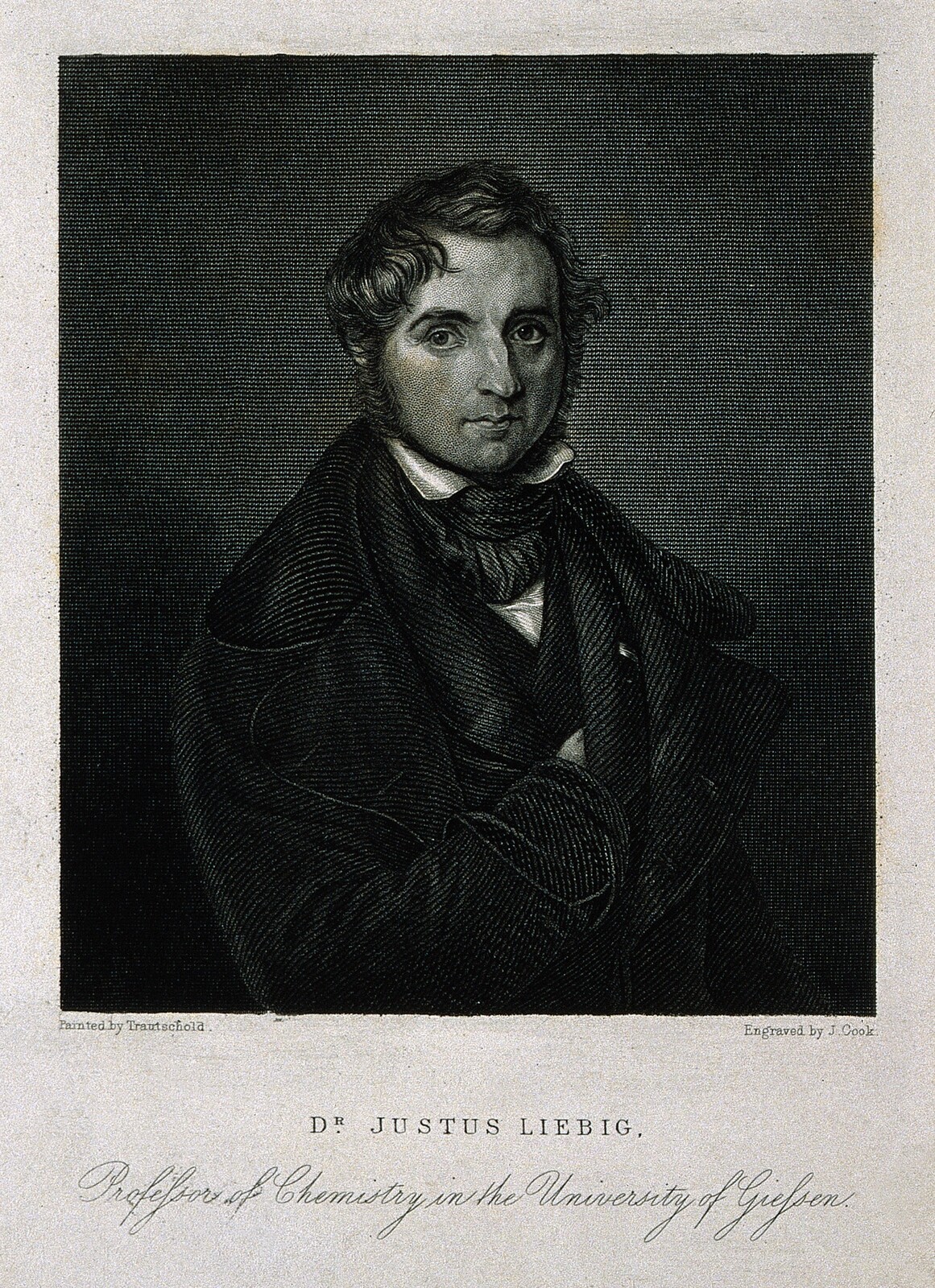
Science for those who could pay for it
The intervention occupied a premium niche from the outset. LEMCO first marketed its products through physicians and apothecaries, accompanying each shipment with pamphlets describing the extract’s medicinal and nutritional virtues and targeting the prescribing class directly. Pricing placed it above most households: the premium version of nourishment for invalids, convalescents, officers, explorers, and the urban professional class who could afford to improve their diet or the diets of their sick dependants. Florence Nightingale and the hospital-diet reformers debated it; polar and military expeditions carried it; Liebig’s signature appeared on every jar. The early LEMCO product was not food for the poor but a scientific preparation for those who could pay for science.
The wrong fraction of the beef
The mechanism was Liebig’s theory of nitrogen and vital force. He held that the water-soluble nitrogenous fraction of meat, chiefly albuminoids and kreatin, constituted meat’s essential nutritive principle. Muscle tissue was continuously rebuilt from dietary albuminoids and muscular work was fuelled by their catabolism; the extract, concentrating these substances from approximately 34 pounds of beef into one pound of dark paste, therefore delivered their nutritive power in a portable and convenient form. The theory was biochemically plausible at the level of chemical identification: Liebig had genuinely isolated nitrogenous compounds from meat. What he had not done was demonstrate that the particular fraction concentrated in the extract was the nutritive fraction, or that creatine and creatinine, the dominant nitrogenous species in the water-soluble phase, contributed to tissue building rather than being waste products. The mechanistic language was correct; its application to the extract was wrong.
A lump sum, a salary, and 2% of profits
Liebig was named scientific director of LEMCO on its incorporation, 4 December 1865, and received an immediate lump sum of £5,000, an annual salary of £1,000, and 2% of the company’s profits for five years. These were the financial terms recorded by Brock (2017) and Finlay (1992). Scholars have noted that the meat extract was the only invention that made Liebig significant personal income. His arrangement was explicit and publicly known: LEMCO used Liebig’s name and signature as its primary marketing asset, printing his name on every jar and advertising the product as his scientific discovery. The conflict was a founding condition of the enterprise, not a later complication.
The dogs that ate nothing else
The scientific case against the extract was assembled within the decade of LEMCO’s founding. The Lancet published critical analyses in 1865, the year of LEMCO’s incorporation, arguing that the extract contained almost no usable protein. Swedish chemist August Almén subjected the product to rigorous chemical analysis and found it consisted mainly of salts, creatine, and creatinine: molecules he identified as metabolic waste products without nutritive value. Almén calculated that a similar mixture of salts could be prepared for approximately 1% of the extract’s price and concluded that its nutritive value was ‘almost nil.’ He closed his published commentary with the Latin ‘Mundus vult decipi, ergo decipiatur.’ In 1868, physiologist Edward Kemmerich fed dogs exclusively on the extract; all died, a result he published as evidence that the extract could not sustain life. The broader theoretical pillar also fell: Fick and Wislicenus’s 1865 Faulhorn mountain-ascent self-experiment, and Voit and Pettenkofer’s Munich respiratory chamber studies from 1866 onward, established that muscular work was fuelled substantially by carbohydrates and fats, not protein alone, dismantling the theory that concentrated nitrogenous substances were the essential source of physical energy. LEMCO ceased advertising in medical and pharmaceutical publications after 1874. Liebig died in 1873 and his signature continued to appear on the jars long after the scientific basis for his claims had been rejected.
The pattern repeats
The same structural machinery appears in different treatments and eras. These cases show the claimed mechanism and how the claim met evidence.
Soured-milk ('Bulgarian bacillus') longevity therapy
Biologic living (the Battle Creek Idea)
Order-energy raw-food regimen (Bircher-Benner's 'Lebendige Kraft' nutrition)
Part of the lineage
Evidence · 7 sources
- Quackery and cookery: Justus von Liebig's extract of meat and the theory of nutrition in the Victorian age (1992)
- Early marketing of the theory of nutrition: the science and culture of Liebig's extract of meat (1995)
- Proceedings of the Upsala Medical Society: How it all started 150 years ago (2015)
- A short history of nutritional science: part 1 (1785-1885) (2003)
- Bodies, Sport and Science in the Nineteenth Century (2016)
- LEMCO: The Meat Industry's Colossus in Fray Bentos, Uruguay (2017)
- Extract of meat (1872)