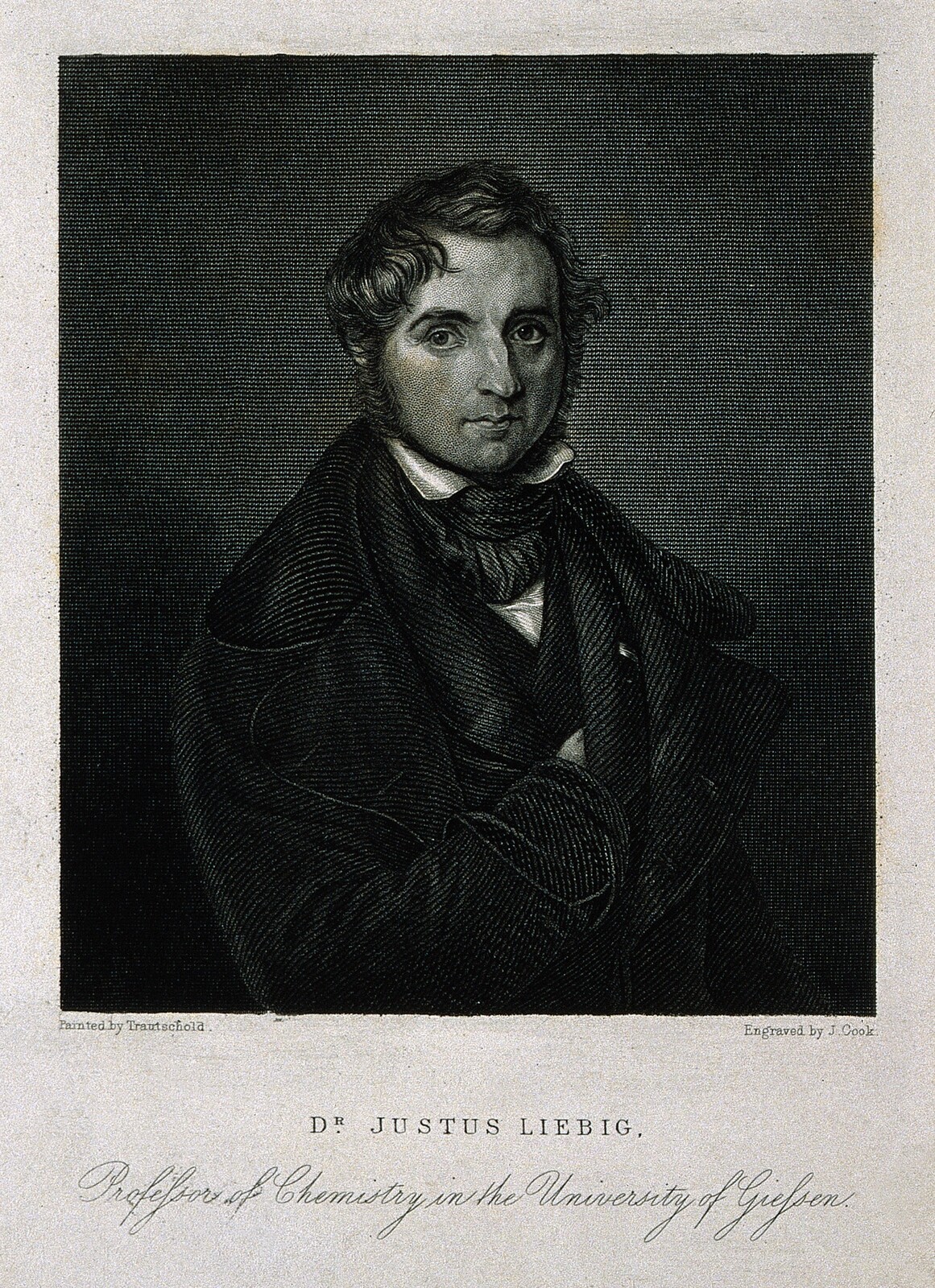
Justus von Liebig (Baron Liebig)
Justus von Liebig (12 May 1803 to 18 April 1873) held the chair of chemistry at the University of Giessen from 1824, where he built Europe’s first systematic teaching laboratory and trained a generation of chemists. He moved to Munich in 1852 and was elevated to the hereditary nobility (Freiherr von Liebig) in 1845. His core scientific contributions, which were genuine and durable, include the co-identification of structural formulae for organic compounds, the development of agricultural chemistry and the mineral theory of plant nutrition (though his specific theories of nitrogen fertilisation were later corrected), and the invention of the Liebig condenser. He was widely regarded as the greatest chemist of his generation.
Liebig’s nutritional theory, developed from the 1840s, rested on the identification of albuminoids (proteins, in modern terminology) as the primary nutritive principle: he held that muscular work was powered by the catabolism of tissue protein and that dietary nitrogenous substances were the essential restorative. This framework, plausible in outline, was extended by Liebig to claim that meat’s virtues could be concentrated into a water-soluble extract and sold as a medical food. When the German engineer Georg Christian Giebert approached Liebig in 1862 with a proposal to manufacture the extract industrially from South American cattle, Liebig endorsed the venture.
His signature appeared on every jar of Liebig’s Extract of Meat Company’s products until his death in 1873 at age 69. He continued to assert the product’s nutritive value in print, publishing a short pamphlet “Extract of Meat” in 1872 one year before his death (Wellcome Collection record cemrjbbt). The combination of the world’s most famous chemist’s personal endorsement, his signature on every jar, and the mechanistic plausibility of his nutritional theory drove the product’s commercial success during his lifetime.