Brandreth's Vegetable Universal Pills
Benjamin Brandreth arrived in New York in 1835 and built a large pill business. A congressional committee in 1849 predicted his fame would fade like his rival Morison's; an 1858 physician recorded Brandreth's one-disease, one-cure pitch and called the enterprise a dangerous farce. Instead the purgative made Brandreth rich, and he later won a state senate seat.
An apprentice pill-maker conquers the New World
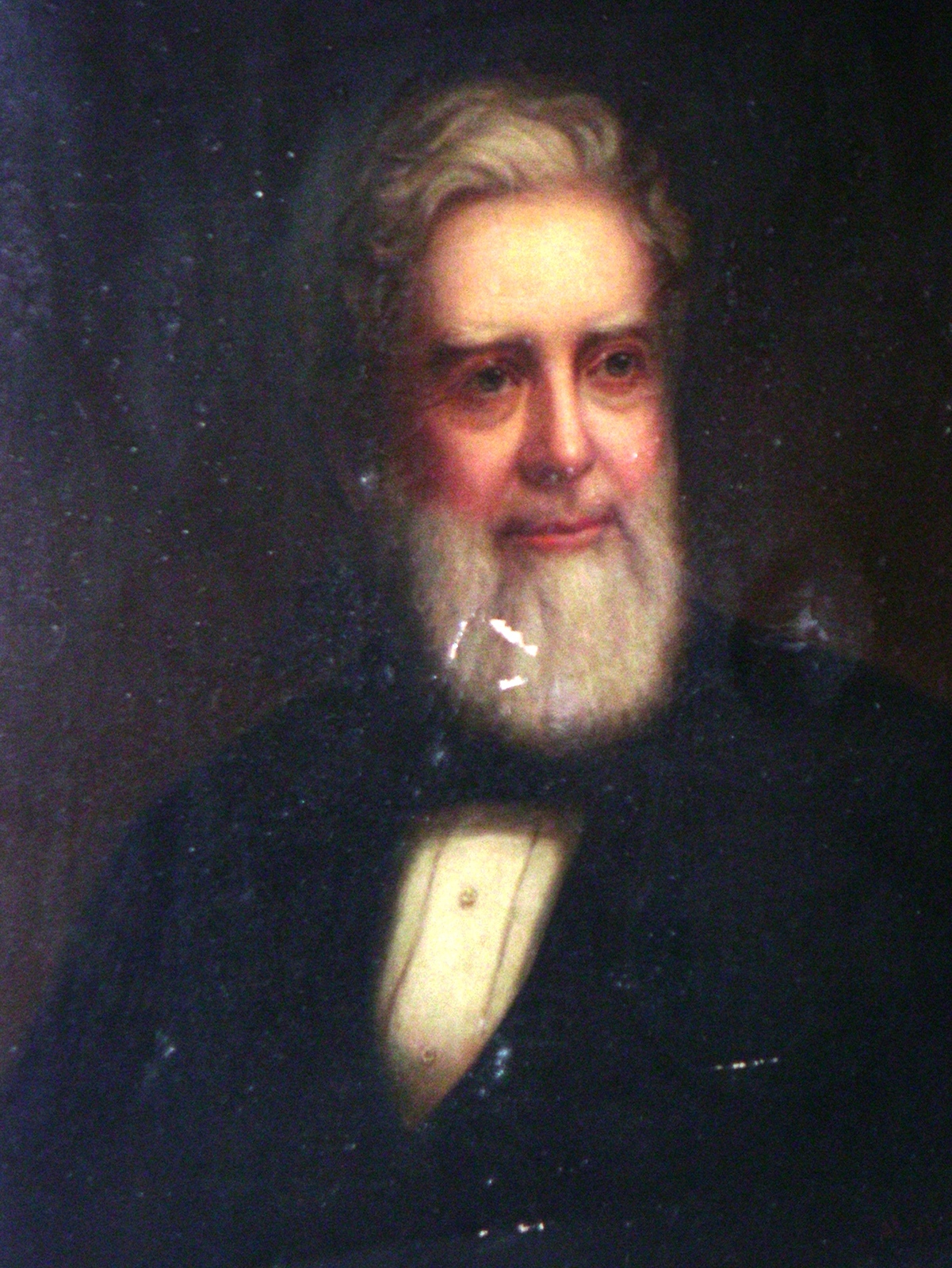
Benjamin Brandreth came from Leeds, England, to New York in 1835. The National Cyclopaedia of American Biography, in its entry on Brandreth’s son, says that as a boy Benjamin compounded pills for the poor under the direction of a maternal grandfather who ran a large medical practice near Liverpool. Appletons’ Cyclopaedia of American Biography (1900) describes the practitioner more generally as his grandfather, while a 2000 Adirondack Life profile of Brandreth’s great-grandson calls him a father-in-law. In 1836 he built a factory at Sing Sing (renamed Ossining in 1901). Westchester County Archives records that Brandreth products continued to be manufactured and distributed at that site until 1979.
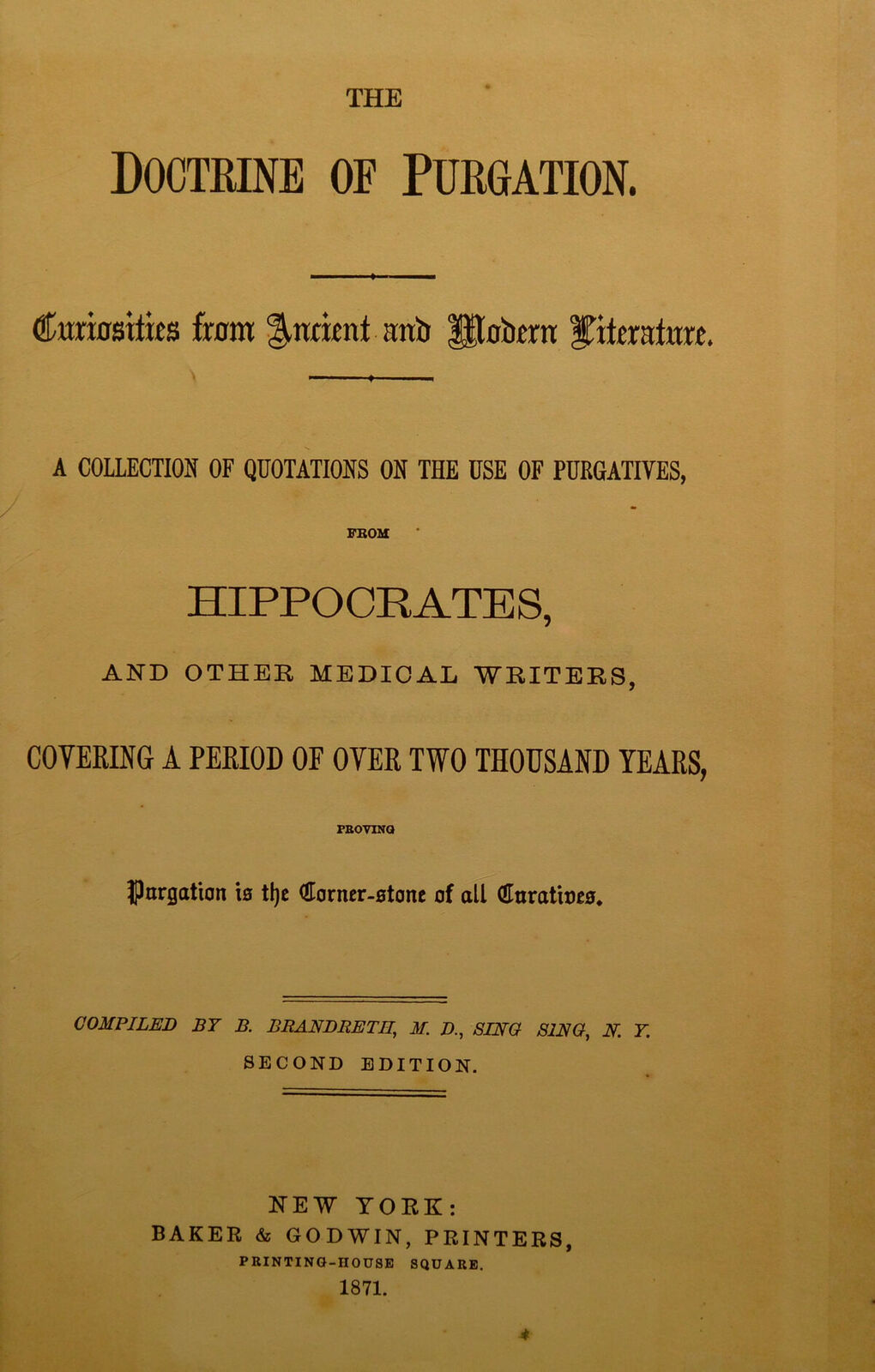
No source attached to this bundle documents a medical degree. His own 1880 obituary says that he “studied medicine with his grandfather,” and the title page of his 1871 book The Doctrine of Purgation identifies him as “B. Brandreth, M.D., Sing Sing, N.Y.” The attached record does establish the volume of his promotion: pamphlets, almanacs, newspaper advertising on a scale a congressional committee singled out by name in 1849 (below), and that historical-quotation anthology built around his own byline. Within a decade of his arrival, “Brandreth’s pills” was a punchline mainstream American writers could use without explanation: Edgar Allan Poe’s 1845 satire “Some Words with a Mummy” has a character ask a revived Egyptian mummy whether the ancients knew “the manufacture of either Ponnonner’s lozenges or Brandreth’s pills,” and Herman Melville’s Moby-Dick (1851) jokes that curing a sick whale’s indigestion would take “three or four boat loads of Brandreth’s pills.” That same 1849 committee predicted his name would soon be as forgotten as his rival Morison’s. It was a bad prediction: Brandreth went on to a seat in the New York State Senate and accumulated enough wealth to buy 26,000 acres of Adirondack wilderness.
National sales, an undocumented access channel
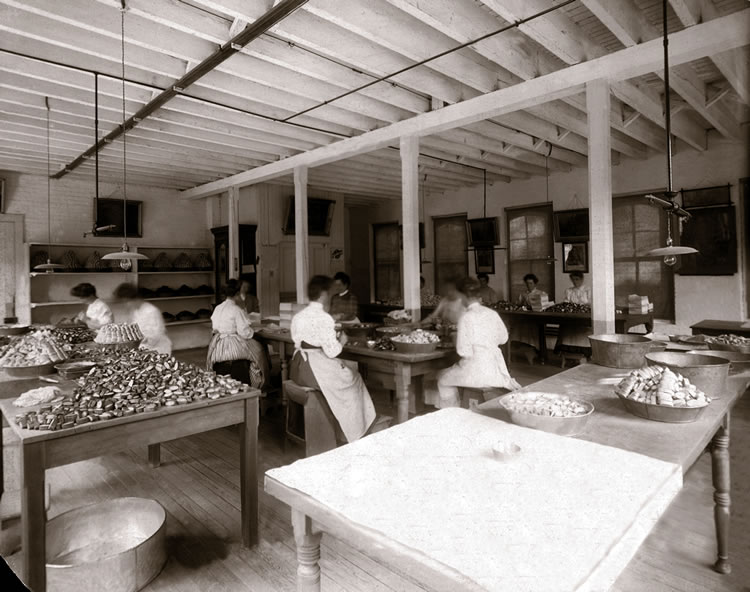
The Westchester County Archives’ history of Brandreth’s Ossining pill works states that the pills “were sold throughout the United States and, eventually, all over the world.” The attached sources do not identify a particular retail channel, price, or access terms, so the structured access profile remains unknown. A period photograph of the factory’s packing room shows women filling round tins from open bowls of loose pills. A later Allcock-manufactured tin also carried facsimile signatures and an explicit warning that “no Brandreth Pills are genuine” without them, documenting how authenticity was presented to buyers.
One disease, one cure, repeated purging
Brandreth’s system reduced every illness to a single cause. Dan King, a physician who devoted a chapter of his 1858 book Quackery Unmasked to the American nostrum trade, records the pitch in Brandreth’s own terms: he had discovered that there is but one disease, the impurity of the blood, and only one sure remedy. A Brandreth’s Pills tin catalogued by History Colorado lists eight ingredients and gives gum gamboge the largest weight, but the museum marks its manufacture date unknown, supplies a range of 1888-1965, and identifies Allcock Mfg. Co. as its maker. That later artifact does not establish the formula Brandreth sold before 1880. An 1884 Brandreth company almanac assured buyers the pills were free from mercury, calomel, antimony, or any poisonous mineral and would always do good and never injure; the later Allcock tin directed doses of one to eight pills. Those successor materials document the posthumous sales pitch, while King’s 1858 account documents harms from repeated dosing during Brandreth’s lifetime.
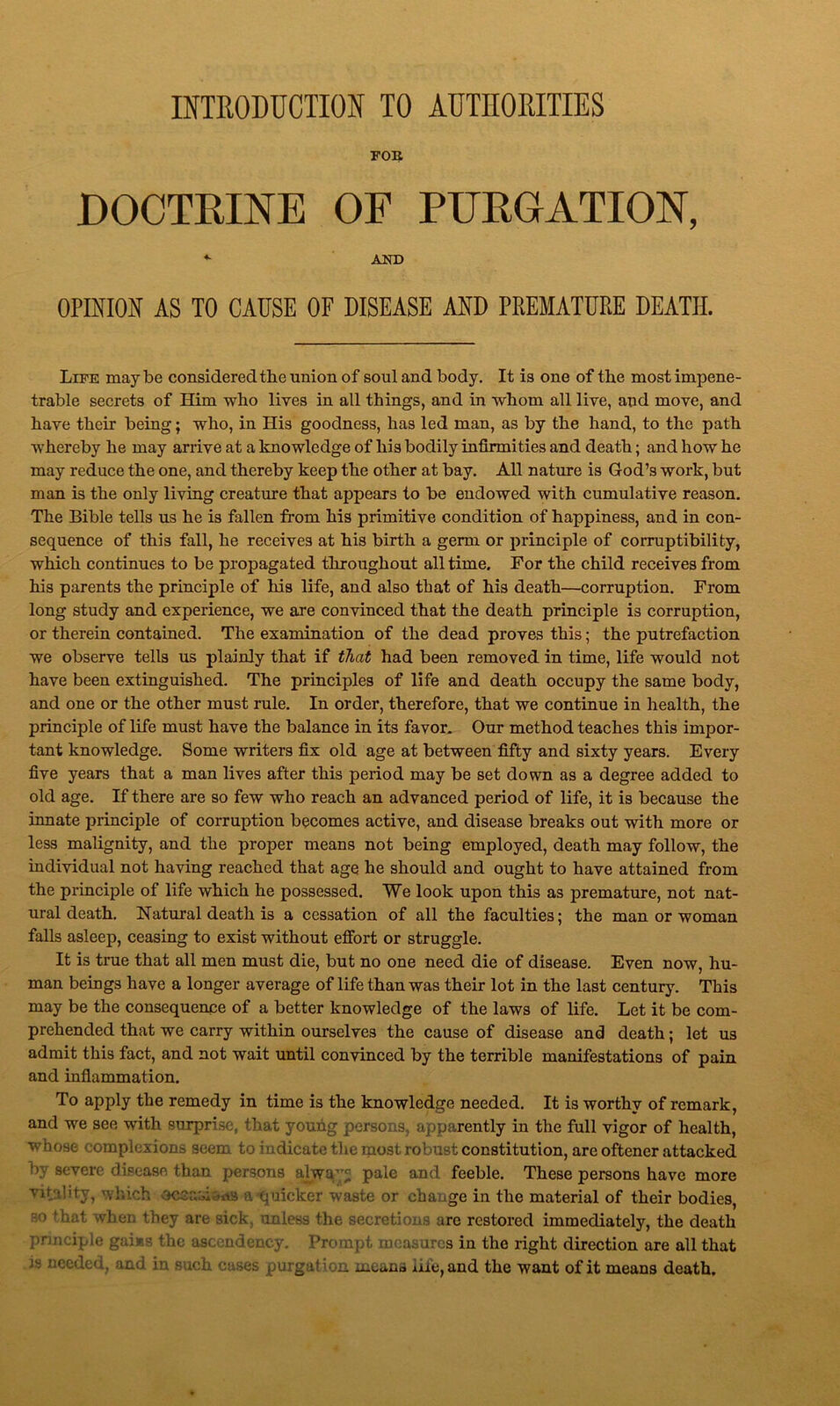
The mechanism carried a longevity promise as explicit as its cure-all claim. Brandreth’s own 1871 Doctrine of Purgation argues that natural death is merely “a cessation of all the faculties,” so any earlier death is “premature, not natural,” caused by a retained “principle of corruption” in the body. All men must die, the book concedes, but no one need die of disease: a longer average lifespan than earlier centuries enjoyed is achievable by removing that inner cause in time, because, in the book’s own formulation of the case’s central claim, purgation means life, and the want of it means death. The attached record contains no controlled test connecting purgation to a longer life, so the longevity Claim is recorded as untested.
Author, owner, and vendor — and a state senator
The conflict follows the documented facts directly: Brandreth wrote the theory, owned the factory that embodied it, and was the proprietor of his own pill sold under it. The scale of what that funded is independently attested twice. A U.S. House of Representatives select committee investigating the patent-medicine trade reported in 1849: “The annual fee for publishing Brandreth’s pills has amounted to one hundred thousand dollars.” That same report said Morison had spent more than twice that amount advertising his “never dying Hygeine,” immediately before predicting that both men’s fame would fade together. Three decades later, Brandreth’s own Brooklyn Daily Eagle obituary (February 1880) put the figure differently but consistently: over his first twenty years in business he had spent nearly the entire profits of the business, an estimated $150,000 a year, on advertising, leaving an estate at his death valued at two to three million dollars.
In 1851 he bought 26,000 acres of Adirondack wilderness, Township 39 of the Totten and Crossfield Purchase, at fifteen cents an acre — land that a 2000 Adirondack Life profile reported remained in the family’s hands as Brandreth Park. In 1857 he built the Brandreth House hotel at Canal Street and Broadway in Manhattan. And, per his own 1880 obituary, he was elected to the New York State Senate in 1849 and served four years — a seat in the very kind of legislature that a congressional committee had already named as a possible check on the “vast system of medical empiricism” his business belonged to.
Called a dangerous farce in his own lifetime — and the business continued
The attached record contains no decisive trial; it does show that Brandreth’s theory was disputed in print during his career. The 1849 congressional committee’s report is emphatic that no single remedy, or “specific,” can rationally cure diseases “diametrically opposite” to one another, and names Brandreth directly as an example of the trade it condemns. Dan King’s 1858 Quackery Unmasked is more direct still, dismissing the whole enterprise as “the mighty farce” that made Brandreth “a wealthy baron,” and documenting the actual cost of habitual heavy dosing: hundreds of users were left, in King’s words, “with all its incidental miseries” of perpetual constipation “by the injudicious use of these pills.” King adds, without naming individual cases, that some users were “hastened to their dread account” by them.
The business continued after the criticism. Brandreth died suddenly on 19 February 1880 — the date given by both his own Brooklyn Daily Eagle obituary and Appletons’ Cyclopaedia — of a cardiac embolism in a wash room at his Sing Sing home, hours after spending his last working morning in his factory’s pill-mixing room. An 1884 company calendar identifies the publisher as B. Brandreth’s Sons, and the Westchester County Archives records that Brandreth products continued to be manufactured and distributed at the Ossining site until 1979. The single-cause blood-impurity pitch was already being disputed in print while Brandreth was alive and profiting from it.
The pattern repeats
The same structural machinery appears in different treatments and eras. These cases show the claimed mechanism and how the claim met evidence.
Morison's Vegetable Universal Medicine (Hygeian pills)
Holloway's Pills and Ointment
Ward's Pill and Drop
Part of the lineage
External references
Evidence · 13 sources
- Brandreth, Benjamin (Appletons' Cyclopaedia of American Biography) (1900)
- Patent Medicines (House Report No. 52, 30th Congress, 2nd Session) (1849)
- Quackery Unmasked (1858)
- The Doctrine of Purgation, Curiosities from Ancient and Modern Literature (1871)
- Obituary of Benjamin Brandreth (1880)
- Brandreth's Pills (pill box, catalogue record) (2026)
- Brandreth Pill Factory (Historical Treasures of Westchester County) (1900)
- Brandreth, William (The National Cyclopaedia of American Biography) (1895)
- Franklin Brandreth (2000)
- Moby-Dick; or, The Whale (chapter 92, "Ambergris") (1851)
- Some Words with a Mummy (1845)
- Brandreth's Almanac / Brandreth Calendar, 1884 (1884)
- Portrait of Benjamin Brandreth (oil painting reproduction, Wikimedia Commons) (1870)