Swaim's Panacea
William Swaim swore in signed print that his Panacea, sold from Philadelphia after 1820, was purely vegetable and free of mercury, safe enough for a nursing infant. In 1828 the Philadelphia Medical Society found it neither effective nor safe; three chemists then proved Swaim's oath false, revealing corrosive sublimate in bottles marketed to cure diseases mercury itself caused.
A cure for mercury poisoning, secretly made of mercury
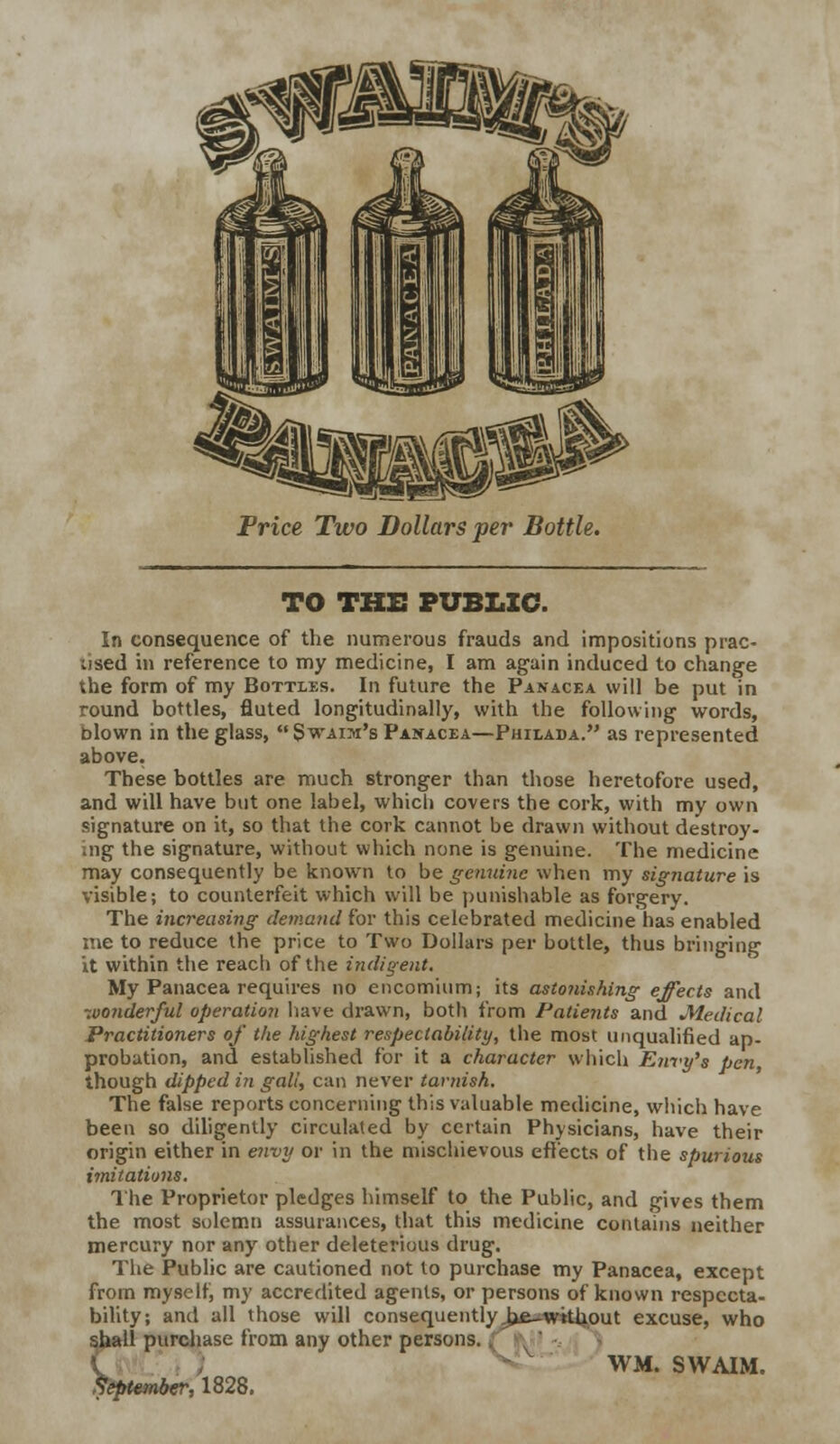
In September 1828, William Swaim signed his name to a printed notice bound into his own treatise, priced at two dollars a bottle, pledging to the public that his Panacea contained neither mercury nor any other deleterious drug (Wellcome Collection, work bst63dyx). It was a pointed promise: the medicine was marketed, among other things, as a cure for “mercurial disease,” the poisoning contemporary doctors’ own mercury-based treatments could cause. Three separate chemists later proved that pledge false. His Panacea, the standard scholarly history of American patent medicine records, in fact contained corrosive sublimate, one of the harshest mercury compounds in the nineteenth-century pharmacy, in at least some of the bottles he sold (Young 1961).
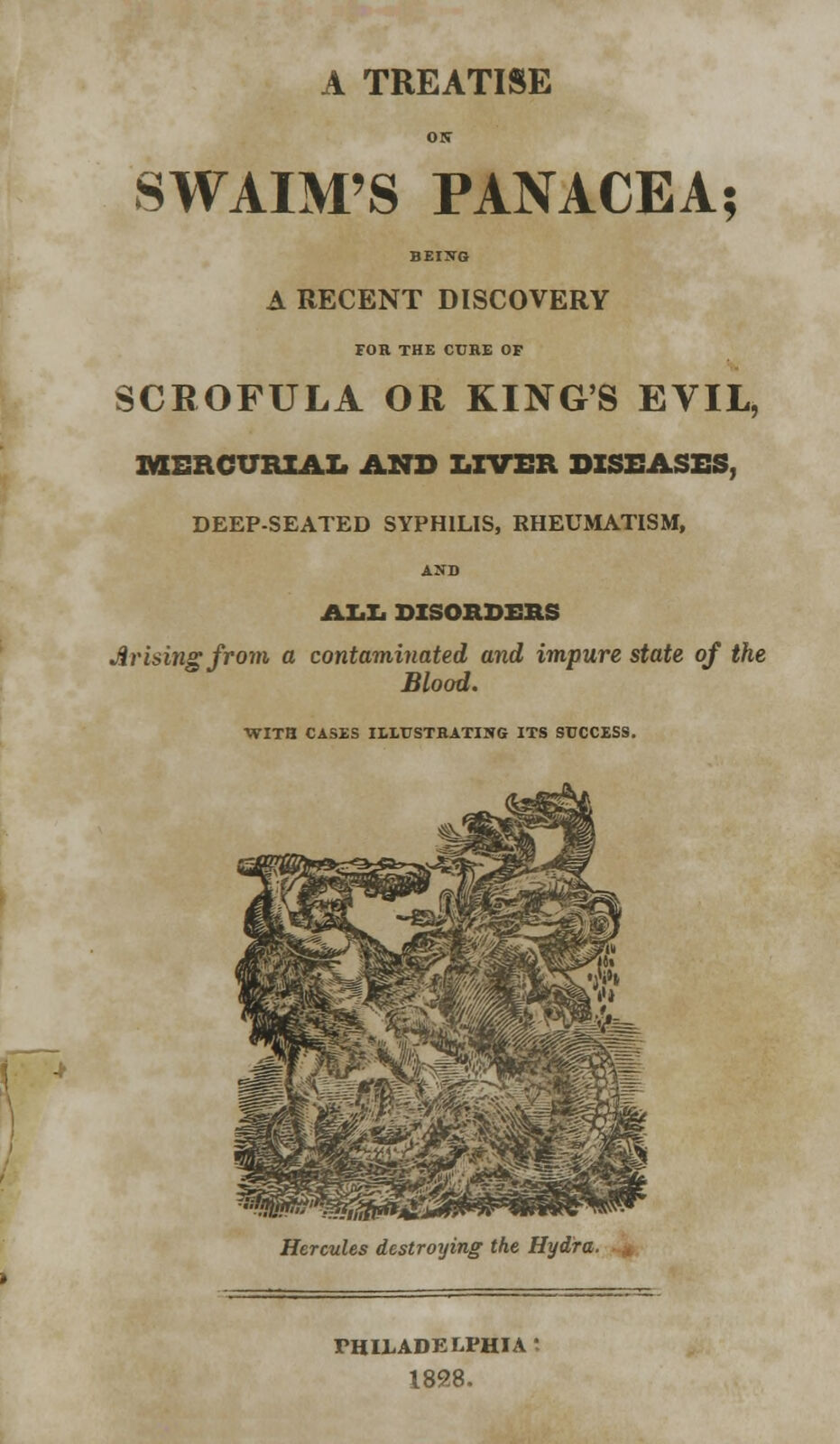
Swaim (1781-1846) began his working life as a Philadelphia bookbinder. In the 1820s he switched to patent medicine, seeing in it a financial opportunity, and launched Swaim’s Panacea around 1820 (Library Company of Philadelphia 2018). He was not a doctor (Library Company of Philadelphia 2018). His own treatise’s title page named the conditions his Panacea claimed to cure — scrofula, or King’s evil; mercurial and liver diseases; deep-seated syphilis; rheumatism; and any disorder arising from a contaminated and impure state of the blood — beneath an engraved emblem captioned Hercules destroying the Hydra: one preparation, personally authored and personally guaranteed, set against every disease at once (Wellcome Collection, work bst63dyx). Prominent Philadelphia physicians lent Swaim’s business early credibility. Nathaniel Chapman, later a founding figure of the American Medical Association, and William Gibson both endorsed the Panacea in its early years, testimony Swaim’s advertising made full use of (Young 1961).
Sold through agents, signed by one man
Swaim’s medicine was not scarce. It was a two-dollar bottle sold through William Swaim himself and a network of accredited agents, and his own 1828 notice explained that he was redesigning the bottle and its printed label specifically to defeat counterfeiters trading on his product’s popularity, while rising demand let him lower the price to that two-dollar figure (Wellcome Collection, work bst63dyx). What was exclusive was not access to the bottle but the proprietary claim behind it: a single secret formula, a personal signature meant to certify authenticity, and Swaim’s own sole authorship of the medicine’s safety and efficacy. The public was cautioned to buy only from Swaim or his accredited agents, and from no one else (Wellcome Collection, work bst63dyx).
One tainted blood, one vegetable cure
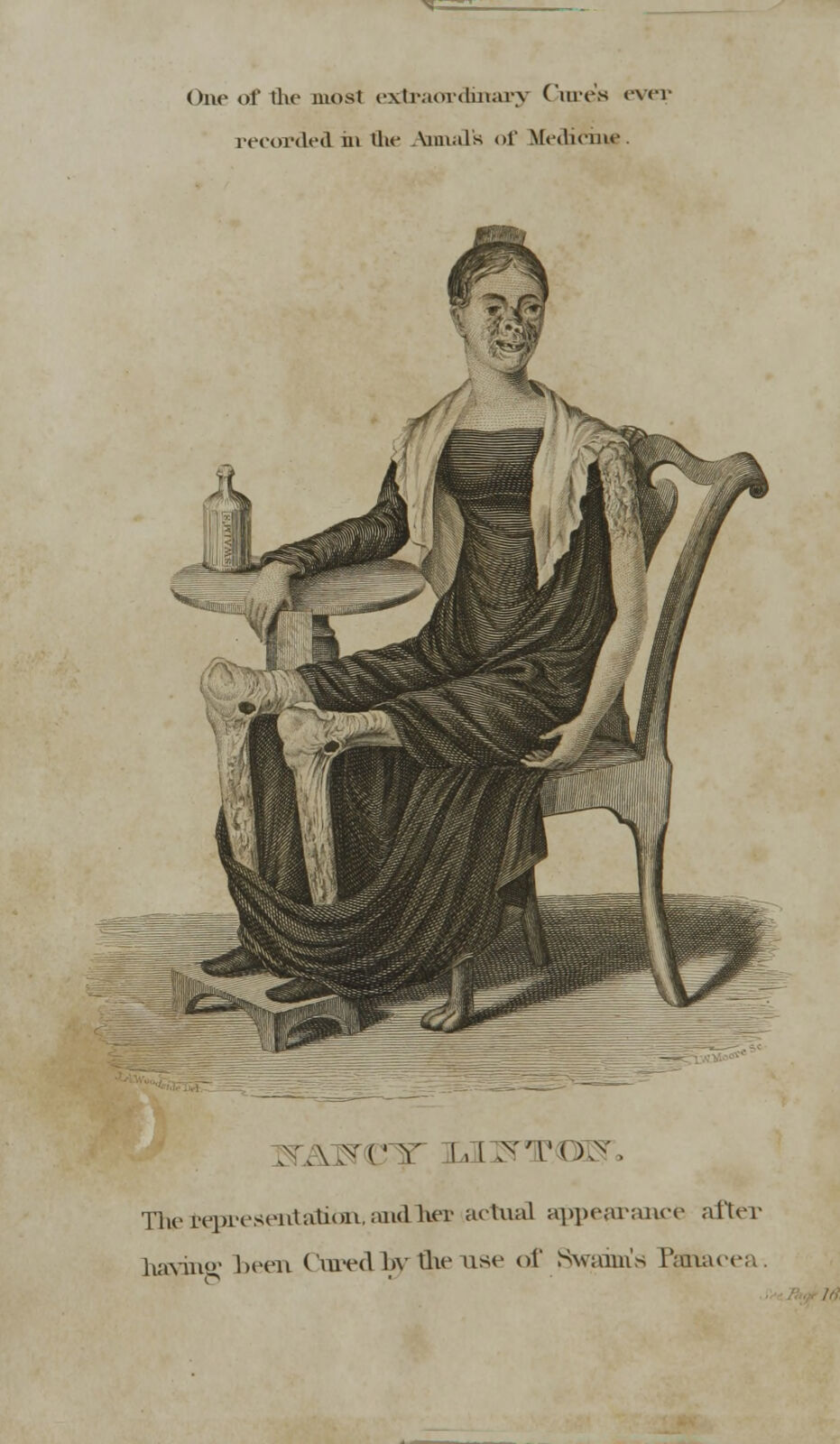
Swaim’s marketed theory, like others in this archive, reduced many named diseases to a single cause: a contaminated and impure state of the blood, which his purely vegetable Panacea — sarsaparilla and oil of wintergreen, substituted for sassafras — would purify away (Wellcome Collection, work bst63dyx; Young 1961). No mechanism connecting sarsaparilla or oil of wintergreen to a cure for syphilis, scrofula, or liver disease was ever demonstrated; the treatise supported the claim with testimonial case narratives of Swaim’s own selection, exemplified by the frontispiece account of a patient, Nancy Linton, presented in a “before and after” engraving as one of the most extraordinary cures on record (Wellcome Collection, work bst63dyx). The mechanism the label advertised was never the mechanism the bottle delivered: the Philadelphia Medical Society’s investigating committee inferred mercury exposure from patients’ own physiological symptoms, and chemists then confirmed that corrosive sublimate, not sarsaparilla, was doing whatever the medicine actually did to the body (Young 1961).
Author, proprietor, and principal vendor
The conflict is the developer-vendor pattern, named on the documented facts. Swaim was at once the author of the mercury-free claim, the proprietor of the medicine, and a seller of it: his own signed notice set the retail price, explained his commercial reasons for a redesigned bottle, and personally guaranteed the safety claim the business depended on (Wellcome Collection, work bst63dyx). The Library Company of Philadelphia’s institutional profile records that he continued to grow wealthy from the product even after the Philadelphia Medical Society had already discredited it by 1829, the year he purchased Library Company share number 439 (Library Company of Philadelphia 2018). The proceeds were not his alone — his accredited agents also sold the medicine — so the conflict named here is Swaim’s own direct financial dependence on a safety pledge he personally authored and signed, not exclusive command of every dollar the trade produced.
The pledge a Philadelphia committee and three chemists disproved
The Philadelphia Medical Society appointed a committee to investigate Swaim’s Panacea, and by 1828 that committee’s report — which Swaim contested in his own pamphlet the same year — concluded the medicine belonged with the era’s other quack remedies (Wellcome Collection, work avydpj7r; Young 1961). James Harvey Young’s academic history of American patent medicine records the committee’s central findings: the Panacea was neither effective nor safe; Swaim’s claim that it could be given even to a nursing infant was rejected outright; and the committee documented cases in which the medicine may have caused a patient’s death, while noting that its ingredients were inconsistently mixed, so that one bottle’s mercury content could differ from the next (Young 1961). Most damaging of all, the committee inferred mercury exposure from patients’ own symptoms, and three separate chemists then proved by direct chemical analysis what Swaim’s signed public pledge had denied: at least some bottles of his supposedly vegetable, mercury-free cure-all in fact contained corrosive sublimate (Young 1961). Nathaniel Chapman, one of the physicians who had endorsed the Panacea early on, later recanted, stopped prescribing it, and cited cases alarming enough to change his mind (Young 1961). Swaim died in 1846, but the verdict on his central marketed promise was already settled by the Philadelphia Medical Society’s investigators and the chemists who analyzed the Panacea: a medicine sworn free of mercury was not.
The pattern repeats
The same structural machinery appears in different treatments and eras. These cases show the claimed mechanism and how the claim met evidence.
Morison's Vegetable Universal Medicine (Hygeian pills)
Thomsonian Botanic System
Holloway's Pills and Ointment
Part of the lineage
External references
Evidence · 6 sources
- A Treatise on Swaim's Panacea (title page, Philadelphia, 1828 edition) (1828)
- A Treatise on Swaim's Panacea (frontispiece: Nancy Linton, before and after, Philadelphia, 1828 edition) (1828)
- A Treatise on Swaim's Panacea (bound-in notice: To the Public, signed Wm. Swaim, September 1828) (1828)
- Some Remarks upon a Publication by the Philadelphia Medical Society Concerning Swaim's Panacea (1828)
- The Toadstool Millionaires: A Social History of Patent Medicines in America before Federal Regulation, chapter 5 (Hercules and Hydra, the first significant critique of patent medicines) (1961)
- Shareholder Spotlight: William Swaim (2018)