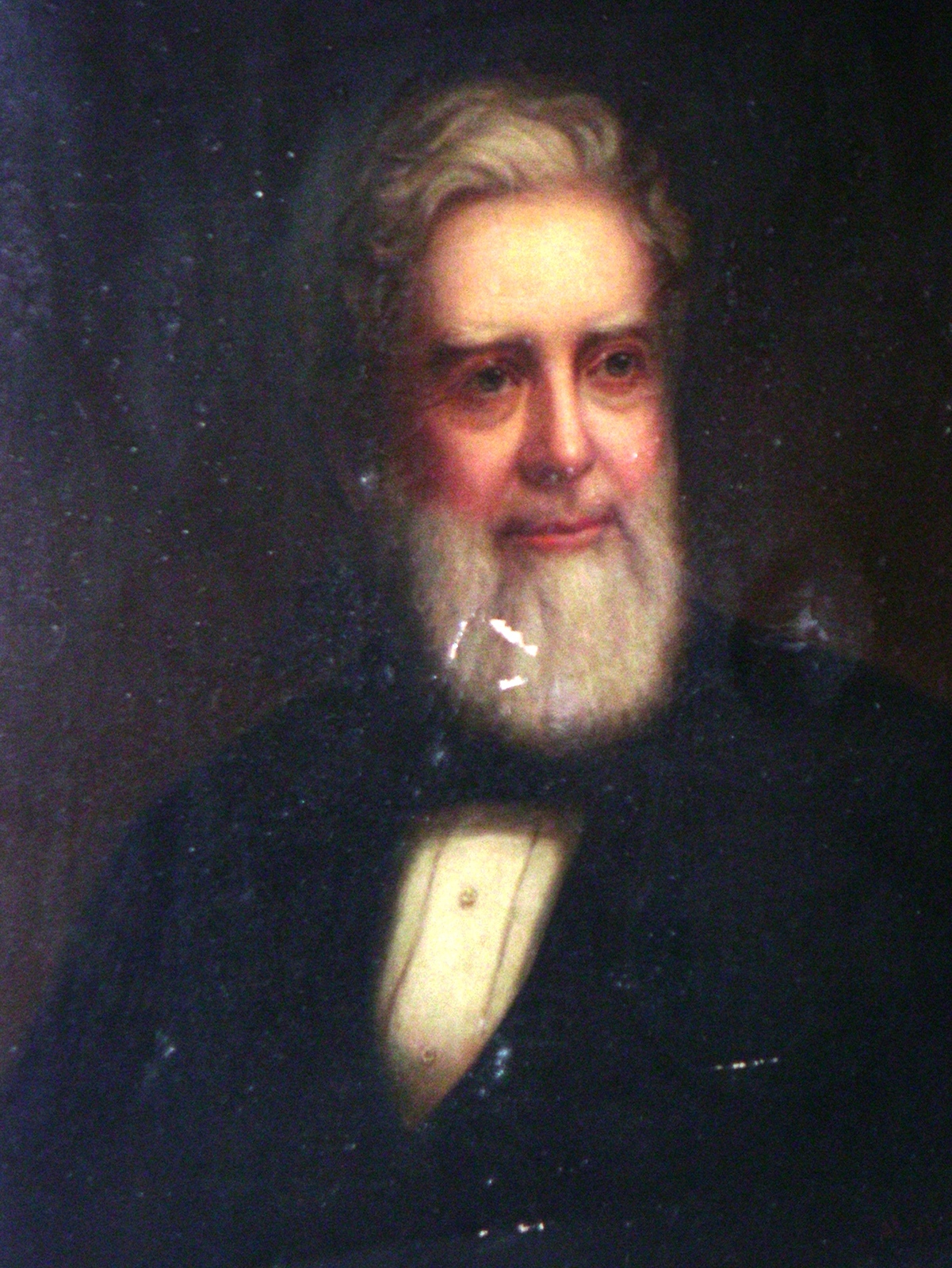
Benjamin Brandreth
Benjamin Brandreth was born in Leeds, England (Appletons’ Cyclopaedia of American Biography and his own 1880 Brooklyn Daily Eagle obituary both give Leeds; sources disagree on the exact year, Appletons’ giving 9 January 1807 and a family gravestone inscription giving 23 June 1809). He came to New York in 1835. The National Cyclopaedia of American Biography says he had learned to compound pills as a boy under the direction of a maternal grandfather who ran a large medical practice near Liverpool; Appletons describes the practitioner more generally as his grandfather, while one Adirondack Life account calls him a father-in-law. No source attached to this bundle documents a medical degree for Brandreth: his own obituary says that he “studied medicine with his grandfather,” and the title page of his 1871 book identifies him as “B. Brandreth, M.D.”
Brandreth built a factory at Sing Sing (renamed Ossining in 1901) in 1836. Westchester County Archives records that Brandreth products continued to be manufactured and distributed at the site until 1979; an 1884 calendar identifies B. Brandreth’s Sons as the publisher four years after his death, but the attached sources do not establish continuous family control through 1979. Brandreth proved to be one of the era’s most aggressive advertisers: pamphlets, almanacs, and a 224-page anthology of historical medical quotations (The Doctrine of Purgation, 1871) built around his own name, alongside newspaper advertising on a scale that drew the attention of a congressional committee in 1849. He was a New York State Senator (per his own obituary, elected in 1849 and serving four years), and in 1851 bought 26,000 acres of Adirondack wilderness that a 2000 Adirondack Life profile reported remained in the family as Brandreth Park. He died suddenly at his Sing Sing home on 19 February 1880; Appletons’ Cyclopaedia and his obituary both give the date, while the obituary supplies the cause — a cardiac embolism — and the circumstances, hours after he spent his last working morning in his factory’s pill-mixing room. The publicly_disconfirmed status attaches to the blood-impurity and disease-prevention claims criticized in print during his lifetime; it does not imply a legal or commercial defeat.