Hoxsey herbal tonic and escharotic paste
In 1924 Harry Hoxsey began selling a family tonic and caustic paste as a cure for cancer, no surgery required. The National Cancer Institute rejected his case reports; a federal appeals court found his booklet's named 'cured' patients had not been cured; the FDA banned the treatment in 1956. The same formula is still sold today at a Tijuana clinic, called unproven by Memorial Sloan Kettering and McGill University in 2021 and 2017.
A horse’s tumor and a family legend
The story Harry Hoxsey told about his cancer formula began, by his own account, with a horse. Sometime around 1840, his great-grandfather John Hoxsey noticed that one of his horses had developed a tumor on its leg; the animal began grazing on a particular mix of wild plants in its pasture, and the tumor reportedly cleared up within a short time. John Hoxsey gathered those plants, combined them with home remedies of the era, and the family carried the recipe forward. Harry Hoxsey was born near Auburn, Illinois, on 23 October 1901, one of twelve children of a livery-stable owner and veterinary surgeon. He had no medical training of any kind: he left school at fifteen to work as a coal miner and finished high school later by correspondence course. What he inherited instead was the formula, and in 1924 he opened his first cancer clinic in Taylorville, Illinois. He would spend the rest of his life moving the business between states, one step ahead of licensing prosecutions, until 1936, when he opened a clinic in Dallas that grew into one of the largest privately owned cancer treatment centers in the world. By the mid-1950s, affiliated Hoxsey clinics operated in as many as seventeen states.
One name, one formula, one clinic at a time
Hoxsey’s tonic and paste were never sold over the counter or licensed to other manufacturers; a patient could get them only from a Hoxsey clinic, under a Hoxsey-affiliated doctor’s supervision. That kept the business, and its revenue, concentrated in Hoxsey’s own hands even as it grew into a multi-state operation run out of the Dallas headquarters. The arrangement did not survive American regulators: the U.S. Food and Drug Administration banned interstate sale of the treatment in 1956, and further federal action forced Hoxsey’s clinics to close by 1960. It did survive the border. In 1963, Mildred Nelson, a former nurse at the Dallas clinic, opened the Bio-Medical Center in Tijuana, Mexico, one of the first of what became a cluster of Tijuana clinics offering treatments unavailable or unapproved in the United States. A current independent Tijuana clinic directory lists the Bio-Medical Center at an address on Avenida General Ferreira and names Hoxsey Therapy among its services; Memorial Sloan Kettering’s current monograph independently describes the treatment as available at a clinic in Tijuana. Those records document one current clinic offering the formula by name, more than sixty years after the Tijuana operation opened.
A tonic that “normalizes” and a paste that really does burn
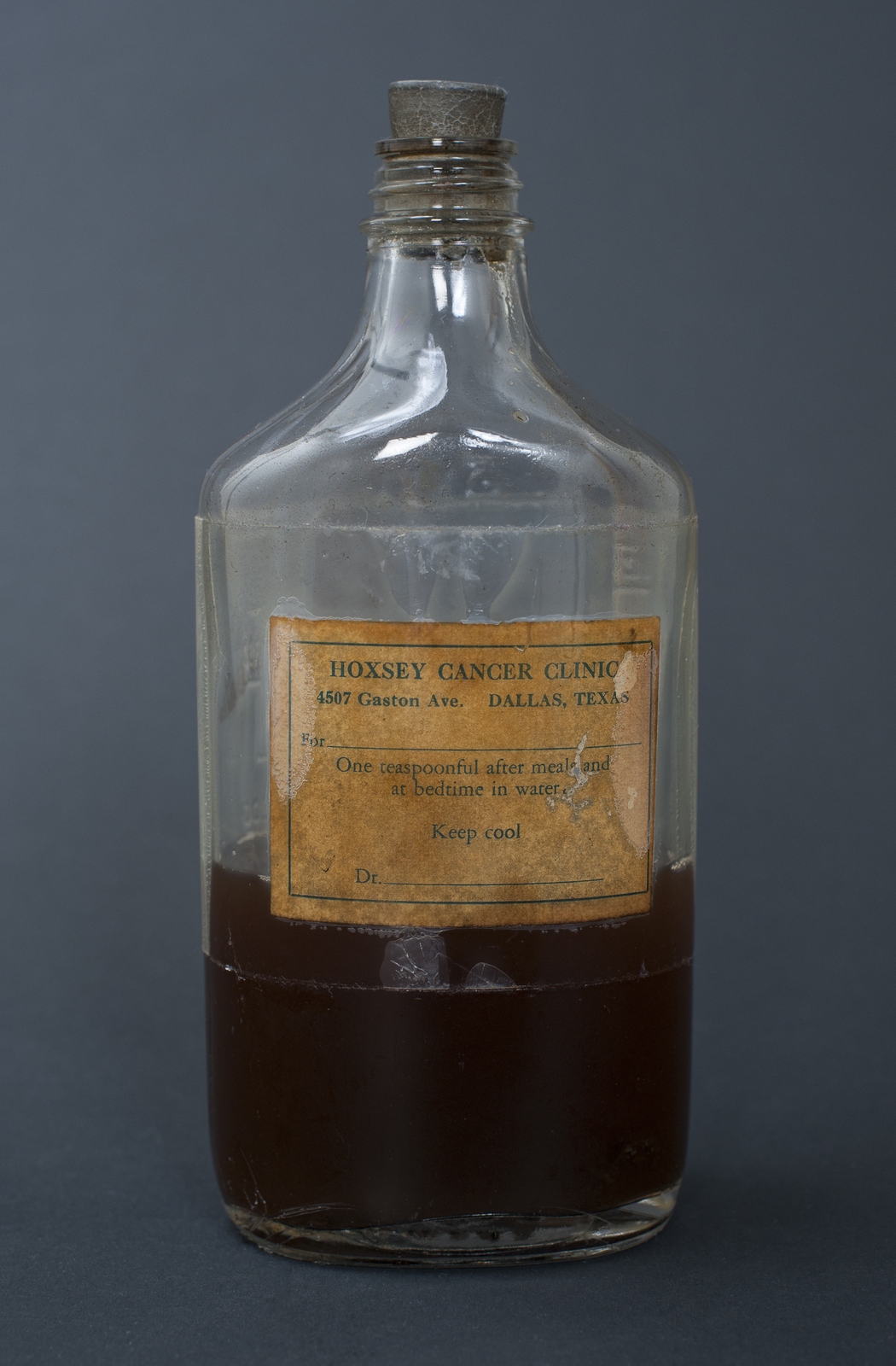
The internal tonic was a liquid combining potassium iodide with licorice, red clover, burdock root, stillingia root, barberry, cascara, pokeroot, prickly ash bark, and buckthorn bark, taken by the teaspoonful after meals and at bedtime alongside a restrictive diet, laxatives, and vitamin supplements. Its claimed mechanism, in Hoxsey’s own description as Memorial Sloan Kettering’s current monograph records it, was that the tonic “stimulates the elimination of toxins that poison the system, thereby correcting the abnormal blood chemistry and normalizing cell metabolism.” No specific toxin, pathway, or blood-chemistry abnormality was ever named or measured. For external and skin tumors, a second preparation, a red paste of antimony trisulfide, zinc chloride, and bloodroot, or a yellow powder of arsenic sulfide, sulfur, and talc, was applied directly to the growth and promoted as able to selectively destroy cancerous tissue. That preparation is a genuine escharotic: it does burn and destroy tissue on contact, which supplied the treatment’s only directly visible effect and lent the “selective” claim its plausibility. The American Cancer Society’s own historical review is blunt about what the paste actually does: it “can severely burn, disfigure and scar the skin,” burning healthy tissue along with any tumor rather than selecting between them, a conclusion a 2005 peer-reviewed dermatologic-history review of escharotic agents situates within a wider caustic tradition that was never tissue-selective.
The doctor who was also the landlord, the pharmacist, and the accountant
Hoxsey personally owned the clinics that sold his formula and collected patients’ treatment fees, without a medical license and despite repeated convictions for practicing medicine without one. That did not stop the business from growing into a multi-state operation for three decades. A University of Texas patient-information summary, current as of its 1999 revision, recorded a flat charge of $3,500 for a lifetime supply of tonic, visits, medications, and doctor fees, with laboratory tests, x-rays, physical exams, and travel costs on top of that. No source reviewed for this case quantifies Hoxsey’s total personal earnings from the clinics, but the structure left one man simultaneously the formula’s owner, its sole legal supplier, and the person collecting every patient’s fee, with no outside pharmaceutical company, licensing board, or independent clinical trial standing between the claim and the cash register.
Rejected by the NCI, disbelieved by a federal court, banned by the FDA, and still for sale
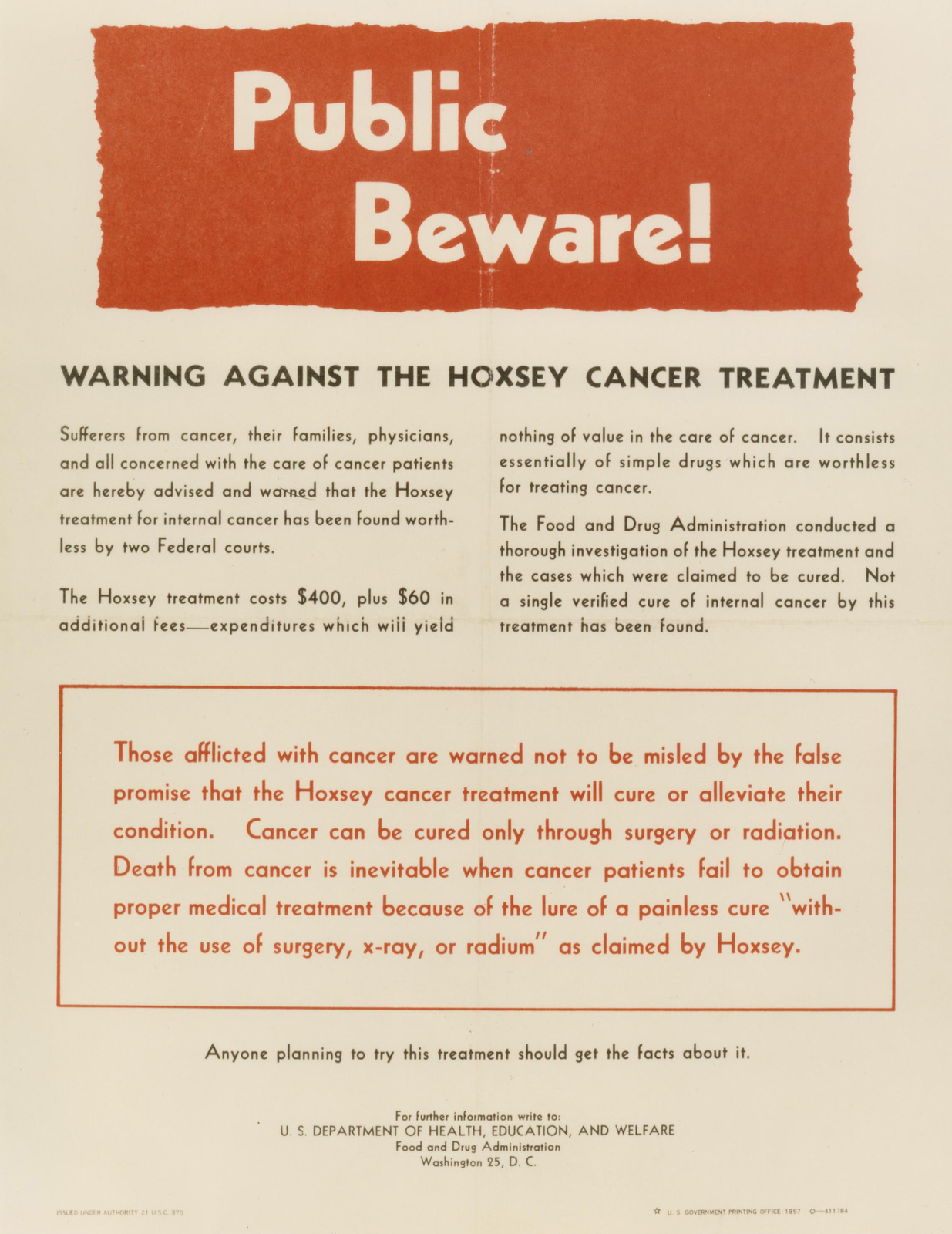
Disconfirmation came from several directions at once, and none of it ended the business. In 1946, the National Cancer Institute reviewed 77 case reports Hoxsey submitted as proof of cures and concluded that none of them met its criteria for scientific evaluation. The federal government’s own Food, Drug and Cosmetic Act enforcement action against the Hoxsey Cancer Clinic reached the Fifth Circuit Court of Appeals in 1952; the court’s opinion, reprinted in the Maryland State Medical Journal, found that the government’s evidence established that specific individuals Hoxsey’s promotional booklet named as cured, complete with photographs and an invitation for readers to write to them directly, had in fact not been cured. Separately, Hoxsey sued Morris Fishbein, editor of the Journal of the American Medical Association, for libel after Fishbein’s publications called him a fraud; Hoxsey won, but, in the American Cancer Society’s own words, “the judge awarded him only $1.” A follow-up study of 39 patients who had taken the Hoxsey herbal treatment, cited in the American Cancer Society’s review, found ten had died after an average of 15 months and only six were disease-free after 48 months, with 23 patients never completing the study. The U.S. Food and Drug Administration banned interstate sale of the Hoxsey treatment in 1956, warning in a public flyer that year, read directly from the flyer itself, that the treatment had been found worthless by two federal courts and that not a single verified cure of internal cancer by the treatment had been found, and further federal action closed Hoxsey’s American clinics by 1960. Hoxsey himself developed prostate cancer in 1967; when his own tonic did not work, he underwent conventional surgery, and he died in Dallas in late December 1974. None of this touched the clinic Mildred Nelson opened in Tijuana in 1963. The identical formula is sold there today, and the disconfirmation has simply continued in real time alongside it: Memorial Sloan Kettering’s monograph, last updated in February 2021, states that “Hoxsey Herbal Therapy is not a cancer cure and some of its components may be dangerous,” and McGill University’s Office for Science and Society concluded in 2017 that the evidence “indicates that Harry Hoxsey purported to have medical knowledge that he did not actually possess. In other words, he was a quack.”
The pattern repeats
The same structural machinery appears in different treatments and eras. These cases show the claimed mechanism and how the claim met evidence.
Krebiozen Cancer Treatment
Megadose vitamin C ('orthomolecular' ascorbate therapy)
Part of the lineage
Evidence · 15 sources
- Hoxsey, Harry M. (2009)
- Hoxsey Herbal Treatment (2000)
- Escharotic agents, Fred Mohs, and Harry Hoxsey (2005)
- Statement on Hoxsey Cancer Treatment (1957)
- Patient perspectives: Tijuana cancer clinics in the post-NAFTA era (2005)
- Unproven methods of cancer management. Krebiozen and carcalon (1973)
- High-dose vitamin C versus placebo in the treatment of patients with advanced cancer who have had no prior chemotherapy. A randomized double-blind comparison (1985)
- High-Dose IV Vitamin C (IVC) (2026)
- Case of the United States versus the Hoxsey Cancer Clinic; opinion of the United States Court of Appeals for the Fifth Circuit (1952)
- Hoxsey Herbal Therapy (2021)
- The Hoxsey Hoax (2017)
- Center for Alternative Medicine Research in Cancer: Hoxsey summary (1999)
- Hoxsey Bio Medical Center (2026)
- File:Hoxsey Cancer Clinic Bottle (33304994272).jpg (2014)
- File:FDA History - Hoxsey Fraud Warning Poster (4899254828).jpg (1957)