Therapeutic plasma exchange with intravenous immunoglobulin (TPE-IVIG)
For a fee, a clinic drains and replaces a client's plasma and says it cut their biological age by 2.61 years. The figure comes from one trial: 42 adults, three months, single-blind, measuring an epigenetic lab marker, not death or disease. Three authors belong to Circulate, the firm selling the procedure. The Mayo Clinic's chair of transfusion medicine called the trial "too small to prove anti-aging benefits," and no independent group has replicated it.

The institute that lends its name
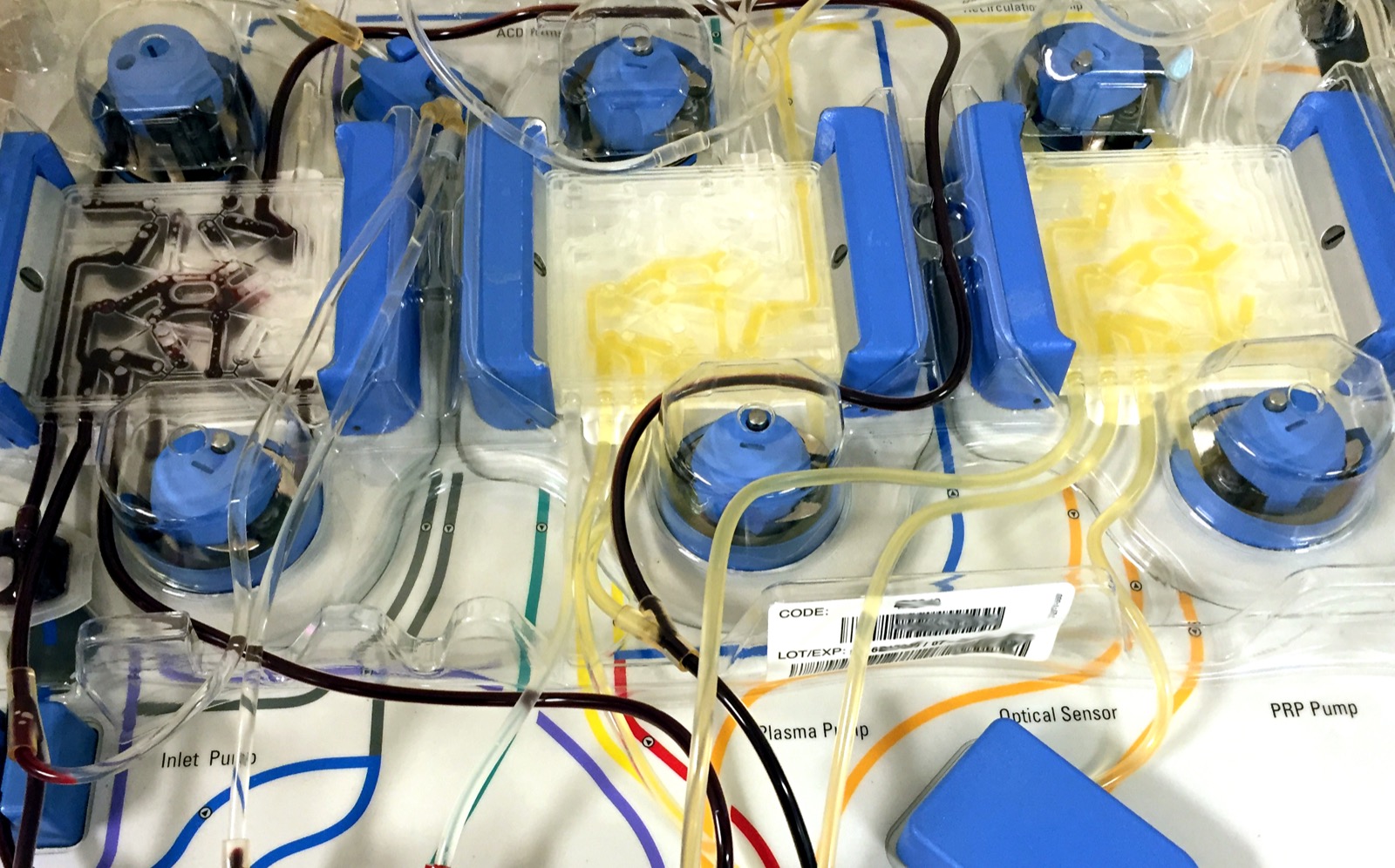
You sit for several hours while a machine pulls your blood out, spins the plasma off, throws that plasma away, and returns your cells to you suspended in fresh fluid. Do that six times over about three months, in the arm that also gets an immunoglobulin infusion, and a clinical-service company will tell you that you are, by one measure, 2.61 years younger than when you started.
The company is Circulate Health, and the measure comes from a 2025 trial run at the Buck Institute for Research on Aging in Novato, California, a nonprofit founded in 1999 and one of the leading aging-research organizations in the United States. Its president since 2016, Eric Verdin, co-founded Circulate. So did Dobri Kiprov, the company’s chief scientific officer, a senior apheresis clinician with more than four decades of practice and a founding member of the American Society for Apheresis; Brad Younggren is CEO. David Furman, a Buck professor and director of the Stanford 1,000 Immunomes Project, is the primary scientific contact for the Aging Cell trial and a Circulate member. The credential here is not one charismatic name but an institution: the Buck Institute’s research reputation is what stands behind the procedure, with the clinical service delivered through the affiliated company.
A hospital procedure, sold off-label to the well
Therapeutic plasma exchange is a recognized clinical procedure (FDA-approved for autoimmune neurological and hematologic indications) but is neither approved nor reimbursed for healthspan extension or aging-related use. The Circulate Health protocol is sold as a private clinical service at price points and access patterns characteristic of contemporary elite longevity medicine. The trial itself was conducted in a defined population of 42 healthy adults over 50; the intervention as currently marketed is offered to a similar demographic of paying private clients. Public-pay healthcare systems do not cover the protocol.
A younger number on a panel of clocks
The Aging Cell trial used a multi-omics framework with 35 epigenetic clocks as primary outcome measures. The trial reported biological-age reductions on these surrogate endpoints rather than on hard clinical outcomes (mortality, disease incidence, functional capacity over time). The mechanistic story (replacement of aged plasma reduces inflammaging and immunosenescence markers; IVIG modulates immune function) is biologically plausible at the molecular level and substantially more developed than the mechanistic stories of Brown-Séquard, Voronoff, or Niehans. The unresolved question is whether reduction on epigenetic-clock surrogates translates to mortality or disease-incidence outcomes in any individual. Epigenetic clocks are validated against chronological age and population-level mortality; they have not been demonstrated as causal mediators of mortality at the individual level. Moving the surrogate does not necessarily move the underlying outcome.
Authors inside the company selling the result
The paper states that the authors received no specific funding for this work. What is disclosed is a conflict of interest: three of the listed authors (David Furman, Eric Verdin, Dobri Kiprov) are members of Circulate, Inc., the company that is now commercializing the protocol, and Verdin and Kiprov are co-founders; the paper also acknowledges technology support from Edifice Health. The disclosed conflict is acknowledged in the paper’s disclosures section but the equity stakes and commercial terms are not specified in the public record. The 2.61-year biological-age-reduction finding is deployed by Circulate as evidence for its commercial service offering at the time of writing. The structural relationship (a surrogate-endpoint trial whose investigators are members of the commercializing company, generating a marketing claim deployed by that company) is the modern instantiation of the developer-vendor-credentialing identity pattern that recurs across this archive.
Not disproven, just unproven
Disconfirmation on hard endpoints would require larger and longer trials; the current evidence base is insufficient to confirm or reject the clinical translation of the epigenetic-clock findings. Independent replication of the Aging Cell trial by groups unaffiliated with Circulate has not been published as of this writing. The trial’s own design bounds what it can show: small N (42), short follow-up (approximately three months), single-blind design rather than double-blind, surrogate-only endpoints, and a disclosed conflict of interest in which the investigators are members of the commercializing company. Independent specialists quoted in the New York Times were skeptical: Jeffrey Winters, chair of transfusion medicine at the Mayo Clinic, said the trial was “too small to prove anti-aging benefits”, that its few-months follow-up left the durability of any effect unclear, and that “given the absence of evidence in the literature” the longevity benefit “really isn’t there”; Katayoun Fani of the University of Alabama at Birmingham said the anti-aging benefit for healthy people has never been proven in large trials and that the procedure carries risk without a clear payoff; and Zbigniew Szczepiorkowski of Dartmouth Health noted the result may be confounded by the healthy Bay-Area cohort the company recruited (New York Times, 28 May 2025). The case is currently active. The disconfirmation, if it comes, will follow the structural template of the historical cases in this archive: a surrogate-endpoint finding sold ahead of hard-endpoint confirmation, with the commercial product retired only after the gap between marketing and evidence becomes professionally untenable.
The pattern repeats
The same structural machinery appears in different treatments and eras. These cases show the claimed mechanism and how the claim met evidence.
Blueprint (Project Blueprint)
Animal magnetism (mesmerism)
Brown-Séquard testicular extract (organotherapy)
Evidence · 8 sources
- Multi-omics Analysis Reveals Biomarkers That Contribute to Biological Age Rejuvenation in Response to Single-Blinded Randomized Placebo-Controlled Therapeutic Plasma Exchange (2025)
- ClinicalTrials.gov registration NCT06534450 (2024)
- Buck Institute press release on TPE biological-age trial (2025)
- Can This Trendy Anti-Aging Treatment Really Help You Live Longer? (2025)
- Epigenetic age clocks and mortality at the individual level — methodological review (2023)
- Bad Medicine: Doctors Doing Harm Since Hippocrates (2006)
- Apheresis machine, NIAID, 2016 (2016)
- Glass bottle with immunoglobulin to fight against chickenpox (1964)