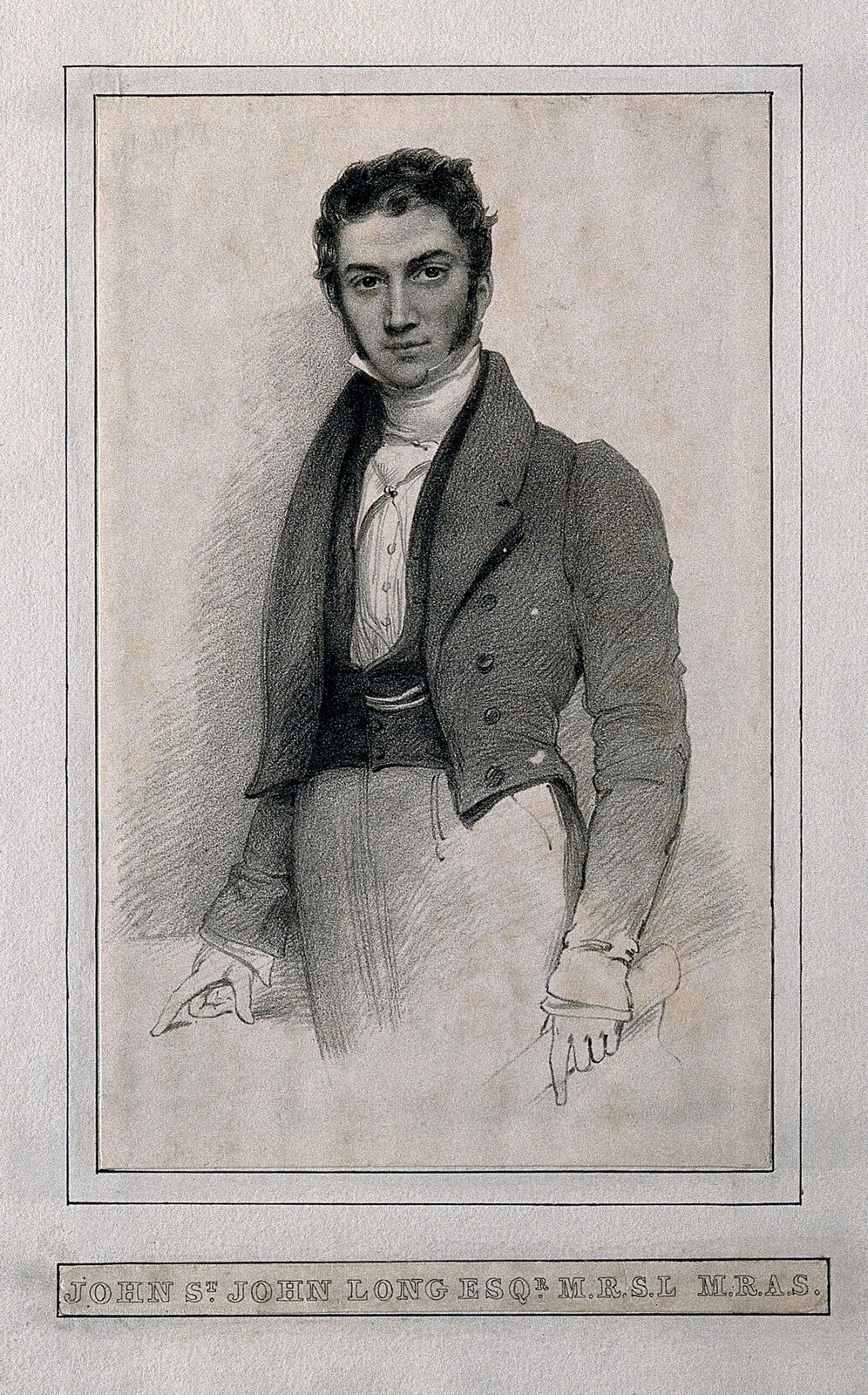
John St John Long
"he was quite the 'médecin à la mode'"
John St John Long (born 1798, Newcastle West, Co. Limerick; died 2 July 1834, London) was the second son of John Long, a basket-maker, and Anne St John. Locals in Limerick paid for him to attend the Dublin Society’s school of design in 1816; he returned to Limerick after two years and supported himself giving drawing lessons and painting portraits and still life (the Dictionary of National Biography entry by James McMullen Rigg, 1893, records his occupation at this stage as an unsuccessful painter). He moved to London in 1822 and, per the DNB, “soon exchanged art for medicine, having lit upon an entirely original method of treating consumption, rheumatism, and other complaints, viz. the application of corrosive liniments and friction.” He opened a practice in Howland Street, Fitzroy Square, in 1827, and within months moved to 41 Harley Street, where the DNB records he was, for some years, “quite the ‘médecin à la mode.’” One of his patients, Catherine Cashin, died from the effects of his treatment in 1830; he was tried at the Old Bailey and found guilty of manslaughter on 23 October 1830, fined £250, and discharged. A second manslaughter trial, over the death of Mrs Colin Campbell Lloyd, ended in acquittal on 19 February 1831. He died of the tuberculosis he refused to treat by his own method on 2 July 1834, and left his property, including the liniment “secret” he valued at £10,000, to his brother William. His case became a byword for fashionable quackery in the contemporary medical press, discussed under that framing in The Medico-chirurgical Review in both 1829 and 1830 and revisited as a historical case study by Sandra Hempel in The Lancet in 2014.