Tesla BioHealing Biophoton Generators (BioHealer / Tesla MedBed Generator)
Since 2019 Tesla BioHealing has sold sealed canisters it calls Biophoton Generators, claiming they emit 'Life Force Energy' that treats terminal cancers, stroke paralysis, and dementia. The FDA found the devices adulterated and misbranded in 2023, and a registered trial of the device posted no results; founder James Liu had already drawn a 2014 FTC letter over unsubstantiated claims for a different product. The company kept selling, still running eight centers.
The doctor who calls them “customers,” not patients
At the Tesla Wellness Hotel and MedBed Center outside Butler, Pennsylvania, a converted Days Inn about 45 minutes north of Pittsburgh, an Amish woman from Ohio floats on a pool noodle in the swimming pool, drifting among two dozen submerged metal canisters the size of large thermoses. She visits twice a month. It’s November 2023, and the Associated Press is on site to find out what the canisters are supposed to do. “We are not a clinic, not a doctor’s office,” the company’s founder, Dr. James Zhou Liu, tells AP reporter David Klepper. “For me, for the company, I always call them customers.” Liu says he earned a medical degree in China and a Ph.D. in human nutrition from Penn State University. He founded Tesla BioHealing, Inc. in 2019 at 111 McCoy Street in Milford, Delaware, selling canisters he calls “Biophoton Generators” that, per the company, “create their own environments of pure Life Force Energy” strong enough to make the body’s own cells “self-repair” faster than they otherwise could. It was not Liu’s first health-marketing venture at that address. In September 2014, the FTC sent a closing letter to Dr. James Liu at DrNaturalHealing, Inc. — the same 111 McCoy Street building — over an asthma product called the AsthmaCare Kit, a nasal-irrigation device and homeopathic spray the company claimed could prevent or reduce asthma attacks. FTC staff said the cited evidence did not adequately substantiate the health claims, and the agency closed the matter — expressly stating that closing it was not a determination that no violation had occurred — only because Liu agreed to stop using the AsthmaCare Kit name and its asthma claims and because, as WTAE reported the FTC noting, sales had been “very limited.” Liu later described the episode to WTAE, in a written statement, as a learning experience that still guides him. Five years after that letter, at the same address, he was selling a new device with a much larger claim.
From a $599 canister to a hotel built around it
Tesla BioHealing sells its smallest “BioHealer” canister for $599 direct to any online buyer, with cheaper versions for children and pets; AP reported prices ranging up to $11,000 for the largest model. There is no waiting list, referral, or means test — anyone with a credit card can order. The company has scaled that retail model into hospitality: as of AP’s late-2023 reporting it operated wellness-hotel “MedBed centers,” including the Butler, PA location where canisters are built into the bed frames of every room and submerged in the pool, and where a guest (never called a patient) paid $450 for a one-night stay. The Skeptic’s Alice Howarth, reviewing the product line in August 2024, found the same offer still running a year after the FDA’s warning letter, now also pricing a paired “MedBed Generator” (which the company says is 100 times stronger than a single canister) at $19,999, and center visits at $120 an hour, $300 overnight, or $150 for a “BioWell scan,” across what the company then described as eight centers nationwide. By July 2026 the company’s own website still lists eight operating centers — Butler, PA; Milford, DE; Kearny, AZ; East Dubuque, IL; Tampa, FL; Leesburg, FL; Woburn, MA; and Hot Springs, AR — plus free US ground shipping on orders over $600 and financing for buyers who cannot pay up front. What began as a single product listing is now a nationwide chain, still open to any paying customer.
Real light, invented medicine
The company’s pitch rests on a real phenomenon stretched past what it can support. Biophotons — extremely weak light naturally emitted by living tissue — do exist and are measurable. Tesla BioHealing’s marketing, quoted directly in the FDA’s 2023 warning letter, claims its canisters generate “a much higher concentration of this natural healing force than is available in everyday environments,” so that “cellular self-repair mechanisms can begin to activate much faster and more profoundly than previously was possible.” The company’s own website, also quoted in the letter, credits “trends” observed in “over 20,000 people using Tesla BioHealing technology” for a list of early signs of efficacy including pain reduction, better sleep, vivid dreams, and increased libido, plus, for “brain-based” conditions such as Parkinson’s, dementia, and stroke paralysis, reports of increased mobility in previously paralyzed limbs and a ceasing of tremors. None of it comes from a controlled study; it is aggregated customer testimony. AP reported that biophotons’ role in health is not well understood and their use as a medical therapy is not proven, according to Bahman Anvari, a professor of bioengineering at UC Riverside. Timothy Caulfield, a health-policy and law professor at the University of Alberta who studies medical fraud, told AP: “There have always been hucksters selling medical cures, but I do feel like it’s accelerating.” He added that internet and social-media-driven distrust of traditional medicine is a key force behind the trend, and that “Conspiracy theories are creating and feeding this distrust.” AP’s own reporting describes the wider “medbed” marketing category these devices belong to as blending “the high-tech jargon of Western science with the spiritual terminology of traditional and Eastern medicine” to sell “the idea of insider information.” Retired psychiatrist Dr. Stephen Barrett, who has investigated questionable or false medical claims for decades, told WTAE, “As far as the disclaimer is concerned, that’s put there to try to protect them in case an agency come after them.” He added: “They can say, ‘Look, we’re not making these claims.’”
The founder who is also the seller
Liu is not a disinterested clinician forwarding a discovery made by someone else. He founded the company that makes the canisters, and in the AP and WTAE coverage he is the one speaking for what they supposedly do. Tesla BioHealing lists a chiropractor, Seth Robinson, as its “medical director,” and a second chiropractor, James Millen, as the Butler facility’s “clinical team leader” — titles naming clinical roles at a facility the company itself insists is not a clinic. No source reviewed for this case documents an independent audit of the company’s revenue or a controlled trial of the canisters against a real endpoint; the only outcome evidence described in those sources is the company’s own aggregated customer testimony, gathered and reported by the company that sells them.
A warning letter, and business as usual
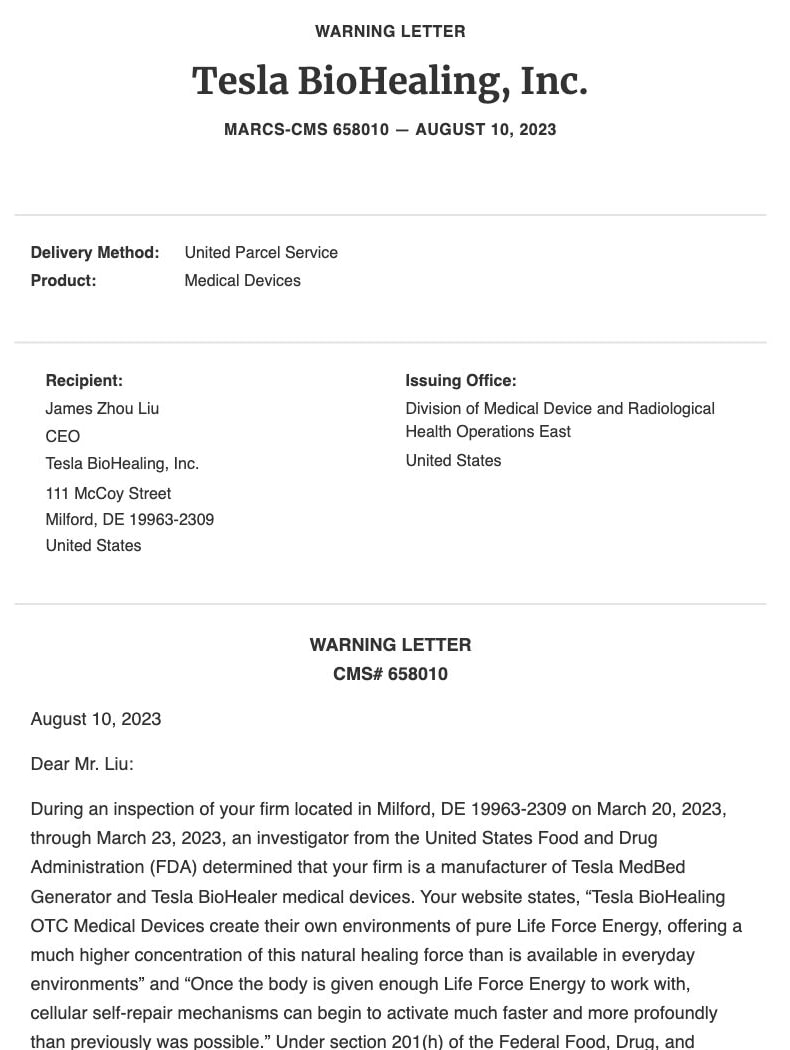
On August 10, 2023, the FDA’s Division of Medical Device and Radiological Health Operations East sent Liu a warning letter (MARCS-CMS 658010) after inspecting Tesla BioHealing’s Milford facility. It found the Tesla MedBed Generator and Tesla BioHealer “adulterated” under the Federal Food, Drug, and Cosmetic Act, because the company had no approved premarket approval application or investigational-device exemption for a device intended to diagnose or treat disease, and “misbranded,” because the devices were registered under a narrow exemption for infrared-lamp heating pads even though, the FDA noted, they “do not have a heating element” and are marketed for uses — including terminal cancers, stroke paralysis, Lyme disease, Alzheimer’s/dementia, and epilepsy — far outside that exemption’s limits. The same letter documented multiple Quality System regulation violations: unimplemented design-validation and complaint-handling procedures, no corrective-action process, and no listing of the “Tesla MedBed Generators” or “Tesla BioHealers” product names in the firm’s required annual FDA device registration. FDA gave the company 15 business days to respond and warned that failing to address the violations could lead to seizure, injunction, or civil penalties; no FDA close-out letter resolving the matter was found in the sources reviewed for this case. It was the second time regulators had acted over a health product Liu marketed at that same address, the FTC having flagged his asthma device nine years earlier — though this action came at far greater scale, over far more serious disease claims, and via an actual adulteration/misbranding determination rather than the FTC’s no-enforcement closing letter (which explicitly disclaimed making any finding of violation). The selling did not stop. A year later, The Skeptic found the identical marketing claims and pricing still live on the company’s site, reporting the same eight MedBed centers the company’s own site still listed as of mid-2026. A present-day independent assessment reached the same judgment: writing for McGill University’s Office for Science and Society in August 2025, Jonathan Jarry described the med-bed mechanisms as a stack of pseudoscientific buzzwords and reported that a Tesla BioHealing customer who opened one of the under-bed canisters “found cement” inside, on a company he noted had run afoul of the FDA in part for registering its canister as an infrared lamp. The claim that a sealed canister can treat terminal cancer, stroke paralysis, or dementia by concentrating an undefined “Life Force Energy” remains without controlled evidence in its favor in the sources reviewed for this case, and it is still for sale.
The pattern repeats
The same structural machinery appears in different treatments and eras. These cases show the claimed mechanism and how the claim met evidence.
Part of the lineage
Evidence · 9 sources
- Warning Letter: Tesla BioHealing, Inc. (MARCS-CMS 658010) (2023)
- Closing Letter: AsthmaCare Kit, FTC File No. 142-3102 (2014)
- Miracle cures: Online conspiracy theories are creating a new age of unproven medical treatments (2024)
- Med Beds: the futuristic health devices promising to cure you with undefined energy (2024)
- What is Tesla BioHealing? Inside the Butler 'medbed' center (2023)
- Tesla BioHealing company website (2026)
- 'Recharge My Exhausted Batteries': Overbeck's Rejuvenator, Patenting, and Public Medical Consumers, 1924-37 (2014)
- The Impact of Biophoton Therapy on Self-Grown Stem Cells (NCT06855459) (2026)
- Med Beds: Not Today, Maybe Tomorrow? (2025)