I-ON-A-CO
The man who gave Wilshire Boulevard its name sold a coil of wire you plugged into a light socket and wore around your neck. Gaylord Wilshire's I-ON-A-CO, he said, magnetized the body's iron and restored perfect health. Yet blood iron is locked in haemoglobin and will not magnetize; the AMA's Arthur J. Cramp called it the "magic horse collar," and in 1927 Wilshire died of kidney disease, "without the benefit of his own invention."
The boulevard’s namesake turns to belts
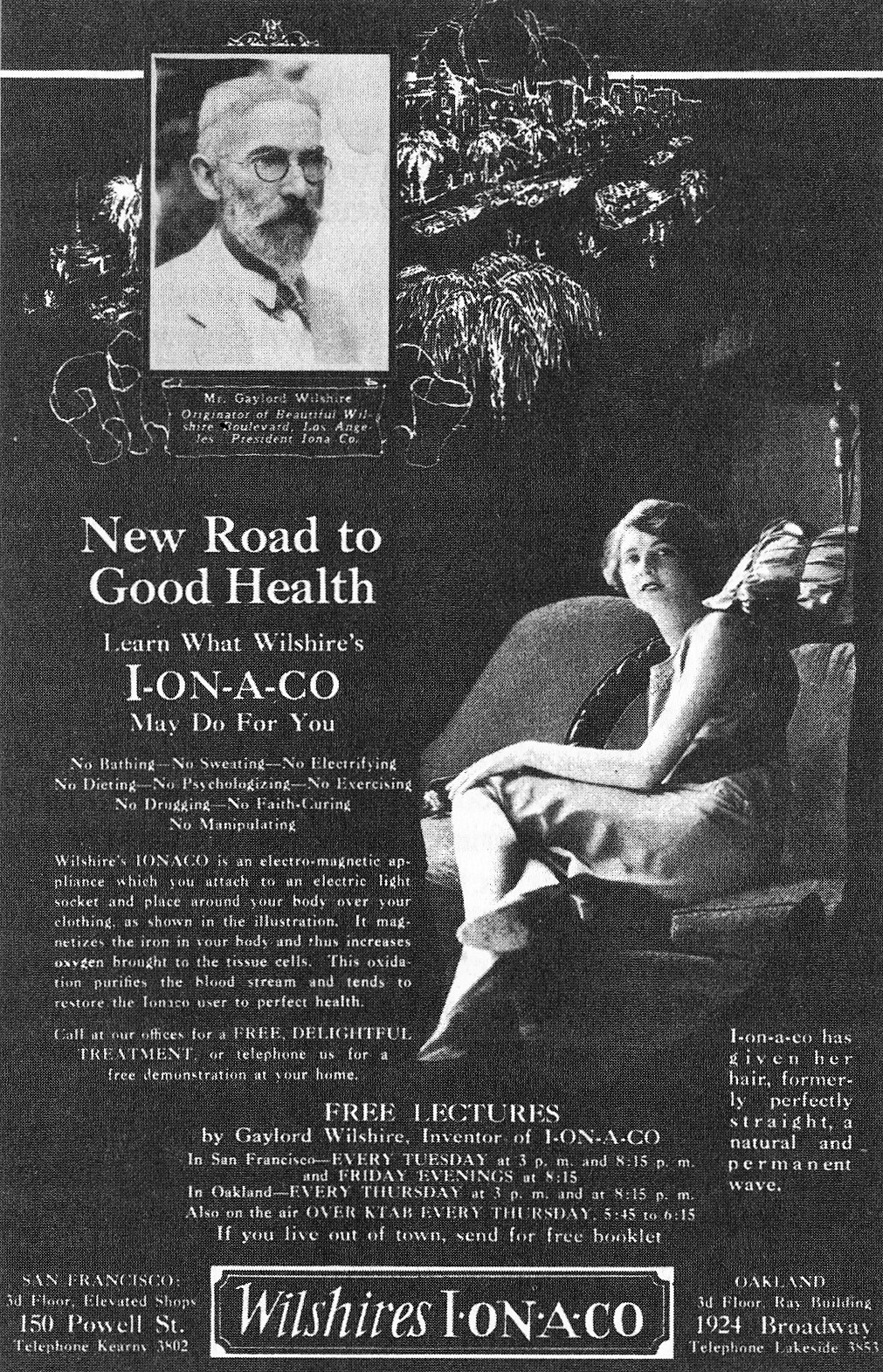
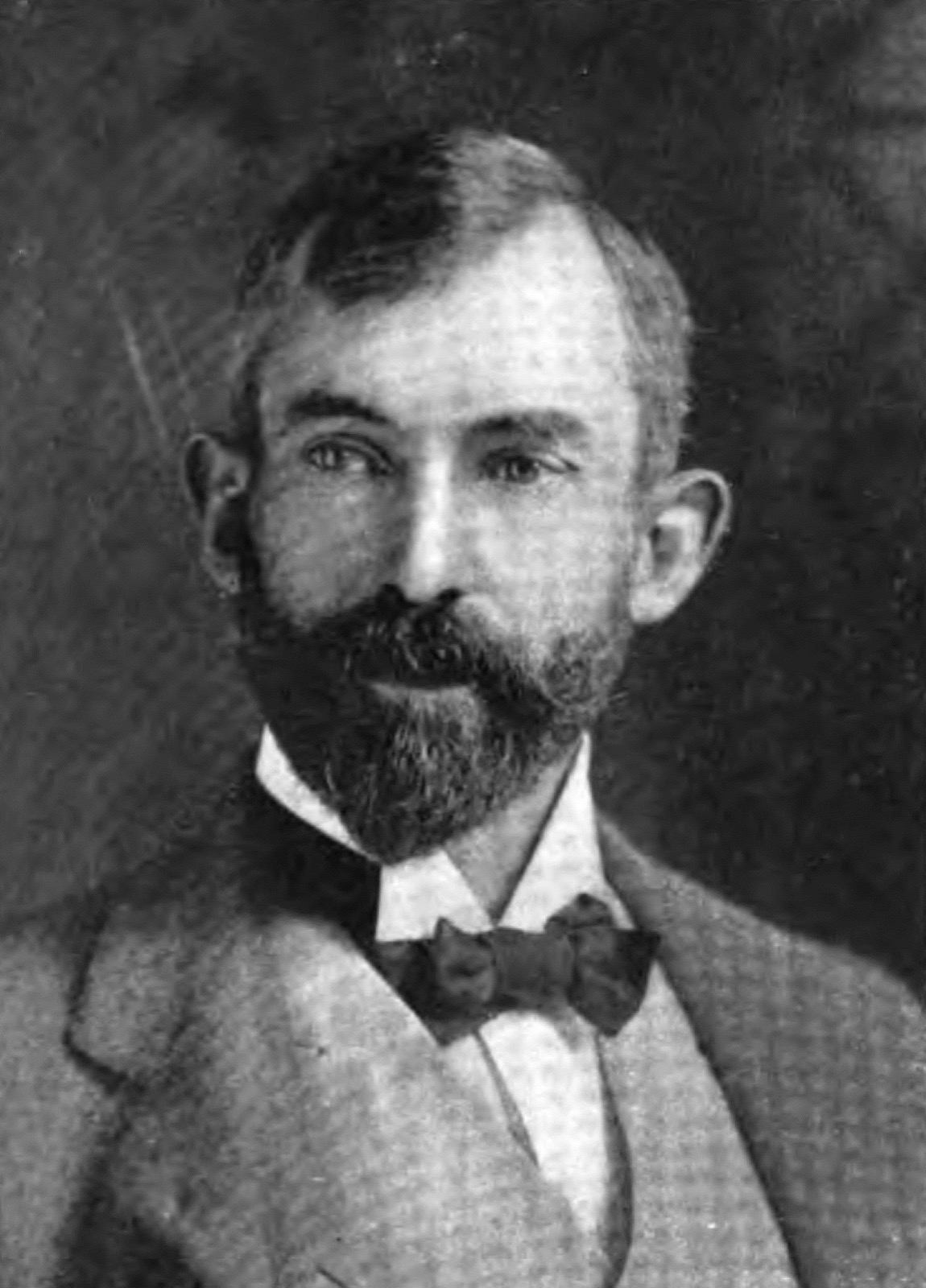
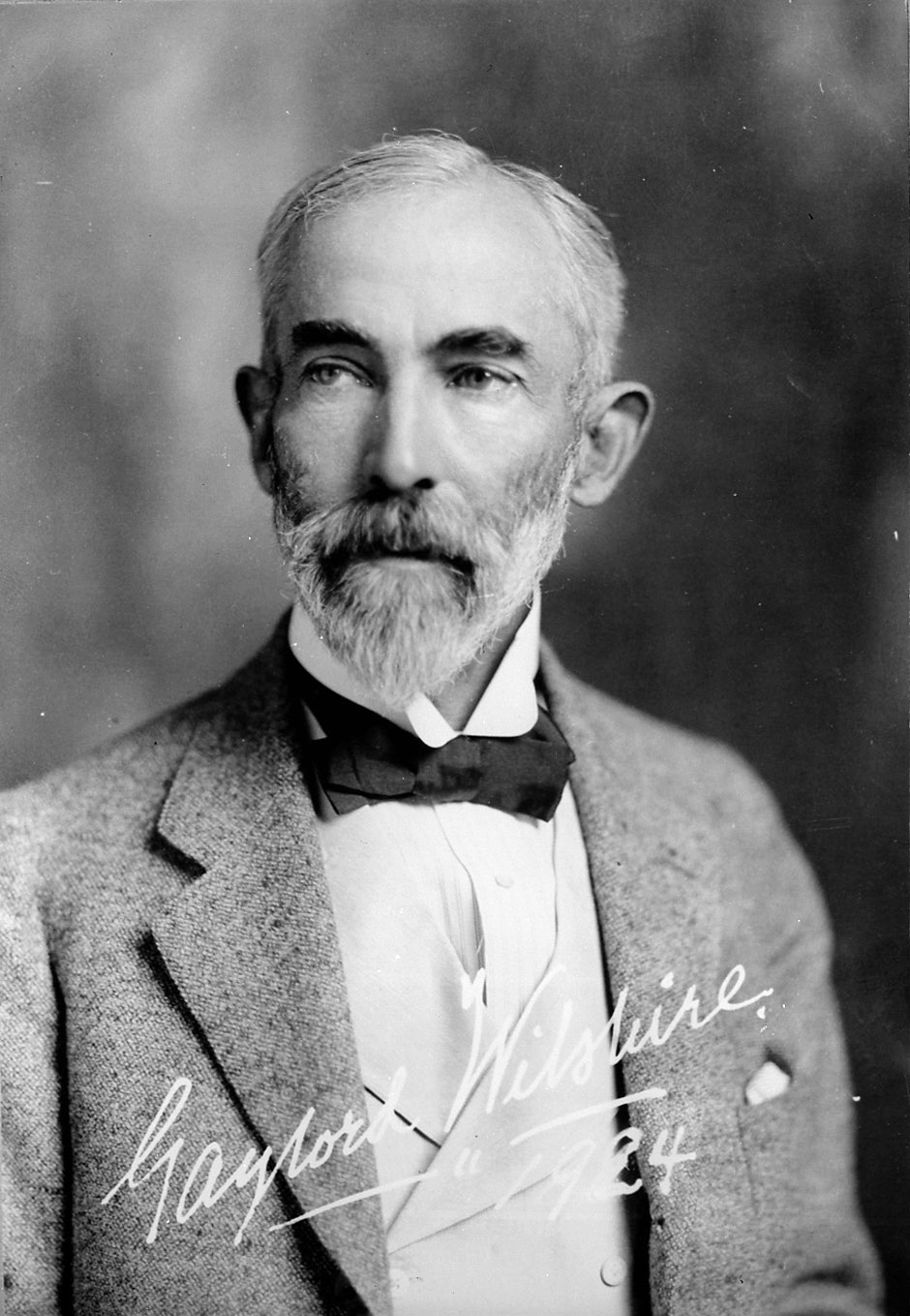
His advertising introduced him as ‘Originator of Beautiful Wilshire Boulevard, Los Angeles’ and ‘Inventor of I-ON-A-CO’ — a developer’s name and a healer’s claim in one breath. Henry Gaylord Wilshire (1861 to 1927) was a real-estate developer, publisher, and well-known socialist, not a physician. Jesse La Tour’s 2024 Fullerton Observer profile records that Wilshire and his brother speculated in Southern California real estate, that Wilshire Boulevard is named for the Wilshire brothers, and that he was a prominent socialist who published his own magazine. He brought the device to the public not through clinical channels but through extensive press announcements, free public lectures he delivered himself, and radio talks. Morris Fishbein, editor of the Journal of the American Medical Association, summarized the figure in his 1932 Fads and Quackery in Healing by characterizing Wilshire as a charlatan and noting that twenty-five years earlier he had first attracted notice selling gold mines to socialists on time payments. The authority projected was that of the famous-name inventor with a branded appliance, not a medical credential.
A free treatment at the office, then a coil for the home
Access was a branded consumer appliance sold and demonstrated directly to the public, bypassing the medical profession. The I-ON-A-CO was offered from company offices (in San Francisco at 150 Powell Street and in Oakland at 1924 Broadway, per the device’s own advertising) with the inducement of a ‘free, delightful treatment’ on the premises or a free demonstration at home, and a free booklet by mail for out-of-town buyers. Wilshire lectured on the device in person on a fixed weekly schedule and broadcast over radio station KTAB. The belt itself was a self-applied home appliance: the buyer plugged it into an electric-light socket and wore it around the body over the clothing. This is the same direct-to-consumer, doctor-bypassing retail logic seen in Otto Overbeck’s contemporaneous Rejuvenator and, earlier, in Perkins’s metallic tractors, here built around a famous promoter’s name and a network of demonstration offices.
Magnetizing iron that cannot be magnetized
The proposed mechanism borrowed the vocabulary of electromagnetism without its physics. The I-ON-A-CO was a coil of insulated wire connected to the household current; the advertising explained that it ‘magnetizes the iron in your body and thus increases oxygen brought to the tissue cells,’ so that ‘this oxidation purifies the blood-stream and tends to restore the Ionaco user to perfect health.’ Fishbein recorded the same pitch in 1932: that a magnetic field ‘controlled all disease by magnetizing the iron in the blood,’ and that the wearer was told he might be rid of any chronic disorder simply by placing the device around the neck and turning on the current. The claim has no physiological basis. The iron in the blood is organically combined within the haemoglobin molecule, not free metallic iron, and is not meaningfully magnetizable; even if it were, magnetizing it would not relieve tuberculosis, heart disease, or kidney disease. Arthur J. Cramp, director of the American Medical Association’s Bureau of Investigation, examined the apparatus and rechristened it the ‘magic horse collar.’
Inventor, president, and pitchman in one man
Wilshire was at once the named inventor of the device, the president of the Iona Company that sold it, and its public lecturer and pitchman. Fishbein records that the belts were sold for $55 cash or $65 on time payments and that thousands of them were sold by these methods of promotion. What the sources support is the concentration of inventor, company head, and promoter in one person, and a direct-to-consumer model (offices, home demonstrations, lectures, radio, mail-order booklets) that monetized a low-cost electrical appliance while bypassing the professional scrutiny a prescribed treatment would have drawn. The sources support the concentration of roles and the direct sales model rather than any figure for net profit.
A coil of wire, and a death from kidney disease
The device was rejected by organized medicine and faded quickly. Arthur J. Cramp and the American Medical Association analyzed the I-ON-A-CO and dismissed it as quackery, and the apparatus, on examination, proved to be nothing more than a coil of wire incapable of the effects advertised. No controlled outcome data were ever produced; the evidence offered was testimonial, gathered for advertising. Fishbein records that Gaylord Wilshire died of kidney disease in a New York hospital shortly after launching the device, in 1927, ‘no doubt without the benefit of his own invention,’ and that imitators followed his death. Imitative belts (sold under names such as the Theronoid) carried the same idea into the 1930s. The magnetic-cure and perfect-health claims are refuted.
The pattern repeats
The same structural machinery appears in different treatments and eras. These cases show the claimed mechanism and how the claim met evidence.
Overbeck's Rejuvenator
Electronic Reactions of Abrams (ERA)
Perkins Metallic Tractors
Part of the lineage
External references
Evidence · 5 sources
- Fads and Quackery in Healing (Wilshire's Ionaco, pp. 153-154) (1932)
- A historical perspective of the popular use of electric and magnetic therapy (2001)
- Henry Gaylord Wilshire: The Millionaire Socialist (2024)
- Advertisement for Wilshire's I-ON-A-CO (c. 1924-1927) (1926)
- Gaylord Wilshire, 1924 (studio portrait) (1924)