Jackson's Psycho Hygienic Method (Our Home on the Hillside water cure)
James Caleb Jackson turned a failing New York spa into a national health brand, invented the cereal credited as the first cold breakfast cereal as a lucrative sideline, and claimed his water-and-diet regimen -- given with no medicine at all -- cured tuberculosis. Robert Koch identified the actual tubercle bacillus in 1882, mid-run; no diet-only regimen cured consumption until antibiotics arrived six decades later. The institution outlived him but went bankrupt in 1914.
The abolitionist editor cured by cold water
In the mid-1840s, James Caleb Jackson was, by his own later account, at death’s door. He was in his mid-thirties, an active abolitionist and supporter of the early women’s rights movement (Berdan, 2015), and his health had broken down entirely (Dansville Public Library, “Castle on the Hill”; Dansville Area Historical Society). A water cure produced what he later described as a dramatic recovery, and Jackson — like James Manby Gully in England a few years earlier — became a convert who abandoned his old career for hydropathic medicine, training as a physician and running a water cure of his own at Glen Haven, on Skaneateles Lake, before moving to Dansville, Livingston County, in 1858. A water-cure spa there, built around a mineral spring reputed to have curative properties, had already failed under a string of owners since 1854; in October 1858, Jackson bought it, renamed it “Our Home on the Hillside,” and, over the following three decades, built it into one of the most successful and nationally recognized health resorts in the country, eventually treating patients by the thousands (Dansville Public Library; Berdan, 2015; Dansville Area Historical Society). He was joined in the work by his wife, Lucretia Jackson, and by his adopted daughter, Dr. Harriet N. Austin, a hydropathic physician trained under R. T. Trall who became a documented practitioner at the institution and a national figure in women’s dress reform in her own right (Library of Congress Name Authority File).
Boarding at the Hillside
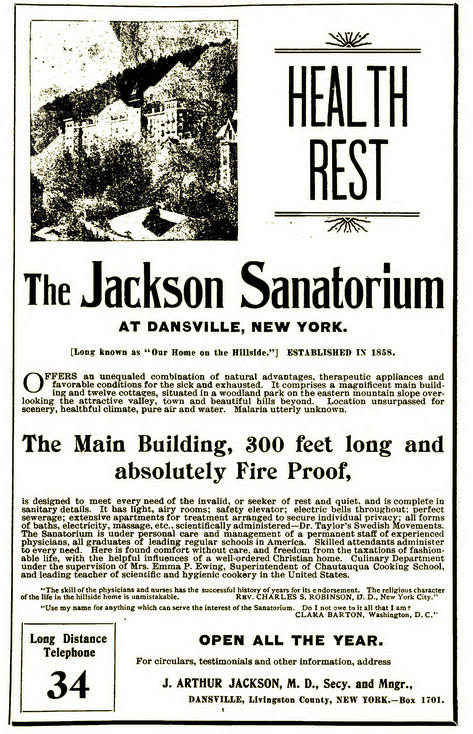
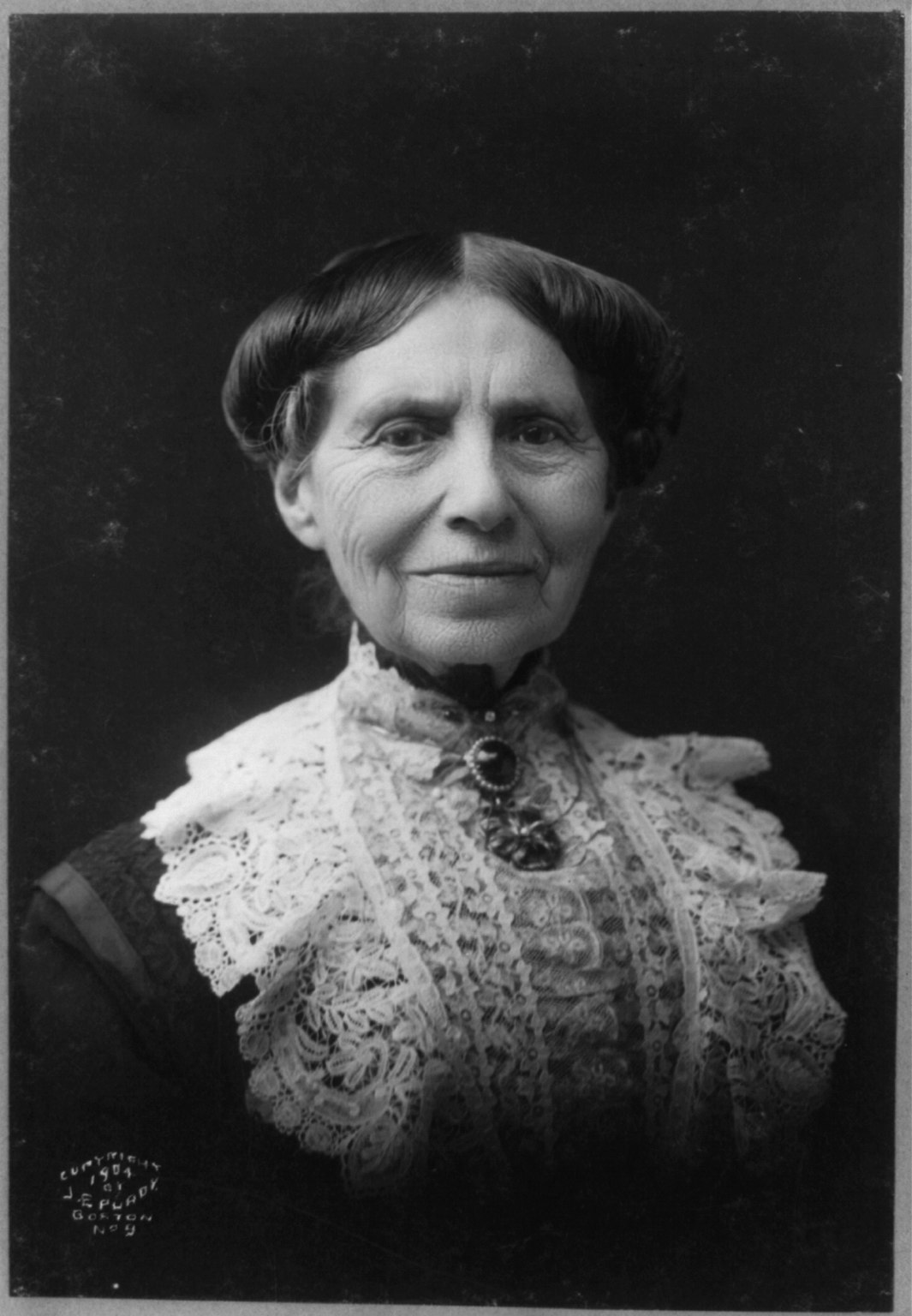
Our Home on the Hillside was not a clinic to visit; like Gully’s Malvern establishments, it was a residence to move into. By the time the rebuilt institution issued its 1890 promotional booklet — by then renamed the Jackson Sanatorium after a fire had destroyed the original wood-frame building in 1882 — the published weekly rates ran $16 to $35 in the main building and $14 to $35 in the cottages, each figure covering board and “the usual medical supervision and care”; a patient who wanted the treatment without a room could still board for $12 a week (Jackson Sanatorium promotional booklet, 1890). Among the residents was Clara Barton, the Civil War nurse and future founder of the American Red Cross, who arrived in 1873 “once again exhausted and in need of rest” and went on to keep a residence in Dansville for roughly a decade, chartering the Red Cross’s first local chapter there in 1881 with the backing of “members of the Jackson family, proprietors of the sanatorium” (Dansville Public Library, “Clara Barton in Dansville”). By 1890 the institution’s own advertising was putting her name to work: the promotional booklet carried a testimonial attributed to Barton (Jackson Sanatorium promotional booklet, 1890). A local chamber-of-commerce history separately records that the resort drew notable visitors including Frederick Douglass and Susan B. Anthony to Dansville in this period, though the sources in this bundle do not establish that either visited specifically as a patient rather than as a guest of the town’s broader abolitionist and reform circles that Jackson himself belonged to (Dansville Area Chamber of Commerce).
The Psycho Hygienic method: no drugs, ever
Jackson called his system the “Psycho Hygienic” method. Its foundational rule was total: patients received water applied externally and taken internally, a strict diet excluding meat, sugar, coffee, tea, alcohol, and tobacco in favor of fruits, vegetables, and unprocessed whole grain, daily exercise, fresh air, rest, and encouraging social and religious influences — and no medicine of any kind (Berdan, 2015). Around 1863 Jackson added a specific dietary invention to the regimen: a baked, crushed graham-flour cereal he named Granula, whose trademark he secured in 1876 (William G. Pomeroy Foundation historic marker). His 1870 book, The Gluttony Plague, and its advertising back matter went further than a general hygienic philosophy. They claimed that no disease the human body is subject to had proved incurable under Psycho Hygienic treatment, and named pulmonary consumption — tuberculosis, then among the leading causes of death in the United States — specifically among the diseases his drug-free method could cure where “ordinary” medication could not, pointing to the large population of consumptive Americans as a claimed beneficiary pool. The evidence offered for all of it was Jackson’s own patient volume and testimonial, not a controlled study of any kind.
A publisher, a cereal maker, and a physician, all the same man
Jackson’s Psycho Hygienic philosophy did not merely direct patients away from drugs; it directed money toward Jackson’s own ventures. The residential fees at Our Home on the Hillside, and later the Jackson Sanatorium, ran to real money for a period stay — by 1890, $14 to $35 a week — collected under Jackson family medical supervision. Jackson’s books explaining and promoting the method, including The Gluttony Plague and How to Treat the Sick Without Medicine, were published and sold through Austin, Jackson & Co., a firm bearing his and his daughter Harriet Austin’s names. And the Granula cereal he invented for the institution’s kitchens became a standalone commercial product: the Our Home Granula Company manufactured and sold it into at least the 1920s (William G. Pomeroy Foundation historic marker). That company’s trademark proved as consequential as its product line: when Dr. John Harvey Kellogg began marketing a similarly named cereal at his own Battle Creek Sanitarium, Jackson’s trademark claim on “Granula” forced Kellogg to rename his product “Granola” — the name the entire modern breakfast-cereal industry still uses (William G. Pomeroy Foundation historic marker). Jackson was not the only one who drew income from the enterprise: his adopted daughter Harriet Austin was a documented practitioner there, and a local-library source records the wider Jackson family, including his wife and later his son and daughter-in-law, as proprietors of the sanatorium. But it was Jackson’s name on the books, Jackson’s name on the cereal trademark, and Jackson’s medical authority behind the publishing and cereal ventures specifically.
What medicine learned while Jackson was still treating patients
Jackson was still actively directing patients at Dansville when, on the evening of 24 March 1882, the German bacteriologist Robert Koch announced to the Berlin Physiological Society his identification of the bacterium that causes tuberculosis — work for which he later received the 1905 Nobel Prize (Armocida & Martini, 2020). That single discovery cut against the specific claim Jackson had been advertising since 1870: that consumption was curable by hygienic living alone, with no medicine at all. It was not. A 2020 peer-reviewed history-of-medicine assessment records that the hygiene-diet-rest regimen general medicine itself used against tuberculosis for decades afterward — isolation, fresh air, exercise, and good nutrition, indistinguishable in kind from Jackson’s own Psycho Hygienic method — offered symptomatic support rather than cure for serious cases, and that no effective drug treatment existed until streptomycin’s introduction in 1943-44, well over half a century after Jackson made his claim (Armocida & Martini, 2020).
Unlike Gully, whose standing collapsed in the Bravo inquest scandal, Jackson stepped back from daily operation in the late 1870s, watched the original wooden building burn in 1882, saw his son and daughter-in-law reopen a larger fireproof brick Jackson Sanatorium in 1883, and died in 1895. What disconfirmed the underlying claim was not scandal but the slower verdict of medical science. Katherine Berdan’s 2015 academic study attributes the water cure’s eventual obsolescence to the era’s “medical advances” in favor of “conventional medicine”; a local chamber-of-commerce history states plainly that the Jackson Health Resort declared bankruptcy in 1914, “citing advances in the medical field yielding the water cure obsolete.” Susan Cayleff’s academic history of the broader water-cure movement records that orthodox medicine had already come to view hydropathy generally as a “crackpot therapeutic” well before that collapse, though she attributes much of the movement’s marginalization to its association with nineteenth-century social reform rather than treating it as a pure verdict on medical merit. The Dansville building outlived the water cure that built it: after service as a World War I veterans’ psychiatric hospital, it reopened in 1929 as physical-culture publisher Bernarr Macfadden’s “Castle on the Hill,” and did not close its doors for good until 1971 (Dansville Public Library).
The pattern repeats
The same structural machinery appears in different treatments and eras. These cases show the claimed mechanism and how the claim met evidence.
Gully's Water Cure (Malvern hydropathy)
Biologic living (the Battle Creek Idea)
Kneipp Cure (hydrotherapy, herbalism, and the 'five pillars')
Part of the lineage
External references
Evidence · 15 sources
- The Gluttony Plague; or, How Persons Kill Themselves by Eating (1870)
- The Jackson Sanatorium: The Best Appointed Health Institution in America. Built of Brick and Iron and Absolutely Fire Proof. (1890)
- The House on The Hill: A Spatial Study of Visitors to the Jackson Sanatorium, 1858-1914 (2015)
- Wash and Be Healed: The Water-Cure Movement and Women's Health (1991)
- Castle on the Hill (2016)
- Clara Barton in Dansville (2016)
- The History of Healthcare in Dansville (2024)
- Historic Marker: Granula (2026)
- Austin, Harriet N. (Library of Congress Name Authority File) (2010)
- Clara Barton, head-and-shoulders portrait, facing front (1904)
- Jackson Sanatorium, Dansville, NY (Polk's Medical Register, 1898) (1898)
- James C. Jackson (2022)
- Tuberculosis: a timeless challenge for medicine (2020)
- Hydropathy in England 1840-70 (1981)
- Unternehmensgeschichte (Company History) (2026)