Immortal Cell Culture (Carrel's Chick-Heart Experiment)
In 1912 the Nobel laureate Alexis Carrel placed a chick-heart fragment in a flask and declared it proof that cells never die. The press reported its birthday for thirty-four years. It was an artifact: the extract Carrel fed it reseeded the flask with fresh cells, no other laboratory could reproduce it, and Hayflick and Moorhead showed in 1961 that normal cells divide only a finite number of times.
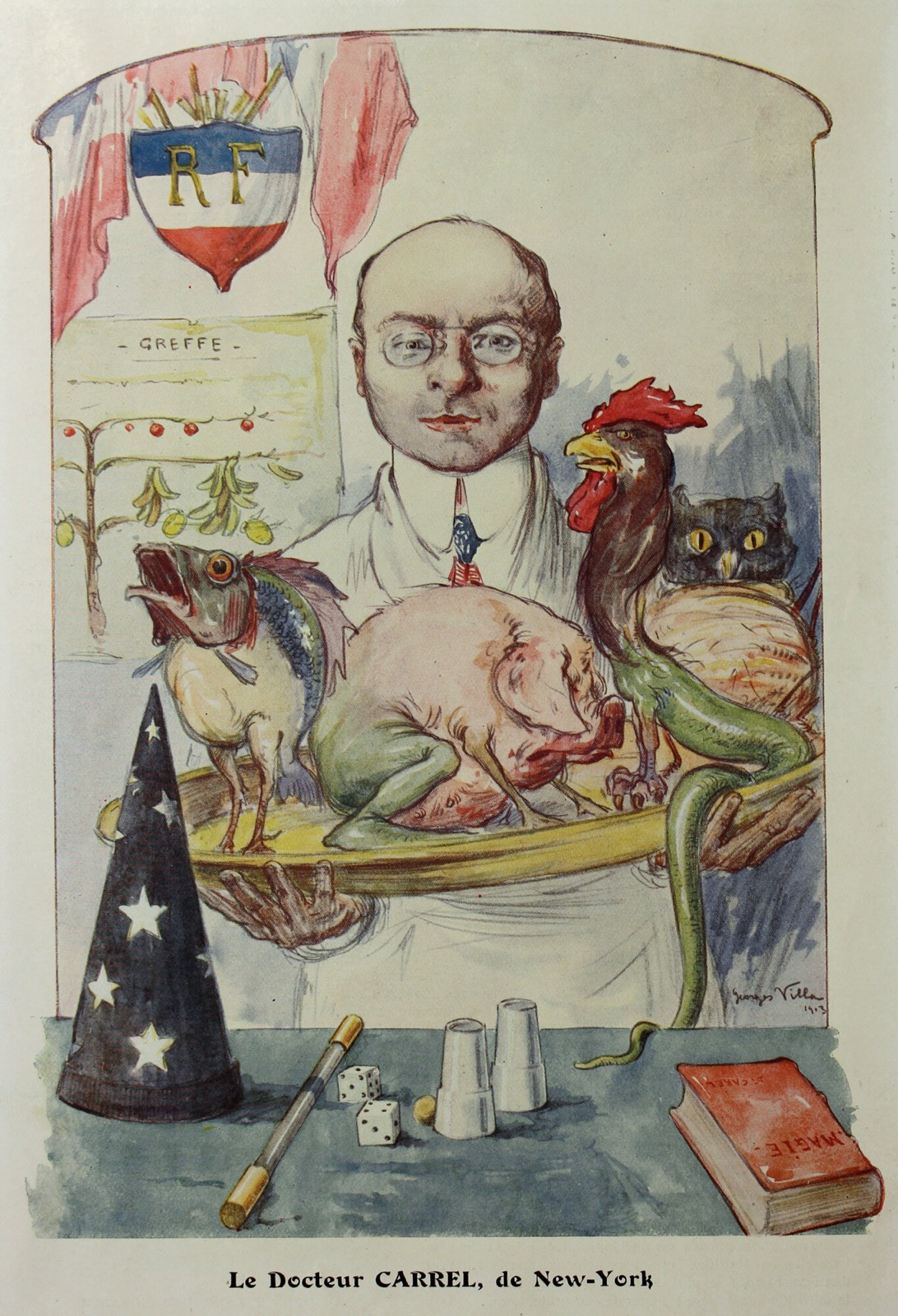
The man whose name kept it alive
On 17 January 1912, Alexis Carrel cut a fragment from the heart of a chick embryo, dropped it into a flask at the Rockefeller Institute, and began what newspapers would spend the next thirty-four years calling immortal. That December he collected the Nobel Prize in Physiology or Medicine. He was 39 years old, the first surgeon to win it, the first recipient whose Nobel work had been conducted in the United States, and the youngest laureate to that date. The prize was for vascular anastomosis, the fine suture techniques that would later make organ transplantation possible, a skill he traced to needlework learned from a Lyon lacemaker while he was still a medical student (Vernon 2019, PMID 31249090).
His fame kept growing. In the early 1930s the aviator Charles Lindbergh, looking for help for a relative with a defective heart valve, came to him at Rockefeller. Over several years the two built a glass perfusion pump that held isolated organs in a sterile, oxygenated stream; in public demonstrations in 1935 a cat thyroid stayed viable for 30 days and a cat heart kept beating for 12 hours outside any body. The work drew heavy press and put Carrel on the cover of Time (Vernon 2019, PMID 31249090).
That standing was not decoration. It was the experiment’s life support. No outsider could check the culture’s age. You had to trust that the flask shown to a visiting reporter in 1940 held the same lineage begun in 1912, and that the yearly growth was real cell division rather than reseeding. Only a Nobel laureate, a Rockefeller scientist, and Lindbergh’s partner could keep a result no one else could reproduce credible for thirty-four years.
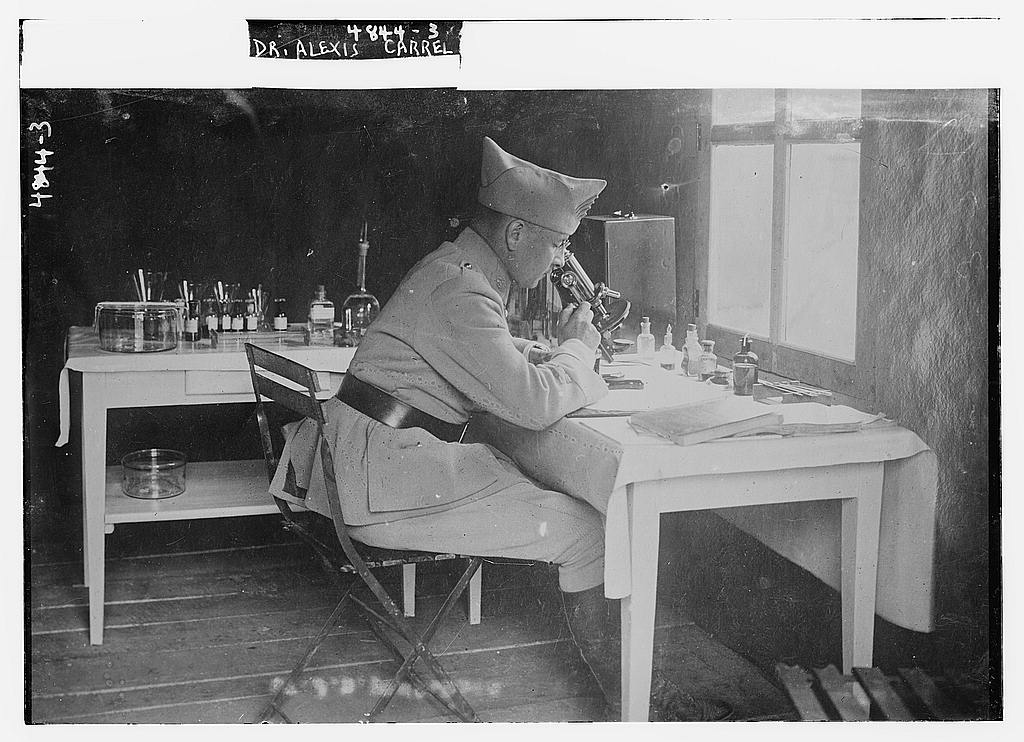
One flask, one laboratory, one keeper
The culture had a name: strain number 725. Carrel kept it himself, in his laboratory, and nowhere else. Every 17 January its “birthday” was marked in the press, and reporters who came to the Rockefeller Institute were shown the flask. The result sat in a strange position: publicly attested, its anniversary in the newspapers, yet open to no independent observer with the training to test what was actually in the glass (Witkowski 1979, PMID 395375).
Other laboratories tried to reproduce the core claim, an indefinitely growing culture of normal, non-cancerous bird tissue. None succeeded (Witkowski 1979, PMID 395375). Carrel put the failures down to the difficulty of his laboratory’s sterile technique. Critics noticed that the difficulty conveniently kept every confirming observation inside one laboratory, under one man.
That arrangement switched off the part of science that catches mistakes. A finding held by a single famous investigator, impossible to reproduce anywhere else, could run for decades without ever facing replication. The exclusivity was the claim’s real preservative. Had the flask been opened to rivals, the feeding error would have surfaced far sooner.
Why the cells supposedly never died
Carrel’s explanation was that the cell is naturally immortal, and that what ages and dies is not the cell but the fluid around it: the body’s “internal milieu” of plasma, lymph, and tissue fluid. Free a cell from that decaying fluid, give it fresh nutrient, and it would live without limit. The flask, he said, was the proof.
None of this was ever put in testable form. “Internal milieu” was a label, not a measured quantity. “Degeneration” was assumed, not counted. Nothing connected what cells did in a flask to what they do in a body, and nothing connected a chicken-heart culture to human lifespan except assertion. In Man the Unknown (1935) Carrel pushed the idea further: human longevity, he wrote, was a question of maintaining the biological quality of the population, which made eugenic selection the practical route to a longer life. With each step the mechanism grew larger and harder to test, until it predicted nothing beyond itself (Witkowski 1979, PMID 395375; Witkowski 1980, PMID 6990125).
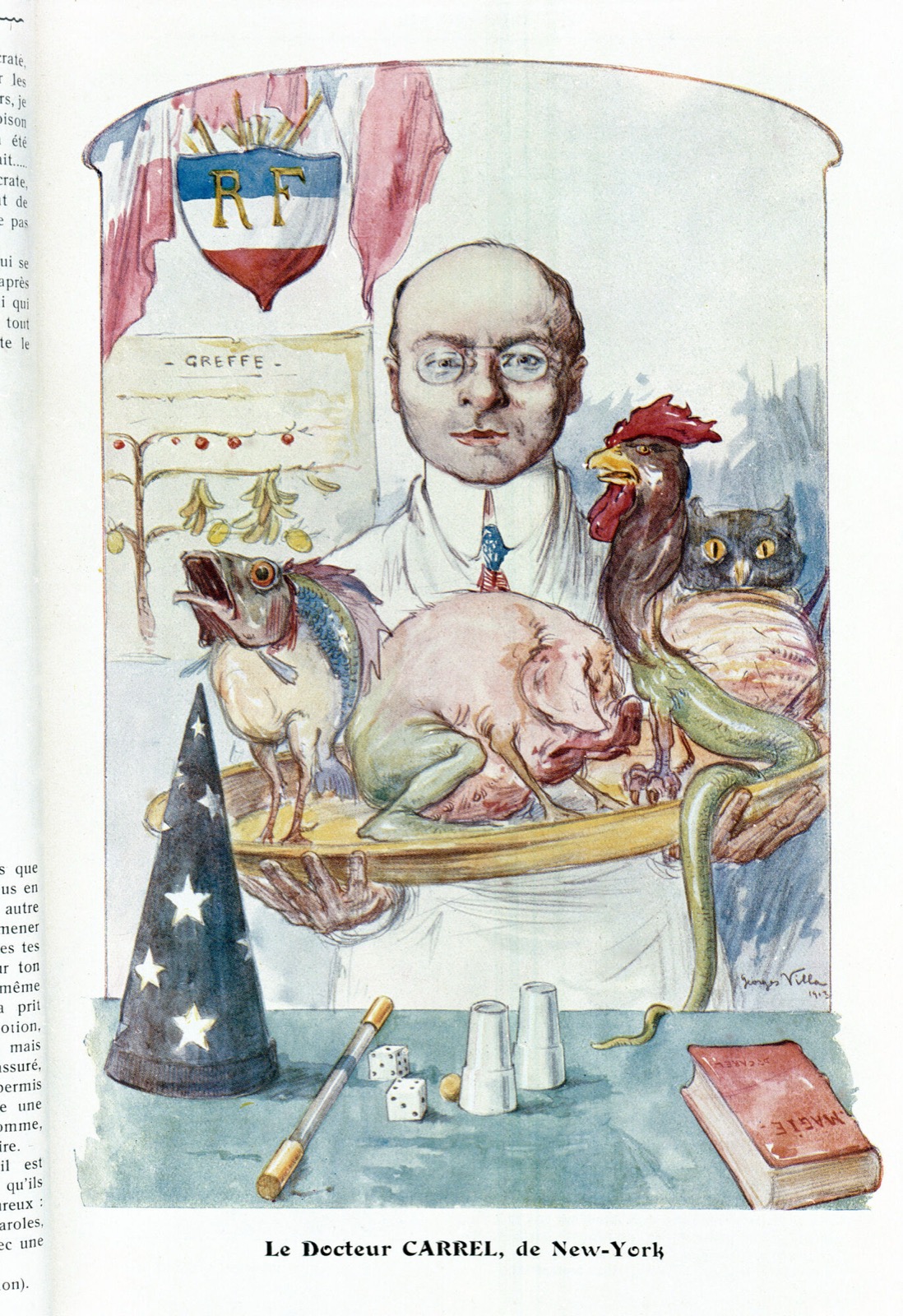
What the immortal culture was worth to him
No patient ever bought anything here. There was no tonic, no clinic, no fee. The stakes were of a different kind, and there were three.
First, the culture was Carrel’s flagship. As the man who kept it, his scientific authority and the flask’s reputation rose and fell together. Conceding that the culture might be contaminated, or that its long life came from the nutrient rather than the cells, would have undone three decades of public claims he had built his name on (Witkowski 1980, PMID 6990125).
Second, Man the Unknown (Harper & Brothers, 1935) was a commercial bestseller, translated across Europe and the United States, and Carrel wrote it. The book sold on the scientific authority he had accumulated, and it presented his case for longevity through eugenics as flowing from laboratory discovery, the immortal culture chief among them. A popular book earning royalties gave him a direct financial stake in that authority (Vernon 2019, PMID 31249090).
Third, after Rockefeller required his retirement at 65 in 1938, Carrel returned to France. In 1941 the Vichy government funded him to found and lead the Fondation pour l’Étude des Problèmes Humains in occupied Paris. As its Régent he drew a salary and state backing for a research program that carried the arguments of Man the Unknown into social policy; the post rested on his standing as a Nobel laureate (Vernon 2019, PMID 31249090).
The mistake in the feeding
The claim came apart over three decades, along three lines of evidence.
The first was the silence of every other laboratory. Witkowski (1979, PMID 395375) went back through the record and found no confirmed independent reproduction of a genuinely deathless culture of normal bird tissue. The failures, set against the special difficulty Carrel claimed for his technique, were what sent Witkowski looking for an explanation.
The second was the most damaging, and it explained the rest. To feed the culture, Carrel’s team made an extract by pressing whole chick embryos and added it to the flask. Witkowski (1980, PMID 6990125) showed that this extract almost certainly carried living chick cells. Every feeding, then, introduced fresh young cells. The culture was not one lineage refusing to die for thirty-four years; it was being quietly restocked, able to grow on forever precisely because nothing in it actually persisted. The error was almost certainly innocent. Carrel’s team was not faking the result; they were being fooled by their own recipe.
The third closed the door on the theory. Hayflick and Moorhead (1961, PMID 13905658) grew normal human cells through many passages and found they stopped dividing after roughly 40 to 60 doublings, then entered a permanent arrest. This limit, now called the Hayflick limit, held no matter how rich the medium. In 1965 (PMID 14315085) Hayflick mixed young and old cells in one shared medium and showed each aged on its own schedule, not the medium’s. Aging was inside the cell, not in the fluid around it: the exact reverse of Carrel’s claim.
Carrel died in November 1944, regarded at the Liberation of Paris as a Vichy collaborator and under an investigation he did not live to answer. His culture was thrown out about two years later, in 1946. For thirty-four years a Nobel laureate’s name, a bestselling book, and a state-funded institute had kept alive a result that rested on cells carried into the flask with its food (Witkowski 1980, PMID 6990125; Vernon 2019, PMID 31249090).
The pattern repeats
The same structural machinery appears in different treatments and eras. These cases show the claimed mechanism and how the claim met evidence.
Brown-Séquard testicular extract (organotherapy)
Steinach Vasoligation (Steinach Operation)
Voronoff testicular xenograft (chimpanzee-to-human)
Part of the lineage
Evidence · 7 sources
- On the permanent life of tissues outside of the organism (1912)
- Man the Unknown (1935)
- Alexis Carrel and the mysticism of tissue culture (1979)
- Dr. Carrel's immortal cells (1980)
- The serial cultivation of human diploid cell strains (1961)
- The limited in vitro lifetime of human diploid cell strains (1965)
- Alexis Carrel: 'father of transplant surgery' and supporter of eugenics (2019)