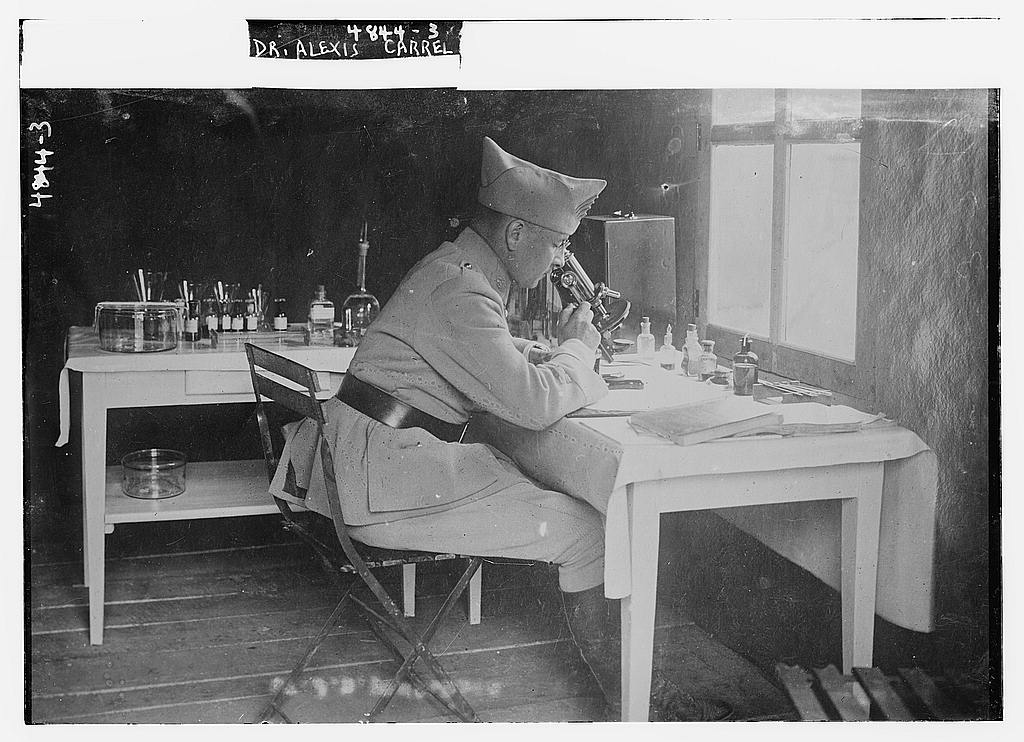
Alexis Carrel
Alexis Carrel (28 June 1873 – 5 November 1944) was a French-born surgeon and biologist who spent the bulk of his career at the Rockefeller Institute for Medical Research in New York. He trained as a physician in Lyon and learned fine embroidery technique from a local craftswoman, which he applied to the development of precise vascular suture methods. These methods allowed him to perform successful vessel anastomosis in animals and proved foundational for organ transplantation surgery. For this work he was awarded the Nobel Prize in Physiology or Medicine in 1912 — the youngest laureate to that date, the first surgeon, and the first whose Nobel research had been conducted in the United States (Vernon 2019, PMID 31249090).
At the Rockefeller Institute, Carrel developed and popularized tissue culture, the technique of maintaining living cells outside the body in nutrient medium. On 17 January 1912 he established a series of chick-embryo heart cultures in his laboratory; one of these, culture number 725, allegedly continued to grow for more than 34 years, reaching its annual newspaper “birthday” notices and becoming the most famous laboratory object of the early twentieth century. Carrel maintained that the culture demonstrated cellular immortality — that cells freed from the body’s degenerating internal fluid could live indefinitely — and built an elaborate public argument for human longevity from this premise.
In the early 1930s Carrel collaborated with the aviator Charles Lindbergh, who had approached him seeking a device to keep a defective heart valve functioning outside the body. Together they developed an organ-perfusion pump, a glass bioreactor that sustained isolated organs in a nutrient-bathed circuit; with this device they kept a cat thyroid viable for 30 days and a cat heart perfusing for 12 hours (Vernon 2019, PMID 31249090). The collaboration received enormous press attention and reinforced Carrel’s public image as a scientist on the threshold of mastering life itself.
Carrel’s 1935 book Man the Unknown argued that the “vital principle” in cells makes them immortal when freed from the body, and that a eugenics program could maintain the biological conditions for human health and longevity. The book’s proposals extended to harsh interventions for the biologically unfit, including the institutional euthanasia of the most dangerous criminals (Vernon 2019, PMID 31249090). The book appeared in multiple translations and brought Carrel mass public attention beyond his scientific audience.
When the Rockefeller Institute required his retirement at age 65 in 1938, Carrel returned to France. In 1941 he accepted a grant from Vichy France to found and lead the Fondation pour l’Étude des Problèmes Humains in occupied Paris. The foundation pursued eugenic and social-policy research under the Pétain regime. At the Liberation in 1944 Carrel was widely regarded as a collaborator; he died on 5 November 1944, before facing charges (Vernon 2019, PMID 31249090). The chick-heart culture was terminated approximately two years after his death, in 1946.