Dr. Kilmer's Swamp Root
In 1878 a Binghamton doctor bottled 'Swamp Root' as a cure for kidney, liver, and bladder disease, Bright's disease, and diabetes; by 1892 his own brother had bought him out, and the business kept his face on the label for decades after. Analysis found mostly sugar, water, and alcohol. Samuel Hopkins Adams called it 'purely fraudulent' in 1912; a federal misbranding case ended not in prosecution but in a softened label.
The face that outlived the doctor
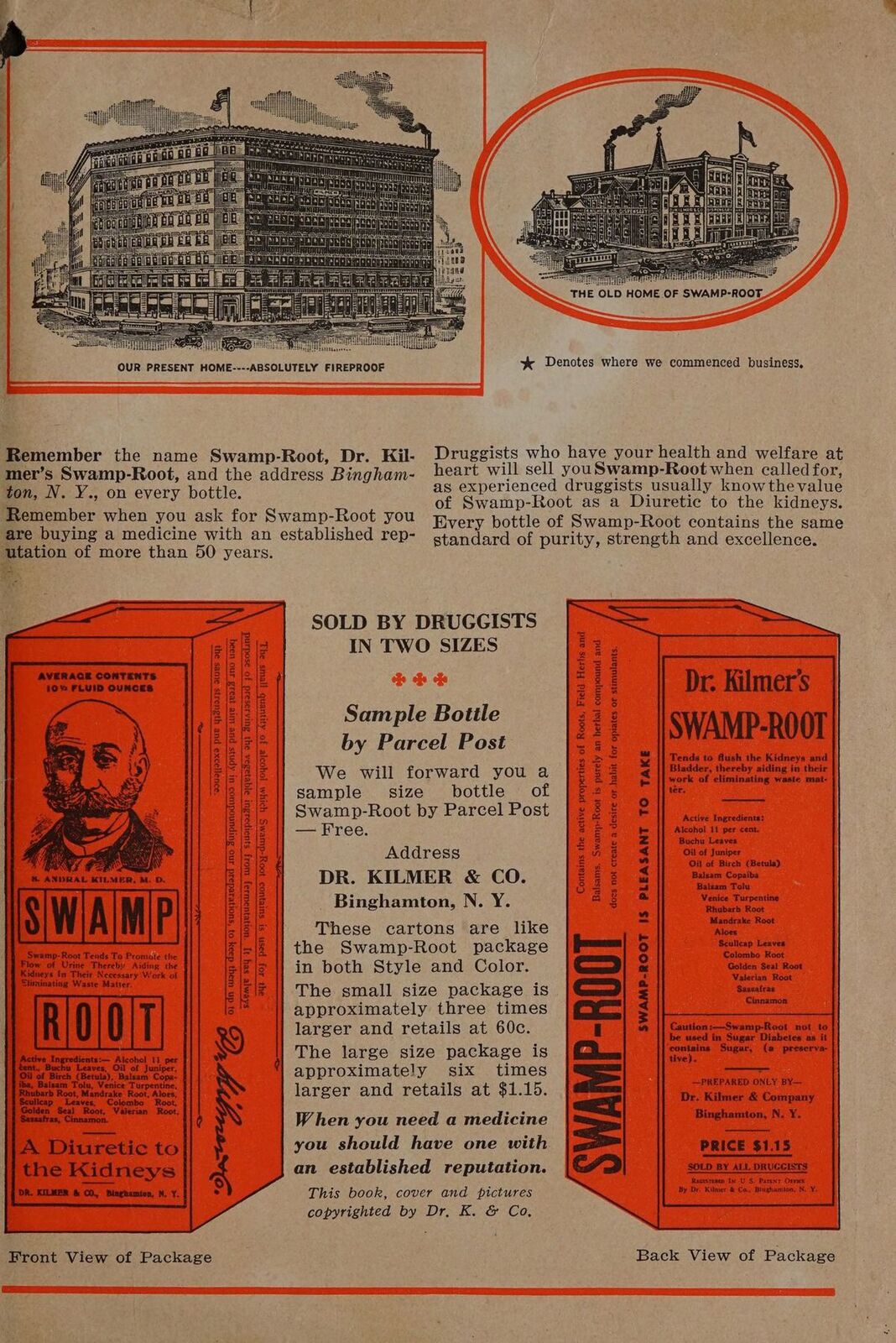
A mild, bewhiskered portrait, printed under the words “S. ANDRAL KILMER, M.D.,” sold the same promise — a cure for kidney, liver, and bladder disease — for decades. Samuel Hopkins Adams reported in 1912 that the face appeared not just in the company’s literature but on the carton itself, twenty years after the man behind it had anything to do with the business; the 1940 retail carton still carried the same portrait, forty-eight years after that. Dr. Sylvester Andral Kilmer was born in Cobleskill, New York, in 1840 and developed the Swamp Root formula in Binghamton in 1878, building it into a regional patent-medicine business over the next fourteen years. In 1892 his brother, Jonas M. Kilmer, bought out Andral’s remaining interest, and Jonas’s son Willis Sharpe Kilmer, a recent Cornell graduate, took over the company’s marketing and advertising.
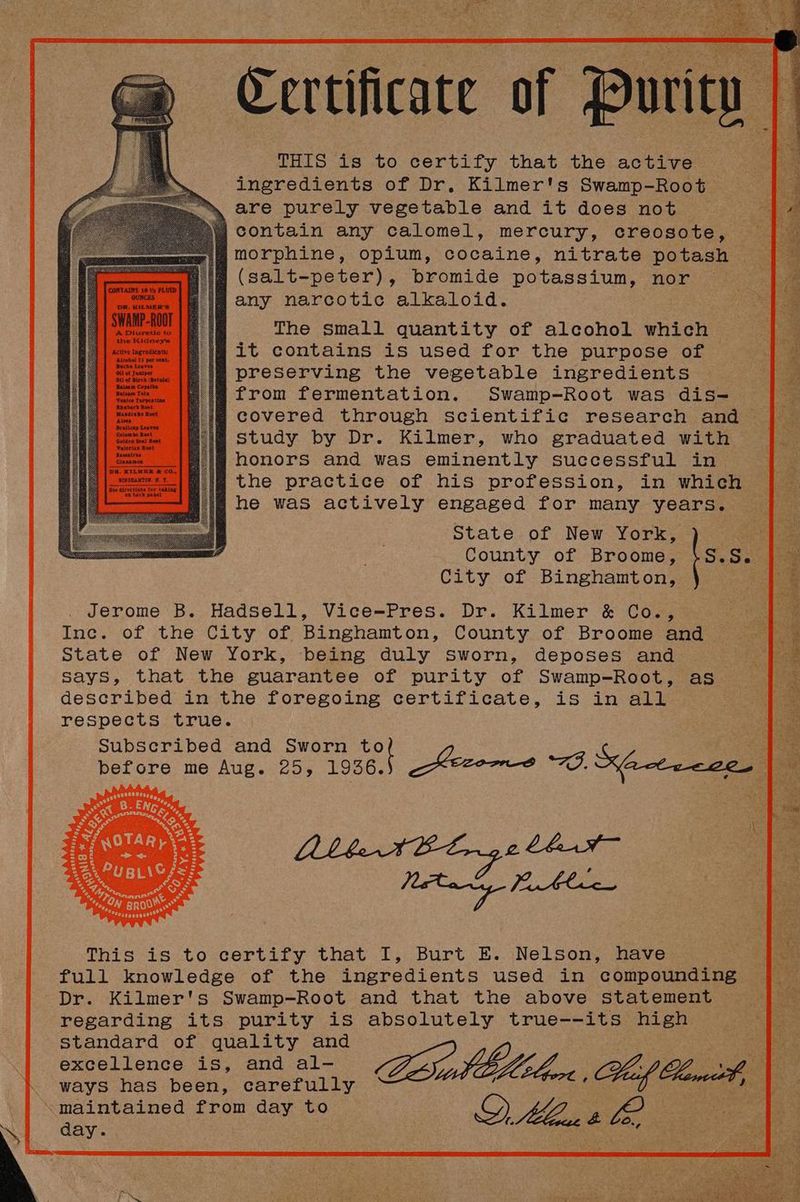
The doctor’s name and likeness stayed on the label for decades after that. Writing in Collier’s in 1912, muckraking journalist Samuel Hopkins Adams reported flatly that Dr. S. Andral Kilmer was still alive but had had no connection with Swamp Root or its affairs for many years — and quoted Kilmer’s own sworn complaint, part of one of two lawsuits he then had pending against “the other Kilmers,” charging that the company falsely held him out as “the duly licensed, qualified and acting physician in charge of” its “medical department.” The company’s own literature never caught up with that fact. A notarized “Certificate of Purity” it was still printing in 1936 — twelve years after Andral Kilmer’s 1924 death — credited him with discovering Swamp Root “through scientific research and study” and claimed he had long been successfully and actively engaged in the practice of his profession, without a word about his death or his thirty-two-year absence from the company. After the 1892 buyout, Kilmer went on to run a separate itinerant cancer clinic of his own, the “CanCertorium,” in Binghamton and other New York towns; Adams’s reporting on that later, different venture tracked seven of its patients through a personal acquaintance and found that five had died.
A dollar bottle, sold everywhere
Swamp Root was never exclusive. It was a mass-market commodity, sold through druggists nationwide and by mail, in bottles that retailed for 50 cents to $1.15 depending on size across the period documented here, with free samples offered by post. The company’s real innovation was in reach, not restriction: a mail-in “urine analysis” offer, whose circular told readers that letting a urine sample stand for twenty-four hours and watching for a sediment would reveal an unhealthy kidney condition, invited them to send in a sample and receive a diagnosis and a recommendation to buy the product. Adams reports that a U.S. Post Office inspector tested this directly, mailing weak tea and horse urine from different towns under assumed names; every sample came back with an “analysis” reporting a dangerous kidney condition. On inspecting the company’s Binghamton premises, the inspector found the “laboratory” was a single room where a young clerk — “not a qualified chemist” — worked through form letters. The scale of the business, not any barrier to entry, is what built the Kilmer family’s fortune: Adams describes their Binghamton houses as “the most expensive” in the city and their two office buildings as “the finest business blocks,” with the fortune from the business “variously estimated at from ten to fifteen millions, all accumulated in the last twenty years.”
Roots no one could name
The label promised “the active medicinal properties of Swamp Root, field Herbs, and Healing Balsams,” without naming a single plant or a dose. The same old label claimed to cure every kidney, liver, bladder, and uric-acid trouble, plus gravel, rheumatism, lumbago, and Bright’s disease. A 1936 company certificate does eventually name ingredients — buchu leaves, scullcap leaves, oil of juniper, oil of birch, valerian root, colombo root, rhubarb root, golden seal root, mandrake root, sassafras, aloes, balsam copaiba, cinnamon, and balsam tolu — but never in a stated dose, and never tied to any of the specific diseases advertised. What Adams’s 1912 analysis found instead was that the bottle was mostly alcohol, sugar, water, and flavoring matter with a slight laxative principle, he wrote, the label’s named ingredients present in such small amounts as to be practically negligible. He put the alcoholic strength at 9 percent, “about that of champagne”; a government-chemist analysis he quotes the same year found 8.55 percent alcohol by volume and 43.3 percent total solids, 42.6 percent of that sugar, plus wintergreen, juniper, and cardamom. Sugar, Adams notes, made up roughly a third of the bottle by itself.
The buyout that built an empire
The money in Swamp Root flowed to the family that bought out the doctor whose name sold it. After the 1892 buyout, Jonas M. Kilmer and his son Willis Sharpe Kilmer ran the business as “the leading industry” of Binghamton, in Adams’s words, drawing a fortune estimated at ten to fifteen million dollars over twenty years. They used part of that fortune to control how the business was covered: Adams wrote that, so far as he knew, “Swamp Root is the only patent medicine whose proprietors directly own a newspaper” — the Binghamton Press, which the Kilmers started, Adams says, because they could not otherwise control the local press. Willis Kilmer also worked the trade’s political muscle directly: a March 10, 1905 telegram he sent, signed “Willis Sharpe Kilmer, Adv. Agt.,” urged out-of-state newspapers carrying Swamp Root advertising to lobby against a pending Massachusetts patent-medicine labeling bill. Adams’s account of an earlier brush with federal prosecutors ties the newspaper directly to the outcome: a U.S. district attorney who had called the case against Swamp Root sound for criminal prosecution reversed himself, Adams reports, only after the Binghamton Press — mid-fight with the local political machine — suddenly stopped its attacks and the case quietly lapsed.
The chemists, the muckraker, and the vanishing prosecution
Swamp Root was disconfirmed on the chemist’s bench before it was ever tested in a courtroom. Adams interviewed a physician about the label’s specific promises: asked whether alcohol is given in kidney disease, the answer was “None that I know”; a physician who would give alcohol in kidney or bladder trouble was, in the same interview, “either a fool or a rascal”; for Bright’s disease, the prescribed dosage “would kill the patient before his time.” Told that sugar made up about a third of the bottle, the physician said the effect on a diabetic patient would be that “Malnutrition would follow, and the patient would waste away and die.” The regulatory record adds a second, independent disconfirmation. On Feb. 17, 1909, the Bureau of Chemistry’s chief inspector recommended prosecuting Swamp Root for misbranding, finding its name unjustified and its curative claims false; the case reached a Board of Food and Drug Inspection hearing that ran, with repeated defense-requested delays, from October to November 1909. The board’s own chemists recommended prosecution. Instead, on July 14, 1910, the government closed the matter by accepting a revised label that replaced the old “Kidney, Liver, and Bladder Cure” with the softer word “Remedy” — and no prosecution followed. Adams’s own verdict on the episode: the softened label had, by a series of special favors and privileged delays, “beaten the law in its very stronghold.” A company still crediting the same absent, and later deceased, doctor with the product’s discovery in 1936 shows how little the softened label actually changed.
The pattern repeats
The same structural machinery appears in different treatments and eras. These cases show the claimed mechanism and how the claim met evidence.
Wm. Radam's Microbe Killer
Holloway's Pills and Ointment
Part of the lineage
Evidence · 8 sources
- The Great American Fraud: Articles on the Nostrum Evil and Quackery Reprinted from Collier's (1912)
- Swamp-Root Almanac: Weather Forecasts, Horoscopes & Dream Book (1940)
- Dr. Kilmer's Curious Cure-All (2021)
- Dr. Kilmer's Medicine Bottle (2022)
- The Kilmer Building: History (2023)
- Radam's Microbe Killer: Advertising Cures for Tuberculosis (2015)
- Medical Quackery (Handbook of Texas Online) (1995)
- Thomas and Jane Holloway - Count Gleichen, c.1883 (2024)