METHUSELAH ARCHIVE PRACTITIONERS / THOMAS HOLLOWAY
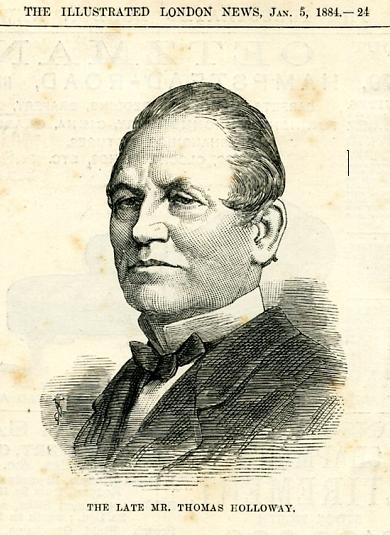
Wood-engraved head-and-shoulders portrait of an older clean-shaven man with muttonchop side-whiskers, in a dark coat, wing collar and bow tie
PUBLIC DOMAIN source

Thomas Holloway

individual · London (patent medicine warehouse, 244 Strand, later 533 and then 78 New Oxford Street)
lived:1800–1883
active:1837–1883
type:individual
role:promoter
location:London (patent medicine warehouse, 244 Strand, later 533 and then 78 New Oxford Street)
eventual status:publicly_disconfirmed
FINANCIAL CONFLICTS
Holloway was the proprietor and vendor of the remedy whose curative system he promoted, so the conflict is the developer-vendor pattern stated on the documented facts. According to the Dictionary of National Biography he began as a merchant and foreign commercial agent, learned the ointment trade through his client Felix Albinolo, announced his own ointment in 1837 and soon added the pills, and built the business on relentless advertising, visiting the London docks daily to press his preparations on departing captains and passengers. His outlay on advertising rose from 5,000l. in 1842 to about 50,000l. a year by his death, and the profits of the business reached about 50,000l. a year. His income depended directly on sales of the pills and ointment whose universal efficacy his pamphlets asserted, and he defended the trade as proprietary: in 1850 he obtained an injunction against his own brother Henry for selling imitations under the Holloway name. The surviving records do not support a stronger claim that he alone profited; the business employed about a hundred hands and a network of agents who shared in the trade. From those profits Holloway endowed the Holloway Sanatorium and the women's college at Egham, more than a million pounds in all.
INTERVENTIONS PROMOTED
EXTERNAL REFERENCES
NOTES

Thomas Holloway (1800-1883) was born at Devonport, then called Plymouth Dock, on 22 September 1800, and was raised at Penzance, where after his father’s death the family kept a grocery and bakery. He had no medical training. About 1828 he moved to London and by 1836 was a merchant and foreign commercial agent; through a client, Felix Albinolo, an Italian who sold an ointment and dealt in leeches, he saw that a well-advertised ointment might be profitable. He announced Holloway’s ointment on 15 October 1837 and soon added the pills, and he built the enterprise on advertising above all else, a faith the Encyclopaedia Britannica records as the secret of his success. His directions were translated into many languages, including Chinese, Turkish, Armenian and Arabic, and his advertisements ran in newspapers around the world.

The publicly_disconfirmed status attaches to the medical claims of the Holloway system rather than to the man’s fortunes, which only grew. The launch of the ointment leaned on a testimonial from Herbert Mayo, senior surgeon at the Middlesex Hospital, that Albinolo warned in 1838 had been given for Albinolo’s own ointment. The British Medical Association’s 1912 analysis found aloes, ginger and soap behind the sweeping cure claims, and Royal Holloway’s institutional history states that the mainly herbal products were incapable of producing the miracle effects advertised. Holloway died wealthy at Sunninghill on 26 December 1883 after endowing the Holloway Sanatorium and the college for women at Egham that still bears his name. The Britannica noted his unconcealed prejudice against doctors, lawyers and parsons.