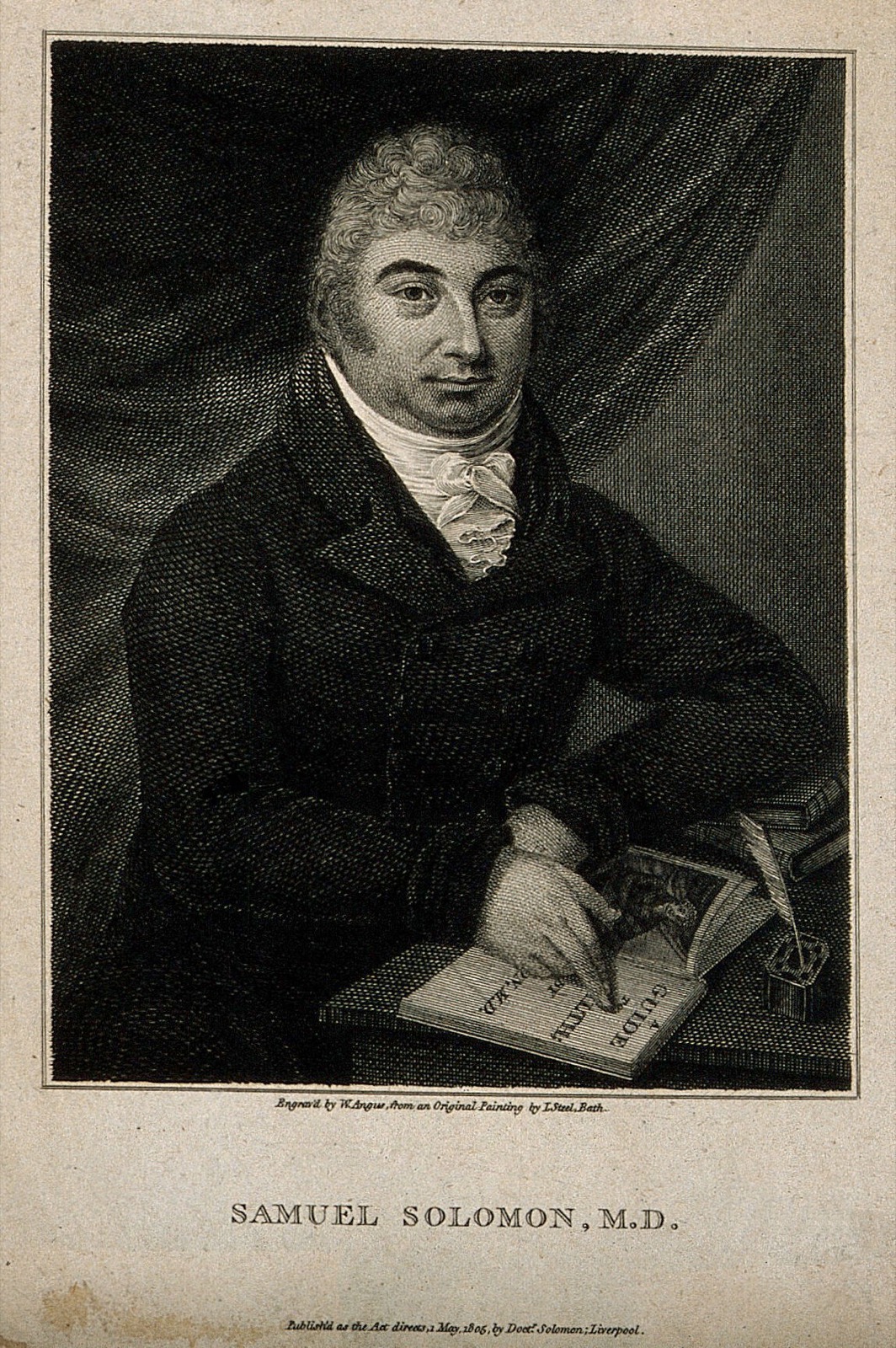
Samuel Solomon
Samuel Solomon (died Bath, 21 May 1819) was the Liverpool proprietor of the Cordial Balm of Gilead, the best-known restorative nostrum of late-Georgian Britain. His birth year is unresolved in the sources: Gabriel Sivan’s biographical study follows Louis Hyman in placing it around 1745 in Cork, where Solomon’s father Abraham was a Jewish butcher, while Mugglestone (2021) gives c.1768. What is documented is that by 1796 Solomon, who had failed in earlier trades, was in Liverpool marketing his balm and styling himself “M.D.” His sales literature carried the degree, and Sivan records that an MD was conferred on him in 1796 on the recommendation of two physicians; it was not the product of medical study, and contemporaries treated the title as part of the marketing.
Solomon’s authority rested on the secret balm, the biblical brand drawn from Jeremiah 8:22 (“Is there no balm in Gilead?”), his book A Guide to Health (which ran through many editions and is the volume he holds in his 1805 engraved portrait), and a print campaign that reached every market town in Britain and Ireland and, by the 1810s, much of Europe and the Empire. The publicly_disconfirmed status attaches to the remedy and its claims rather than to commercial failure, since the business prospered to his death and beyond. Informed contemporaries classed him with the fashionable empirics: John Corry’s Detector of Quackery named Solomon alongside Brodum and Perkins. Modern scholarship reconstructs the secret cordial as a spiced French brandy (Helfand via Mugglestone 2021; cardamom, brandy, and cantharides per McLaren 2007), a flavoured spirit with none of the restorative power its advertising promised.