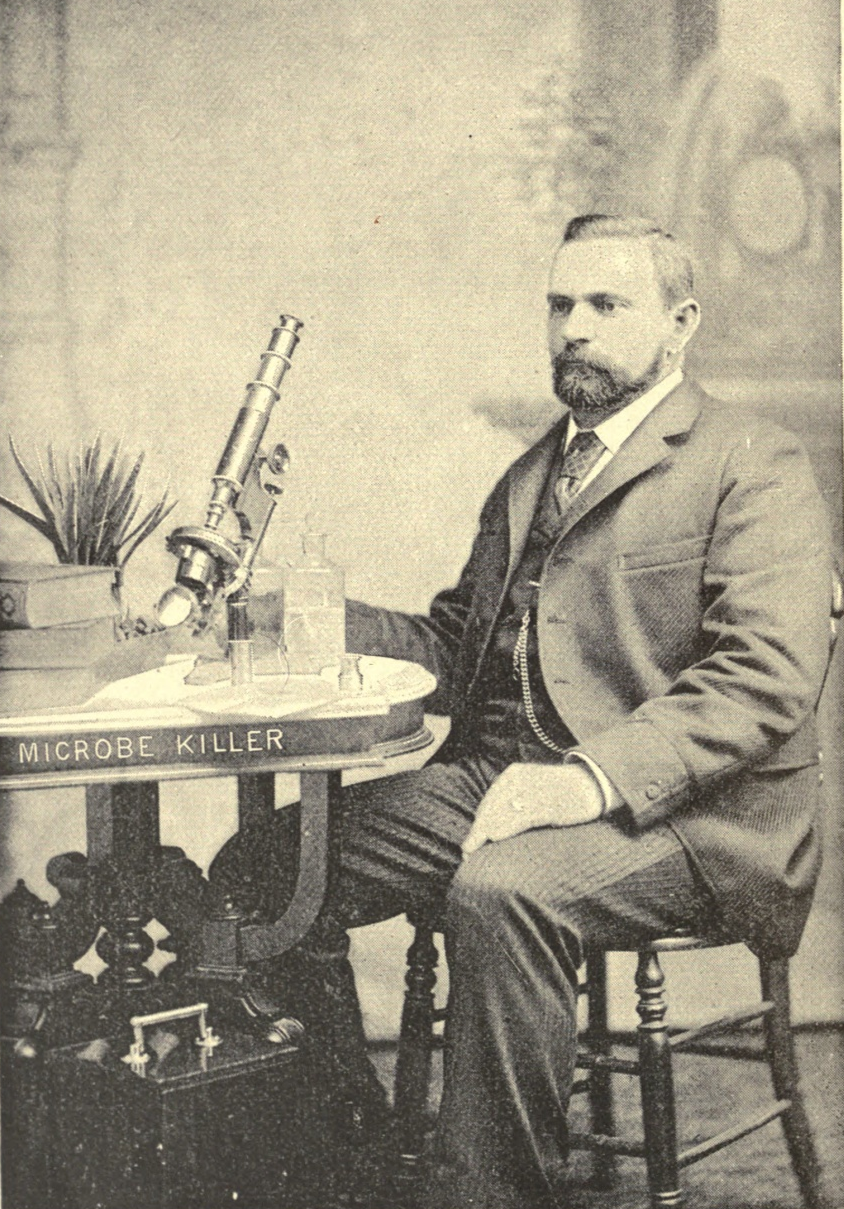
William Radam
"I treated all my patients with the same medicine, just as in my garden I would treat all weeds alike."
William Radam (born 1845; died 1902) was a Prussian-born gardener and nurseryman in Austin, Texas, with no medical training, who turned the new public excitement about germs into a fortune. The Library of Congress name-authority record for Radam describes a native of Prussia who set up a gardening store and nursery in Austin before producing the liquid he regarded as a universal, non-poisonous antiseptic and named the Microbe Killer, a preparation the record notes was later shown to be quackery. Barnett’s account adds the conversion story Radam told in his 1890 book: years of his own illness (malaria, then rheumatism and sciatica) and the death of two of his children led him, after reading of Pasteur and Koch, to conclude that microbes caused all disease and that they could be killed in the body as pests are killed in a garden. He named the resulting acidulated water the Microbe Killer and, after giving samples away, began selling it in 1887.
The business grew very large very quickly. Radam advertised relentlessly, registered the club-and-skeleton trademark in 1887, patented his manufacturing apparatus in 1889, built the Koppel Building in Austin in 1888, and by 1890 had relocated to New York to run seventeen factories and a Fifth Avenue household. The publicly_disconfirmed status attaches to the product and its doctrine, not merely to later commercial decline. The chemist and pharmacist R.G. Eccles published an analysis finding the Microbe Killer to be water with only minute traces of hydrochloric and sulphuric acid, the two men sued each other for libel (Radam retained the orator Robert Ingersoll; a Brooklyn jury awarded Eccles $6,000 and a Manhattan jury later awarded Radam $500, the Brooklyn award afterward reversed), and the muckraker Samuel Hopkins Adams attacked the product in “The Great American Fraud.” Radam died in 1902 and was buried at Oakwood Cemetery in Austin; the company outlived him only until federal authorities, acting under the 1912 Sherley Amendment, seized and destroyed its stock and ended the trade. (Birth year 1845 is from the Smithsonian National Museum of American History object record for a Microbe Killer jug, read from an Internet Archive Wayback Machine snapshot of that record.)