Drown Radio Therapy / Radio-Vision / Homo-Vibra Ray Instruments
Ruth Drown, a Los Angeles chiropractor, sold a dial-covered box she said could diagnose any disease from one dried drop of blood, then cure it by broadcasting a matching "vibratory rate" back to the patient, however far away. A blind 1949 University of Chicago test found every attempted diagnosis wrong; a 1951 federal jury convicted her of criminal misbranding. A reseller still bills her 1939 manual as the birth of holistic medicine.
The credential that didn’t survive cross-examination
A Blue Island, Illinois businessman named Edgar Rice, looking for a way to treat his wife’s breast lump without surgery, first brought her to Ruth B. Drown’s hotel room for a consultation. Learning the reason for their visit, Drown took a drop of Mrs. Rice’s blood on a blotter, worked her console’s dials, and delivered a verdict: not cancer, she said, but a fungus growth reaching the liver, plus gall-bladder trouble, a dead kidney, and low stomach acid — all curable in five months. She was, in the historian James Harvey Young’s description, “a brisk, commanding woman in her mid -50’s.” Months of paid treatment from a Chicago physician who used her instrument followed; in 1948, once the running fees made ownership look cheaper, Rice went to Drown Laboratories in Hollywood and paid $423.07 for a Drown instrument, a black box he carried home on the plane.
Drown’s authority rested on a training record that did not hold up under cross-examination. Born in Colorado in 1891, she testified on direct examination that she had worked for the Southern California Edison Company and “was then required to repair all of my machinery in my department,” claiming “four years and a half of training of repairing machinery.” Asked on cross-examination which department she had in fact worked in, she admitted: “I was in the addressing department.” Drawn to Albert Abrams’s electronic-vibration theories, she testified that she went to the office of an Abrams-oriented doctor and “worked as a nurse, first, and was studying diagnosing, and I diagnosed for four doctors for two years, just experimentally, taking their cases that were difficult to handle.” She also took a chiropractic degree in Los Angeles. She built her own first radionic instrument in 1929 and ran the business as Drown Laboratories in Hollywood, codified in her own books — The Science and Philosophy of the Drown Radio Therapy (1938) and The Theory and Technique of the Drown Radio Therapy and Radio Vision Instruments (1939) — that also explained how the machines worked. The credential that mattered was not a diploma but a decade of hands-on practice she alone could vouch for, wrapped in the vocabulary of contemporary physics.
Sold to practitioners, and to the patient’s husband
There was no single gate. Drown saw patients herself, in Hollywood and, for the Rices, in a Chicago hotel room. She sold instruments to practitioners: Martin Gardner described her “selling her machines to chiropractors, osteopaths, and naturopaths all over the nation,” and noted several Chicago osteopaths using them. The Rices’ own practitioner, Dr. Findley D. John, was a Chicago physician who used the instrument in his practice. And she sold one straight to Edgar Rice, a layman. Young records that the practitioners closed ranks against FDA investigators: “so tightly knit was the circle of Mrs. Drown’s disciples that the task of seizing an instrument that had traveled in interstate commerce was hard to accomplish. Practitioners using the device in their practice were understandably not cooperative with agents from the FDA.” By her 1963 indictment, her total of patients treated had mounted to some 35,000.
A finger on a rubber plate
Drown’s mechanism borrowed the vocabulary of radio without its physics. She held that her instruments “tune[d] into the human body on the same principle as the commercial radio tunes into sound”. As Einstein had stated, she argued, the universe contained one common source of energy, and every organ, gland, and disease carried “its own individual rate of vibration”. Diagnosis meant placing a dried blood sample in the box, then twisting a series of knobs while rubbing a finger across a rubber plate; the reading came from the operator, not from any measurement anyone else could check. Treatment reversed the process: the machine was said to direct the patient’s own energy back to the diseased part at the same vibratory rate discovered during diagnosis, so that, in Drown’s words, “the new cells which form will come in at the higher or normal rate and the diseased cells will automatically fall away”. A companion device, Radio-Vision, claimed to produce radio photographs of internal organs from the same blood sample. At Drown’s 1951 trial, a Federal Communications Commission radio engineer, Robert J. Stratton, took the box apart for the jury and testified that it held a very simple circuit, a wire connecting two blocks of different metals, whose tiny galvanic voltage was what its micro-ammeter registered; the dial settings, he said, were utterly irrelevant, and the blood slot was not connected to the circuit at all; asked whether the device resembled a radio, he answered that both devices contained wire, and that was their only similarity. UCLA physicist Moses Greenfield testified there was nothing inside capable of measuring electrons, radio waves, or radioactivity of any kind.
Author, seller, and biller in one
Drown adapted Abrams’s vibratory-rate theory into her own system, wrote the books that taught it, sold the instruments through Drown Laboratories, and billed her own patients for diagnosis and remote treatment; practitioners such as Dr. John billed separately. The Rice family’s ledger shows the pattern: a $50 check for Drown’s initial diagnosis, roughly $200 for weeks of in-office treatment from Dr. John, a further $350 bill from him when treatment by “radio wave” replaced the office visits, and finally $423.07 for their own instrument once the running fees made ownership look cheaper. None of that revenue was contingent on the patient’s condition improving; Drown’s own reply when Mrs. Rice’s health did not improve was that “Mrs. Rice must realize if she’s to get well she must swing her attention on to the work and put every effort forth” — not a refund. Drown herself testified that over 22 years she had diagnosed or treated more than 17,000 cases; by her 1963 indictment the count had grown to roughly 35,000.
What blind tests and a jury found
Drown’s claims were tested twice, formally, within two years of each other. On 31 December 1949, at the University of Chicago, a committee of physiologists, surgeons, and radiologists — arranged at the urging of one of Drown’s own prominent Chicago supporters, and conducted with Drown’s agreement to strict controls — gave her blood specimens from ten patients whose conditions were already known. She attempted diagnosis on only three. She missed tuberculosis of the upper lobe of the right lung in the first, instead describing metastatic breast cancer, blindness in one eye, and reduced function of some fifteen organs; she called a second patient’s severe high blood pressure normal while reporting improper functioning of both a uterus and a prostate in a male patient; she diagnosed probable prostate cancer with spread to the bones in a healthy young physician. Her radio photographs fared no better: the committee’s report, quoted by both Young and Gardner, found the film images to be “Simple fog patterns produced by exposure of the film to white light before it had been fixed adequately” and, in the passage Gardner quotes, “mere artifacts and totally without clinical value.” A final demonstration, in which Drown tried to stop an anesthetized dog’s induced arterial bleeding by remote broadcast from an adjoining room, ended only when she ordered the artery tied off by hand.
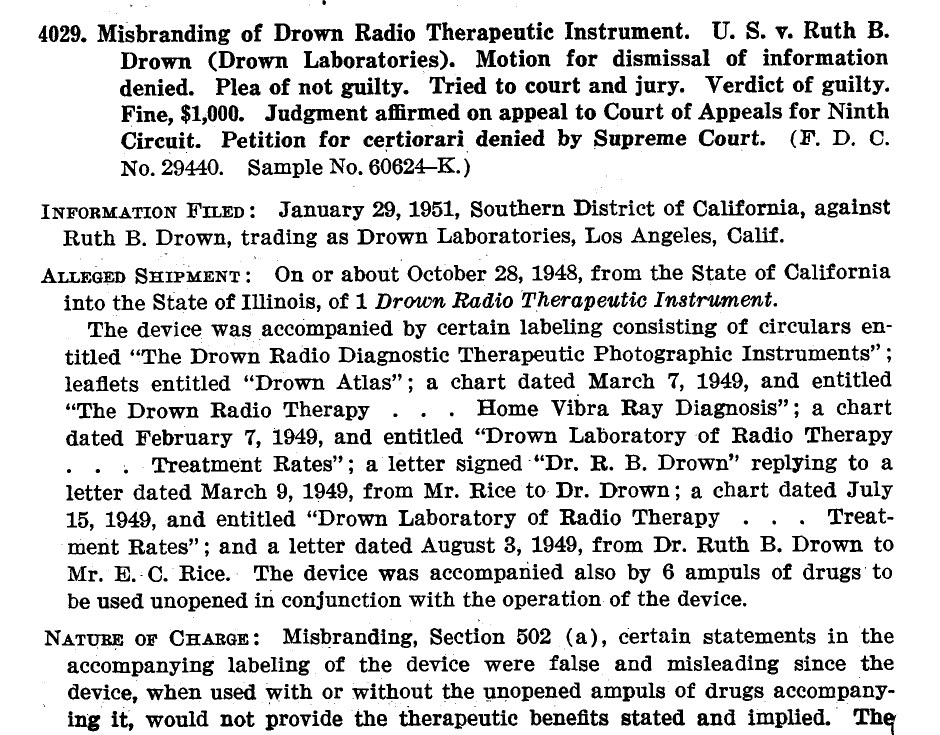
Twenty months later, in September 1951, a federal jury in Los Angeles reached the same verdict by a different route. The government’s case for criminal misbranding — built around the instrument the Rices had carried home to Illinois — brought Stratton and Greenfield’s technical testimony, the assistant dean of the University of Southern California Medical School’s demonstration with a compass that no magnetic field surrounds the human body, and urologist Dr. Elmer Belt’s testimony that the device was “perfectly useless,” would do “no conceivable good,” and would be “laughable if … not so dangerous.” Mrs. Rice’s own doctor confirmed her breast lump was still there, unresolved by 18 months of treatment. On 24 September 1951 the jury convicted Drown; she was fined $1,000, and the conviction was later affirmed on appeal through the Ninth Circuit and left standing when the Supreme Court denied review. Mrs. Rice died on 17 November 1952 of the cancer that diagnosis had missed. Avoiding further interstate shipments, Drown kept practicing in California; in 1963, after an investigation by the state’s Bureau of Food and Drug Inspection, she was indicted for grand theft; she died in 1965, before that case could come to trial. The verdict did not end the sale of her ideas: Borderland Sciences Research Foundation, a self-described alternative-science organization, still sells reprints of her 1939 manual, describing it as a work that “gave birth to holistic medicine” and saying it blends “ancient wisdom with unique radio-vision technology to diagnose and restore balance.” Another online seller, Offworld Tech, offers a $15 copy of her Radio-Vision and Homo-Vibra Ray book, complete with “rate book and instructions by Drown.” Independent assessment of the broader black-box radionics practice she carried on from Abrams has not moved since 1949 either — as the Skeptic’s Dictionary puts it, when such devices are tested under controlled conditions, “they always fail.”
The pattern repeats
The same structural machinery appears in different treatments and eras. These cases show the claimed mechanism and how the claim met evidence.
Part of the lineage
External references
Evidence · 10 sources
- The Medical Messiahs: A Social History of Health Quackery in Twentieth-Century America (Chapter 11) (1967)
- What the American Medical Association Thinks of the Electronic Reactions of Abrams (1923)
- FDA Notices of Judgment Collection: Case 3059, Misbranding of Drown Radio Therapeutic Instrument (U.S. v. 1 Device, etc.) (1950)
- FDA Notices of Judgment Collection: Case 4029, Misbranding of Drown Radio Therapeutic Instrument (U.S. v. Ruth B. Drown) (1953)
- Notices of Judgment under the Federal Food, Drug, and Cosmetic Act, Drugs and Devices: printed entry 4029, Misbranding of Drown Radio Therapeutic Instrument (page 24) (1953)
- Fads and Fallacies in the Name of Science (chapter on Albert Abrams and his imitators, pp. 208-210) (1957)
- radionics (The Skeptic's Dictionary) (2015)
- Radionics (Gale Encyclopedia of Alternative Medicine) (2001)
- Theory and Technique of the Drown H.V.R. and Radio Vision Instruments by Ruth Drown (Borderland Sciences Research Foundation catalog listing) (2026)
- Ruth Drown Radio-Vision rare book (Offworld Tech / radionictech.com store listing) (2026)