Spectro-Chrome
In 1920, Bombay-born drugless practitioner Dinshah P. Ghadiali began selling the Spectro-Chrome, a lightbulb-and-colored-glass box he said could cure nearly any disease by fixing the body's Radio-Active and Radio-Emanative Equilibrium. A 1947 federal jury convicted him of misbranding, affirmed on appeal, and a 1958 injunction followed a renamed successor device. His nonprofit successor still sells the method, which a 2017 review calls pseudomedicine.
A box of colored light, and a man who said it could cure almost anything
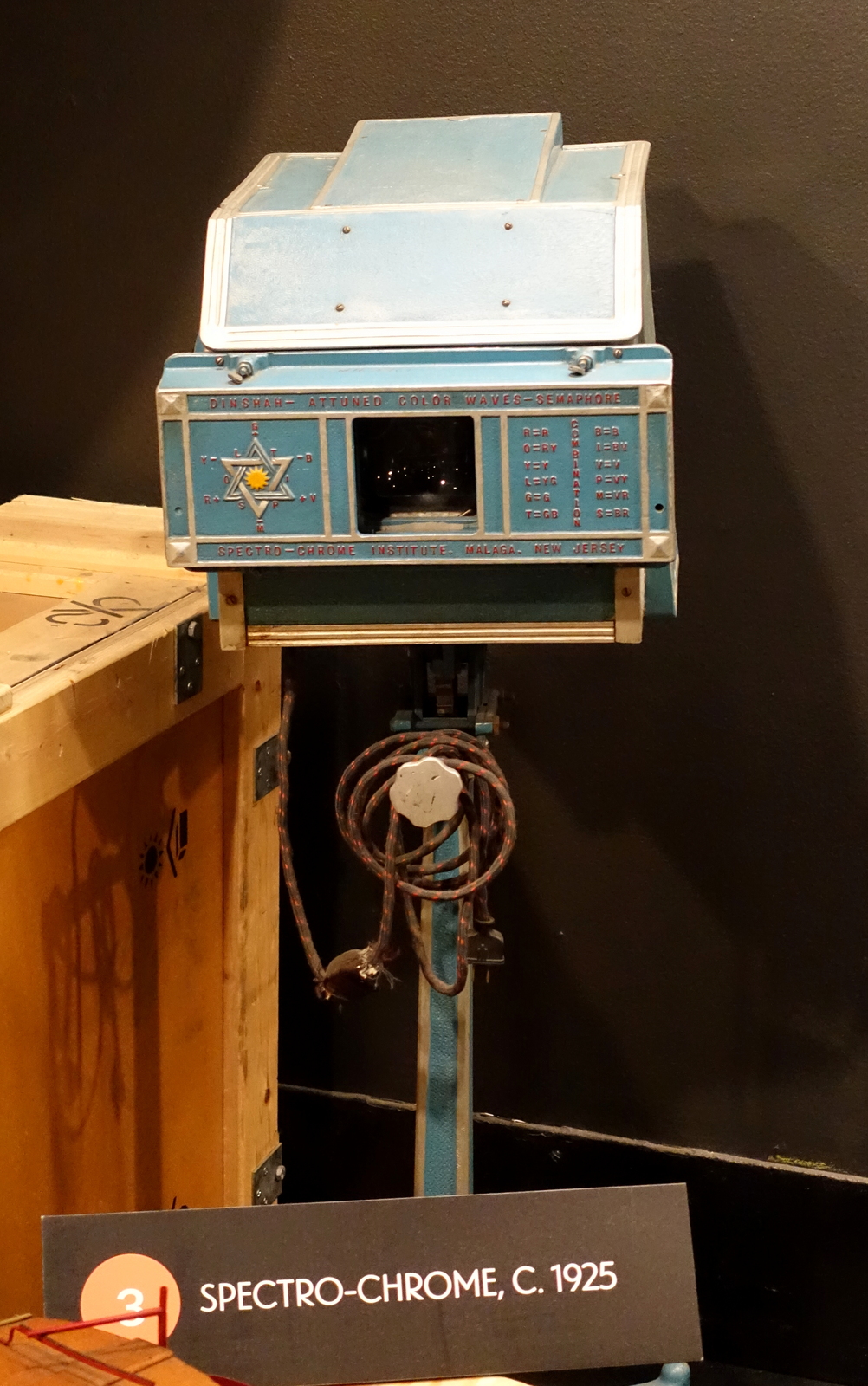
In the Museum of Science and Industry in Chicago sits a teal metal box on a stand, its front panel stamped in red paint with the words DINSHAH-ATTUNED COLOR WAVES-SEMAPHORE, a six-pointed star wheel of color codes beside a dark lamp aperture, and along its base the words SPECTRO-CHROME INSTITUTE, MALAGA, NEW JERSEY. It is one of the projectors Dinshah P. Ghadiali sold as a cure for nearly any disease.
Ghadiali was born November 28, 1873 in Bombay, India, to a Zoroastrian family. Self-taught in chemistry and mathematics — he became a math and science assistant at Wilson College at age eleven, according to the Encyclopedia of Occultism and Parapsychology — he trained informally in several healing systems; the same encyclopedia states plainly that “His medical degree was not recognized in the United States”, and that he was alienated from mainstream medicine as it then existed. He immigrated in 1911, was naturalized in 1917, and by 1919 was vice president of the National Association of Drugless Practitioners, an alternative-medicine advocacy body, not a licensing authority. In April 1920 he delivered his first lecture on what he called Spectro-Chrome therapy and opened the Spectro-Chrome Institute in New York City. In 1924 he acquired a 23-acre property in Malaga, New Jersey that became his permanent headquarters, and in 1933 he finished his three-volume Spectro-Chrome Metry Encyclopaedia. A peer-reviewed 2014 history in Historical Studies in the Natural Sciences describes him as “a charismatic inventor and popular science lecturer” who used the rhetoric of contemporary science popularizers to challenge orthodox medicine’s claim to scientific authority. He ran, unsuccessfully, for Governor of New Jersey as an independent candidate in 1937, placing next-to-last.
A cure open to everyone who could pay the course fee
Spectro-Chrome was never a wealthy person’s secret. The 2014 peer-reviewed history records that the device “was practiced by more than ten thousand Americans over the half-century following its introduction in 1920”; most of its practitioners were working-class, and many were women, treating themselves, their families and friends, and sometimes paying customers. Ghadiali’s Institute ran ten-day training classes — the first, in December 1920, drew 27 students, and the Society’s own history records 26 more such classes across the country within four years, drawing 800 attendees, before later shifting to mail-order correspondence courses that reached still more. A testimonial supposedly written by graduates of a 1933 Cleveland training class called it “a university education compressed into a short two weeks.” Anyone who paid for the course, and later anyone who bought the mail-order manual, could set up a Spectro-Chrome practice; no medical license, wealth, or elite connection was required.
Radio-Active and Radio-Emanative Equilibrium
The Spectro-Chrome itself was simple: a metal box holding a 1,000-watt bulb, fitted with interchangeable colored glass filters, shone on a patient’s bare skin in hour-long sessions Ghadiali called “tonations.” The theory behind it was not simple at all. Ghadiali claimed that “every chemical element was attuned to a specific set of light frequencies” and that disease was a disruption of the body’s Radio-Active and Radio-Emanative Equilibrium — restorable, he said, by exposure to the matching Attuned Color. His color chart assigned specific effects to each of twelve colors: orange light, per his system, stimulated respiration and thyroid function, while magenta wavelengths promoted “love and well-being.” No source in this bundle documents scientific support for either the element-attunement premise or the organ-specific color chart. A 2017 Skeptical Inquirer analysis of present-day chromotherapy reports finding no medical research article defining chromotherapy’s claimed therapeutic colors in the bibliographic database it searched, and concludes that colored-light therapists do not ground their claimed color-to-symptom effects in physics or scientific evidence. A 2023 peer-reviewed letter in the Journal of Family Medicine and Primary Care goes further on the organ-specific claims specifically: since visible light can only penetrate the outer few millimeters of skin, it states, treating internal organs with colored light is “baseless”.
The Institute, the encyclopedia, and the courses were all his
Ghadiali was not a disinterested researcher publishing findings for others to test. He personally owned the original Spectro-Chrome Institute, then founded and controlled its successors — the nonprofit Dinshah Spectro-Chrome Institute, and again in 1953 the Visible Spectrum Research Institute — which sold the projectors, sold Ghadiali’s own three-volume encyclopedia and later manuals, and charged for the training courses that turned buyers into practitioners. No source in this bundle documents an independent hospital, licensing board, or outside tester examining the device’s claims before regulators intervened. That intervention came repeatedly: an acquitted 1931 Buffalo grand-larceny charge (a former student alleged the device did not perform as promised), a defeated 1934 attempt to strip his U.S. citizenship, and, in 1941, a U.S. Post Office administrative fraud-order against his Institute’s mail — ordering postmasters to return, stamped “FRAUDULENT,” any mail addressed to it. The Dinshah Health Society’s own 2012 training manual states that order “stands to this day.”
Convicted, enjoined, and — under a new name — still for sale
The decisive blow came from the federal government. Following the 1938 Food, Drug, and Cosmetic Act, the FDA built a misbranding case against Ghadiali and his Institute, seizing devices in 1942 and again in 1945. A six-week federal criminal trial in Camden, New Jersey in 1947 ended with a jury verdict of guilty on all counts: the Institute was fined $12,000 and Ghadiali $8,000, he received a one-year jail sentence on each of the first three counts (execution suspended) plus five years’ probation, and sentence on the remaining four counts was suspended — on the stipulation, the Society’s own history records, that he “dissolve the Institute and dissociate himself from any form of promotion of Spectro-Chrome”. He was also ordered to surrender for destruction all his Spectro-Chrome-related books, valued at up to $250,000 in 1948 dollars. The judgment was affirmed on appeal (United States v. Ghadiali, 165 F.2d 957 (3d Cir. 1948)), and the U.S. Supreme Court denied review (Ghadiali v. United States, 334 U.S. 821 (1948)).
Ghadiali did not stop. After his probation ended in 1953 he organized a new nonprofit, the Visible Spectrum Research Institute, and resumed selling renamed “Visible Spectrum Projectors” — this time carrying a printed warning that, per accepted medical opinion, they had “no curative or therapeutic value.” The FDA was not satisfied: in 1958 it obtained a permanent injunction barring interstate shipment of the projectors and related books as the same misbranded articles covered by the 1947 judgment. The Society’s own 2012 training manual states plainly: “The injunction still stands.” Ghadiali died April 30, 1966. In 1975, his sons’ Trustees, still bound by that federal injunction, dissolved the Visible Spectrum Research Institute and founded a new nonprofit, the Dinshah Health Society, to carry the work forward under a different corporate name.
That Society operates today. Its current website sells the latest edition of Ghadiali’s training manual, related books and DVDs, and Society memberships — alongside the disclaimer, “These statements have not been evaluated by the Food and Drug Administration. This product and system is not intended to diagnose, treat, cure, or prevent any disease.” The Society’s own 2012 training manual states that FDA regulations “prevent us from selling Spectro-Chrome Color projectors” because they have been held to be medical devices — the 1958 injunction, as of that account, still governing what could be sold. Independent modern assessment of the underlying practice has not been kinder: the 2017 Skeptical Inquirer analysis concludes that chromotherapy generally is a pseudomedicine with no real health benefit, and the 2023 medical-journal letter warns that endorsing it risks patients delaying care for conditions colored light cannot touch.
The pattern repeats
The same structural machinery appears in different treatments and eras. These cases show the claimed mechanism and how the claim met evidence.
Electronic Reactions of Abrams (ERA)
Orgone Energy Accumulator
Overbeck's Rejuvenator
Evidence · 10 sources
- The Science of Automatic Precision (2014)
- Colorful Lights to Cure What Ails You (2024)
- 2389. Misbranding of Spectro-Chrome. U.S. v. Dinshah P. Ghadiali and Dinshah Spectro-Chrome Institute (1949)
- United States v. Ghadiali, 165 F.2d 957 (3d Cir. 1948); Ghadiali v. United States, 334 U.S. 821 (1948) (1948)
- Ghadiali, Dinshah Pestanj (1873-1966) (2001)
- Let There Be Light: Practical Manual for Spectro-Chrome Therapy (2012)
- Dinshah Health Society -- official website (2026)
- The Danger of Chromotherapy (2017)
- Response to The untold saga of chromotherapy in dentistry (2023)
- Spectro-Chrome, c. 1925, Dinshah-Attuned Color Waves-Semaphore, Spectro-Chrome Institute, Malaga, New Jersey - Museum of Science and Industry (Chicago) (2014)