Mattei's Electro-Homeopathy (electrohomeopathic remedies)
Cesare Mattei, an Italian count turned homeopath, sold secret 'electricities' -- five unlabeled colors of plant liquid distributed only through his trademarked depot network -- claiming they cured disease generally, including cancer; St Saviour's Cancer Hospital, London, used them from 1873. A fellow homeopath called the theory erroneous; by the 1930s medicine had moved on. A 2001 ruling rejected recognition; a 2024 ruling allowed practice in Uttar Pradesh without degrees or the title 'Doctor.'
A dog, a plant, and a new science
Cesare Mattei, an Italian nobleman from the Bologna region, was, by his own circle’s later account, a dissatisfied convert to homeopathy: after “careful study and deep and prolonged thought on medical subjects” he had become a confirmed homeopath, but found the remedies available to him “quite insufficient” for many of the diseases he wanted to treat (Gliddon, Stepping Stones to Electro-Homoeopathy, 1892). The story his followers told to explain what came next centers on a dog. Mattei, the account goes, noticed a favorite dog of his, suffering from a skin complaint, returning day after day on its walks to eat the leaves of one particular plant, until the complaint cleared entirely. Taking this as evidence the animal’s instinct had found “the true medicine,” Mattei — “an amateur chemist” by his own description — extracted what he took to be the plant’s active principle, tested it on people he knew, and concluded he had discovered a powerful new class of remedy (Gliddon, 1892).
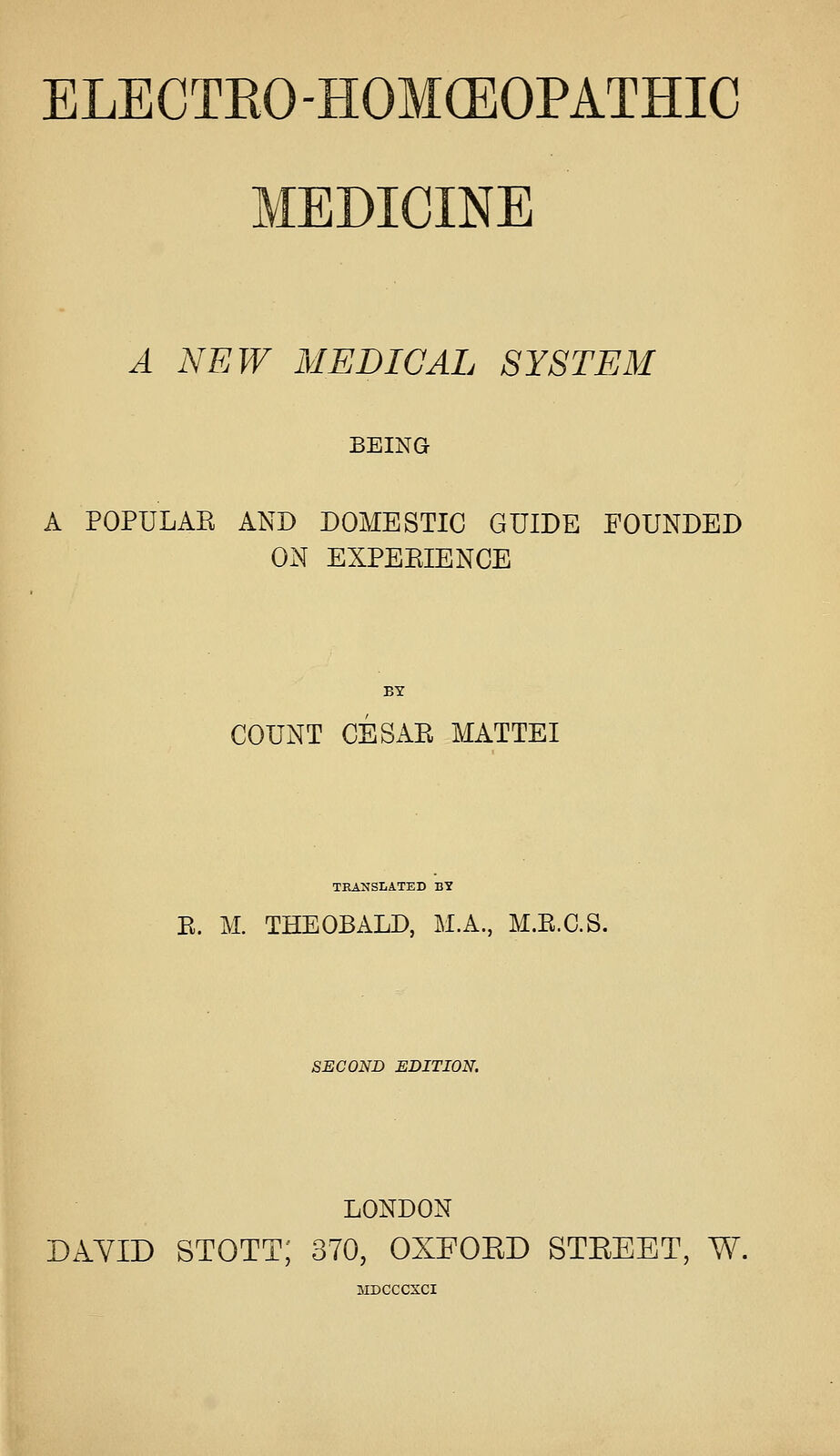
Over the following decades Mattei expanded this single anecdote into a complete system he named “Electro-Homeopathy”: disease diagnosed by symptom, as in ordinary homeopathy, but treated with proprietary plant liquids he called “electricities.” A letter from Mattei to his English translator, printed at the front of the 1891 second edition of his book, is dated from Rochetta, 15 October 1887, placing the count still corresponding with foreign disciples from Rocchetta late in life. No source in this bundle documents Mattei publishing a formal proving, a chemical analysis, or a controlled trial. His authority rested instead on personal testimonial, his own noble title, and the sheer scale of a system he and his followers claimed had already helped patients “in various parts of the world during more than a quarter of a century” by the time the English guidebook appeared (Gliddon, 1892).
No bottle without the crest
No source in this bundle documents Mattei’s remedies being sold through ordinary pharmacies, and their formulas were never publicly disclosed. Every genuine bottle carried a registered trademark — a castle crest above the words “RIMEDI ELETTROMIOPATICI DEL CONTE CESARE MATTEI BOLOGNA” — and the 1892 London guidebook to the system states plainly that “No Remedies are manufactured and no Books or Pamphlets are authorised by Count Mattei” outside this single trademarked channel, printing the exact wording of the genuine mark so buyers could check their own bottles against it and avoid the lookalike products the guidebook says had already been sold by unauthorized sellers. Distribution ran through a General Depot under contract to Mattei, which was in turn permitted to license sub-depots and agents, all bound to sell only genuine, Mattei-supplied stock. London’s own outlet operated as the Central Mattei Depot at 18 Pall Mall East as of 1892. A patient anywhere the depot network reached could obtain the remedies; a patient could not obtain them, or verify what was actually in them, from anyone outside that network.
Five colors, no chemistry
Mattei’s central term was never defined beyond metaphor. His own book describes the liquids as “mysterious liquids, which baffle analysis, act with remarkable power and promptitude,” which he called “electricities” — five of them, distinguished from one another only by the color of the bottle: Red, Green, White, Yellow, and Blue (Gliddon, Stepping Stones to Electro-Homoeopathy, 8th ed., 1930, quoting Mattei, p.62). Applied to or taken by the patient, the liquids were said to act “with electric speed,” restoring a balance of blood and lymph Mattei held to be the common root of all disease — a theory with no mechanism a contemporary physiologist could test, because no source in this bundle documents the plant sources or extraction process behind each color having been published. Specific named preparations extended the same logic to specific ailments: a vial labeled “Canceroso 5” was marketed, among unrelated conditions from chilblains to hair loss, for cancer (Wellcome Images object description, Bologna medicine chest, 1871-1885). Reviewing the system in the homeopathic profession’s own literature, the London physician E. W. Berridge identified an internal contradiction at its core: Mattei supplied no provings of his remedies and stated they produced no effect on a healthy person — which Berridge called “a glaring absurdity” for anything credited with a specific medicinal action — and concluded that “as it happens that this pathological theory is erroneous, the system based thereon must be erroneous also, and all cures made in accordance with it must be accidental” (Berridge, “Matteism — The Latest Craze,” The Homoeopathic Physician, 1888).
One man, one trademark, no outside verification
Every element of Mattei’s commercial structure ran through Mattei’s own authority. He devised the theory, kept the formulas within his own organization, licensed the depots that sold them, and controlled the trademark that made a bottle “genuine”; the sources gathered for this case document Mattei’s control of the theory and formulas, not the internal division of proceeds between Mattei and the licensed sub-depots and agents who did the actual selling. Nothing in those sources documents an independent manufacturer, licensed chemist, or outside authority with the ability to verify — or challenge — what any bottle actually contained; the color-only labeling system communicated nothing about contents to anyone outside Mattei’s own organization. The guidebooks sold alongside the remedies were themselves restricted to the same authorized channel, so that the literature explaining the system and the product it recommended came from a single source. The branded imprint outlasted its founder by decades: an eighth-edition guidebook was still being published in London under the imprint “Count Mattei’s Remedies” as late as 1930, thirty-four years after Mattei’s 1896 death.
A craze, a quiet dismissal, and a claim still contested
The earliest public disconfirmation this record documents came from within Mattei’s own adopted profession. In November 1888, Berridge devoted a full article in The Homoeopathic Physician to what he titled “Matteism — The Latest Craze.” He examined the single detailed case Theobald’s preface had offered as proof — a young woman’s recovery from “marasmus” after Mattei’s remedies succeeded where “ordinary homoeopathic treatment” reportedly had not — and found that, without a fuller account of the earlier treatment, the case showed only “that certain unknown remedies cured after other unknown remedies had failed”: no evidence for Mattei’s system specifically. An institutional catalogue description of a surviving Mattei medicine chest (Bologna, 1871-1885) records the wider verdict of Mattei’s own era in a single passage: the system was dismissed by the medical profession as quackery even as it remained popular and formed part of the treatment offered at St Saviour’s Cancer Hospital in London from 1873, and by the 1930s mainstream medicine had generally moved past it.
The claim did not stay buried. A namesake practice called “electropathy” or “electro-homeopathy” is taught and marketed today in India; the live website of one organization, Naturo Electro-Homoeopathy Medicos of India (NEHM of India), names Mattei directly as founder, stating the system “was first discovered by Dr. Count Ceaser Mattei, an Italian Armed force Officer, in the year 1865.” Ruling directly on a diploma-granting electropathy institution in 2001, the Bombay High Court held the practice unrecognized as a system of medicine in India and, addressing the founding claim by name, unrecognized as a system of medicine anywhere in the world, including Italy, where it is said to have been discovered in 1865 — ordering that institution’s courses closed and its diplomas stripped of any right to practice. NEHM of India’s own site separately points to later government correspondence and court orders between 2010 and 2022 that it says permit continued practice without formally recognizing electropathy as a system of medicine. A 2024 Allahabad High Court judgment supplied the narrower current position in Uttar Pradesh: certificate-holders could practice Electro Homeopathy as an alternative therapy while it remained unbanned, but no institution could confer a diploma or degree and practitioners could not use the prefix “Doctor.”
The pattern repeats
The same structural machinery appears in different treatments and eras. These cases show the claimed mechanism and how the claim met evidence.
Part of the lineage
External references
Evidence · 12 sources
- Stepping Stones to Electro-Homœopathy (Count Mattei's System of Medicine), 2nd edition (1892)
- Stepping Stones to Electro-Homœopathy (Count Mattei's System of Medicine), 8th edition (1930)
- Electro-homoeopathic medicine: a new medical system, being a popular and domestic guide founded on experience (1891)
- Cesare Mattei (concept record) (2026)
- Mattei's electro-homeopathic treatments, Bologna, Italy, 1871-1885 (medicine chest, catalogue description) (1878)
- Matteism -- The Latest Craze (1888)
- Unternehmensgeschichte (Company History) (2026)
- Electro-homoeopathic Medicine title page (digitized scan) (1891)
- Electropathy Medicos Of India (Central Board) v. The State Of Maharashtra & Ors. (2001)
- Rajesh Kumar & Anr. v. Union of India (2024)
- About Electropathy (2026)
- Legal Aspects / Milestones (2026)