Peruna
Dr. S. B. Hartman's Peruna promised to cure catarrh -- a diagnosis he stretched to cover pneumonia, appendicitis, Bright's disease, and even yellow fever -- and became America's best-selling patent medicine. Samuel Hopkins Adams's 1905 investigation found it mostly grain alcohol and water; period labels and a 1905 federal ban on Indian reservations put the exact figure at 28 percent. Hartman admitted to Adams that almost no drug cures disease.
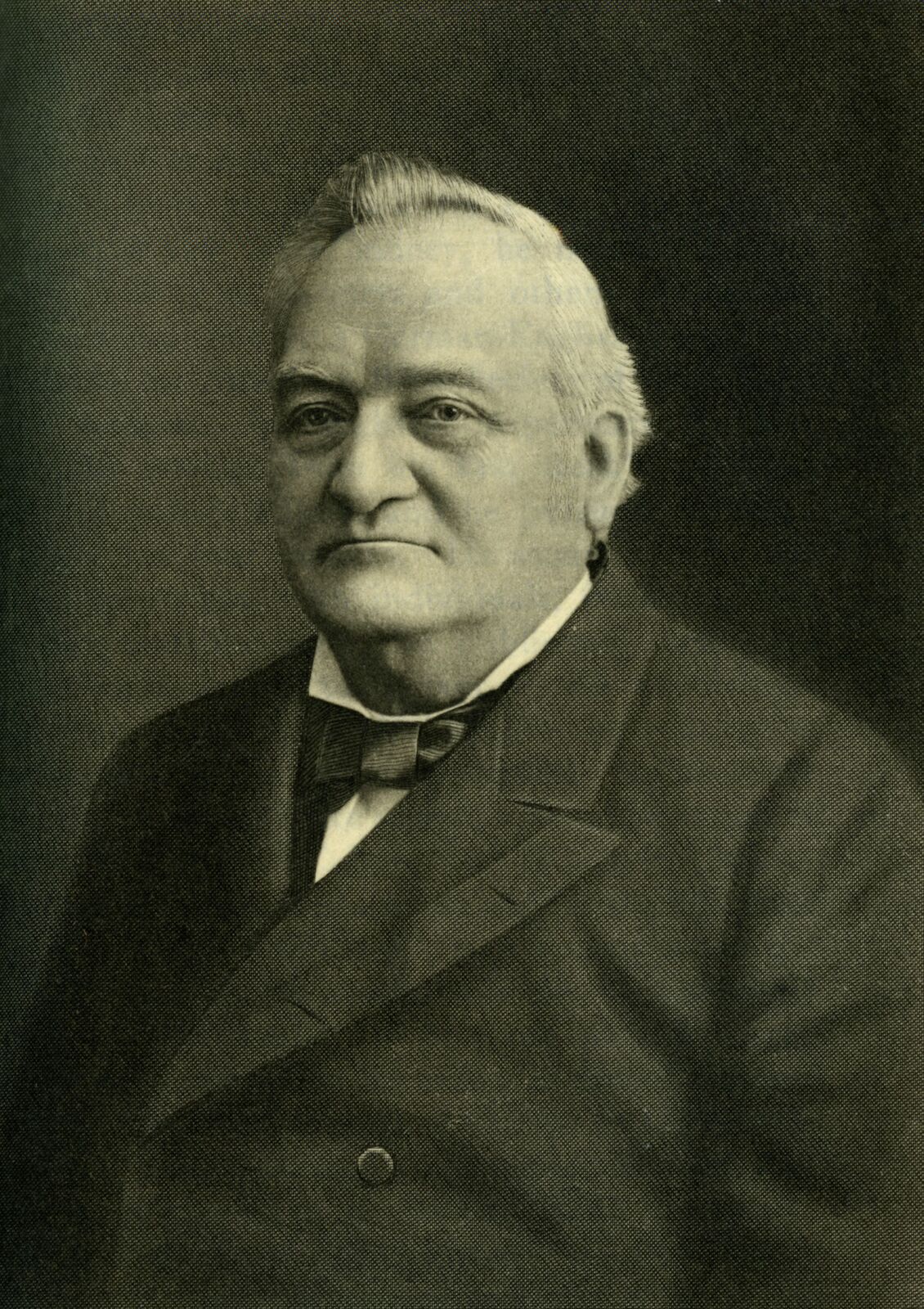
The inventor of the great catarrh remedy
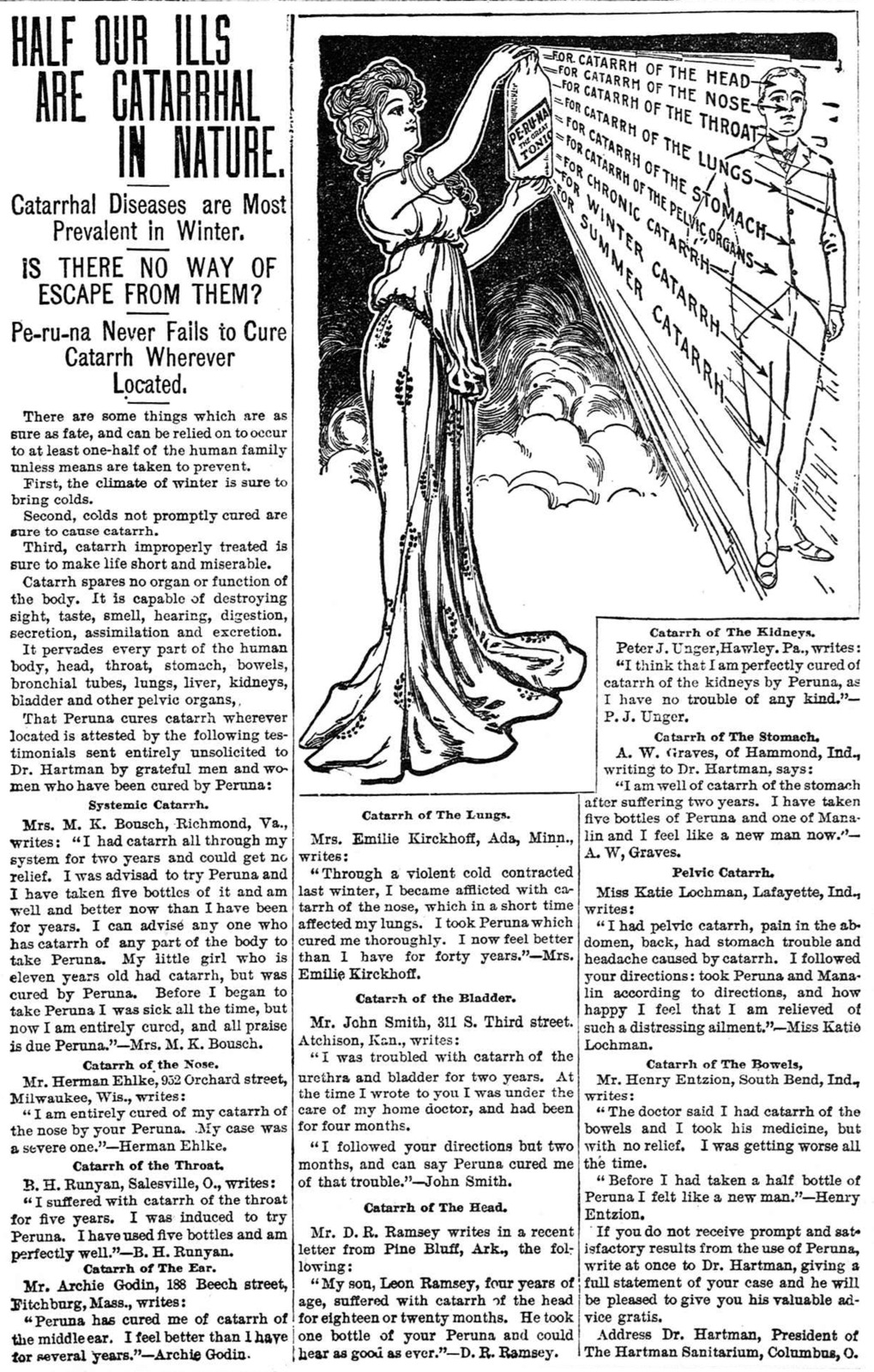
“Half our ills are catarrhal in nature,” read the headline over a 1902 newspaper advertisement showing a woman holding a glowing bottle of Peruna, rays of light connecting it to a sick man’s body — head, throat, lungs, stomach, pelvic organs — each labeled with its own species of catarrh. The company behind it invited readers with any complaint at all to write in for a personal reply, promising Dr. Hartman himself, president of the Hartman Sanitarium in Columbus, would give them his advice free of charge. Dr. Samuel B. Hartman was, by 1905, running what Samuel Hopkins Adams called “the most prominent proprietary nostrum in the country.” Hartman had practiced medicine in Ohio and Pennsylvania for three decades before giving it up around 1890 to sell Peruna full time, and his authority as “once a physician in good standing” — Adams’s own phrase — was the product’s entire premise. His 1901 booklet, The Ills of Life, walked readers through disease after disease recast as catarrh: pneumonia was catarrh of the lungs, dyspepsia catarrh of the stomach, Bright’s disease catarrh of the kidneys, heart disease catarrh of the heart. During a yellow-fever scare in New Orleans, Hartman went further still, and the company advertised Peruna as a preventative against yellow fever.
Adams traveled to Columbus in 1905 and interviewed Hartman face to face. What he got back undercut the entire performance. Hartman, he wrote, “stated to me specifically and repeatedly that no drug or combination of drugs, with the possible exception of quinin for malaria, will cure disease” — a flat denial, from the product’s own inventor, of the premise on which his fortune had been built.
A dollar bottle, sold to everyone
Peruna was a mass-market product. It sold nationally through ordinary druggists for one dollar a bottle — at a time, one period account notes, when twenty-five cents bought a full lunch — and the company backed the price with an advertising budget one secondary account puts at more than a million dollars a year (Sullivan 2007). Its default marketing tool was the unsolicited testimonial: the 1902 advertisement alone reproduces letters from readers in Virginia, Wisconsin, Ohio, Kansas, Minnesota, Indiana, and Arkansas, each crediting Peruna with curing catarrh of a different organ. For readers who wanted more prestigious validation, the company ran an advertisement reproducing letters of endorsement it said came from fifty members of Congress; Adams’s own review of the letters found that most gave no indication the signer had ever tasted the product. Hartman also promised a personal reply to anyone who wrote in, but Adams’s reporting identifies the ordinary purchase as a one-dollar transaction at a druggist.
Belief, alcohol, and feeling better
The label promised cures for catarrh of the head, nose, throat, lungs, stomach, and pelvic organs, and for chronic, winter, and summer catarrh, while Adams found seven drugs totaling less than one-half of one percent of the formula. His analysis described Peruna as “a stimulant pure and simple,” composed chiefly of “cologne spirits” — rectified grain alcohol — diluted with water at roughly three parts water to one part spirits, plus “one-half of 1 per cent. of mild drugs” and coloring matter. A period product label made the same point in the company’s own words, describing Peruna as a cure for an ever-expanding list of catarrhal complaints and then, in the same breath, disclosing an alcohol content of 28 percent. Hartman did not dispute the chemistry; he offered Adams an entirely different theory of why customers felt better. In Sullivan’s account of the same conversation, Hartman attributed customers’ recovery to their faith in Peruna reinforced by its mild stimulant effect. That is a mechanism of belief and mild intoxication, not of medicine — and Adams called the broader claim that the same alcohol-and-water mixture could cure or prevent everything from appendicitis to yellow fever “too ridiculous to need refutation.”
Twelve million dollars in “bunco-profits”
Peruna’s advertised claims financed a genuine personal empire. Hartman’s Peruna Drug Manufacturing Company complex eventually covered two to three blocks of downtown Columbus; he built a combined hotel and sanitarium where, by one account, Peruna flowed freely to residents, bought a large farm south of the city, and in 1911 built the Hartman Theatre downtown. He was not the only beneficiary of the business — his son-in-law, Frederick W. Schumacher, ran the company’s advertising, became vice president, and ran most of its day-to-day operations from 1908 to 1916, separately making a fortune afterward in Canadian mining — but Hartman remained the company’s named proprietor and president through the years these claims were made. When an Internal Revenue liquor-tax ruling forced a reformulation, Collier’s mocked what was left of the operation: Hartman, it wrote, was obliged to retire with only about twelve million dollars of bunco-profits.
Twenty-eight percent alcohol, and a doctor who agreed
Peruna’s disconfirmation did not wait for a courtroom; it came from a chemist’s analysis, a federal ban, and the promoter’s own mouth. In 1905 — the same year Adams’s exposé ran in Collier’s Weekly — the federal government banned Peruna’s sale on Indian reservations specifically because the tonic was 28 percent alcohol, a figure period product labels stated outright. Adams’s own reporting, republished by the American Medical Association in 1907, reached the same underlying conclusion from a different angle — he found the bottle to be mostly cologne spirits and water — and from Hartman’s own words: the man who invented the “great catarrh remedy” told a reporter, on the record, that almost no drug cures disease. An Internal Revenue liquor-tax ruling forced Hartman to add laxatives and cut the alcohol content to roughly 18 percent so Peruna could still be classed as medicine rather than taxed as liquor; the 1906 Pure Food and Drug Act separately required alcohol disclosure on the label. Hartman told his customers he was “shocked beyond all measure” at the accusation of trafficking in liquor, insisted the reformulated product was no kind of alcoholic beverage, and recommended it even for children — a claim already contradicted, on the alcohol-content point, by the federal reservation ban of the previous year. Sales collapsed at first regardless: Hartman tried reviving the original high-alcohol formula under a new name, Katarno, sold through a separate New York company from 1906, with newspaper advertisements for it still running as late as April 1913 — but Katarno never caught on. Peruna’s own sales later revived under Schumacher’s management, boosted by Prohibition and radio advertising, but the product never regained its earlier standing as the nation’s top-selling patent medicine (Sullivan 2007).
The pattern repeats
The same structural machinery appears in different treatments and eras. These cases show the claimed mechanism and how the claim met evidence.
More related cases · 2
Part of the lineage
Evidence · 6 sources
- The Great American Fraud: Articles on the Nostrum Evil and Quacks, in Two Series, Reprinted from Collier's Weekly (1907)
- Dr. S.B. Hartman and Peruna (2025)
- The Peruna Story: Strumming That Old Catarrh (2007)
- Half Our Ills Are Catarrhal in Nature (1902)
- The Great American Fraud: Articles on the Nostrum Evil and Quackery Reprinted from Collier's (1912)
- Hartman, Samuel Brubacker (3/1/1830-1/31/1918) (1915)