Baker's Cancer Cure (tea and injections)
By 1930 Iowa radio-station owner Norman Baker was advertising, on his own station and in his own magazine, a secret cancer cure administered at his own hospital. An Iowa court found the formula was clover, corn silk, watermelon seed, and water. A federal jury convicted him of mail fraud in 1940; he was imprisoned at Leavenworth from March 1941 to July 1944.
The radio evangelist who built his own hospital
Norman G. Baker (27 November 1882 - 8 September 1958) never held a medical license or a day of medical training. What he had was a radio station. By 1930 he had used his own station, KTNT, together with a promotional magazine he founded called The Naked Truth, to advertise the Baker Hospital in Muscatine, Iowa, as a cure for cancer and a wide range of other ailments, running before-and-after patient photographs and testimonials in the magazine’s pages. There was no medical board behind the claim, no hospital affiliation, no published study: there was a broadcaster who owned the station making the claim, the magazine repeating it, and the hospital collecting the fees, all three under one name.
One name, one hospital, then a purple hotel
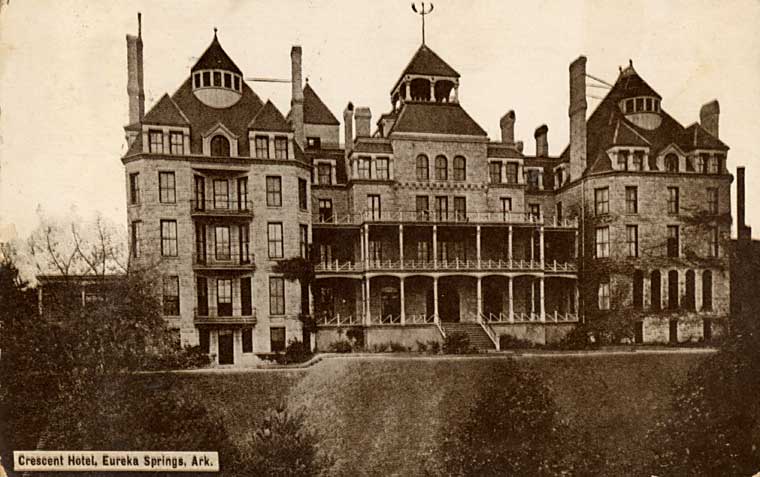
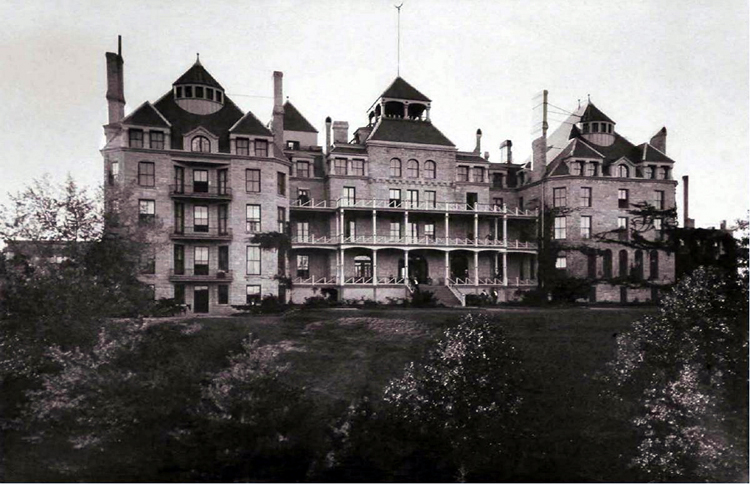
Baker’s treatment was administered at hospitals he operated, first in Muscatine and later in the Crescent Hotel. Iowa authorities sued him for practicing medicine without a license and the Federal Radio Commission separately moved to revoke KTNT’s broadcast license; both actions succeeded, and the Muscatine hospital and radio station closed in 1931. Baker did not stop: in 1934 he sued the American Medical Association and two Iowa medical societies, alleging a conspiracy to deprive him of ownership of KTNT and the Baker Hospital. In July 1937 he bought the Crescent Hotel, a historic Victorian resort in Eureka Springs, Arkansas, built in 1886 and previously the Crescent College and Conservatory for Young Women before the Great Depression closed it. Baker painted virtually everything in the building lavender or purple and reopened it as Baker’s Cancer Curing Hospital, staffed with chiropractors and other unlicensed practitioners rather than physicians, selling the identical cure to an entirely new set of patients under a new address.
A tea with no medicine in it, and an injection with too much
Patients at Baker’s hospitals received two things. The first was a brewed tea: a Baker Hospital employee testified at his 1940 trial that Baker had given her a formula of watermelon seed, brown corn silk, and clover leaves and instructed her to brew it for patients to drink. An Iowa court had already examined the same formula in 1932 and found the cure to be nothing more than clover, corn silk, watermelon seed, and plain water. The second was a series of numbered injections, marketed with no mechanism named beyond the promise of a cure. Government chemists who analyzed the formulas for the 1940 trial found one to be a dilute solution of roughly 0.18 percent hydrochloric acid, 0.03 percent salt, and a trace of phosphate in water, and another to be roughly a quarter glycerin and over a quarter carbolic acid, the balance alcohol. Neither solution had any demonstrated anti-cancer action; the injection was simply a second unlabeled product sold under the same promise as the tea. For a time, Baker also had a rival cancer-cure seller working inside his own hospital: on 1 April 1930 he and Harry Hoxsey, later the seller of his own herbal cancer tonic documented elsewhere in this archive, signed a written contract in which each man claimed to separately possess his own “secret treatment for cancer,” Hoxsey’s said to differ from Baker’s. Hoxsey worked at the Baker Institute for a time under that arrangement before the two men fell out; Hoxsey later sued Baker over it.
The broadcaster, the landlord, and the plaintiff were the same man
Baker owned the hospital that collected patients’ fees, the radio station that advertised the cure to prospective patients, and the magazine that repeated the same claims in print. There was no independent pharmaceutical supplier, no licensing board, and no outside broadcaster standing between the advertisement and the cash register; all three were Baker’s own property. An assistant U.S. attorney, Leon Catlett, quoted Baker at trial as having boasted that he could make a million dollars off the state’s cancer patients. No source reviewed for this case gives an audited total of what Baker personally collected from cancer patients across both hospitals, but the structure of the business, inventor, advertiser, and landlord all held by one uncredentialed man, left no independent check on the claims other than the regulators and courts that eventually intervened.
An Iowa court, then a federal jury, then Leavenworth
Disconfirmation came in stages that Baker simply outran until the end. Iowa’s 1932 court finding that the cure was clover, corn silk, watermelon seed, and water did not stop him: he kept advertising and, five years later, reopened the identical business in Arkansas. What finally ended it was a federal mail-fraud prosecution. A jury convicted Baker on the mail-fraud indictment arising from his advertising, and the Eighth Circuit Court of Appeals affirmed the conviction and sentence on 20 November 1940, in an opinion that found the evidence showed Baker’s advertised claim of a positive, permanent cancer cure had been made and was false. He served roughly three years at the federal penitentiary in Leavenworth, Kansas, from March 1941 to July 1944. The Crescent Hotel reverted to ordinary hotel operation in 1946 and still functions as a hotel today, entirely disconnected from the cancer-cure business once run out of its rooms.
The pattern repeats
The same structural machinery appears in different treatments and eras. These cases show the claimed mechanism and how the claim met evidence.
Evidence · 8 sources
- Baker v. United States, 115 F.2d 533 (8th Cir. 1940) (1940)
- Hoxsey v. Baker, 216 Iowa 85, 246 N.W. 653 (Iowa 1933) (1933)
- Norman Baker (1882-1958) (2026)
- Norman Baker and The Naked Truth (2022)
- A Haunting Hoax: Norman Baker's Cancer Scam (2025)
- Quacks and Crusaders: The Fabulous Careers of John Brinkley, Norman Baker, and Harry Hoxsey (2002)
- File:Crescent Hotel, Eureka Springs, Arkansas - circa 1886.jpg (1886)
- File:Crescent Hotel, Eureka Springs, Arkansas - circa 1890s.jpg (1890)