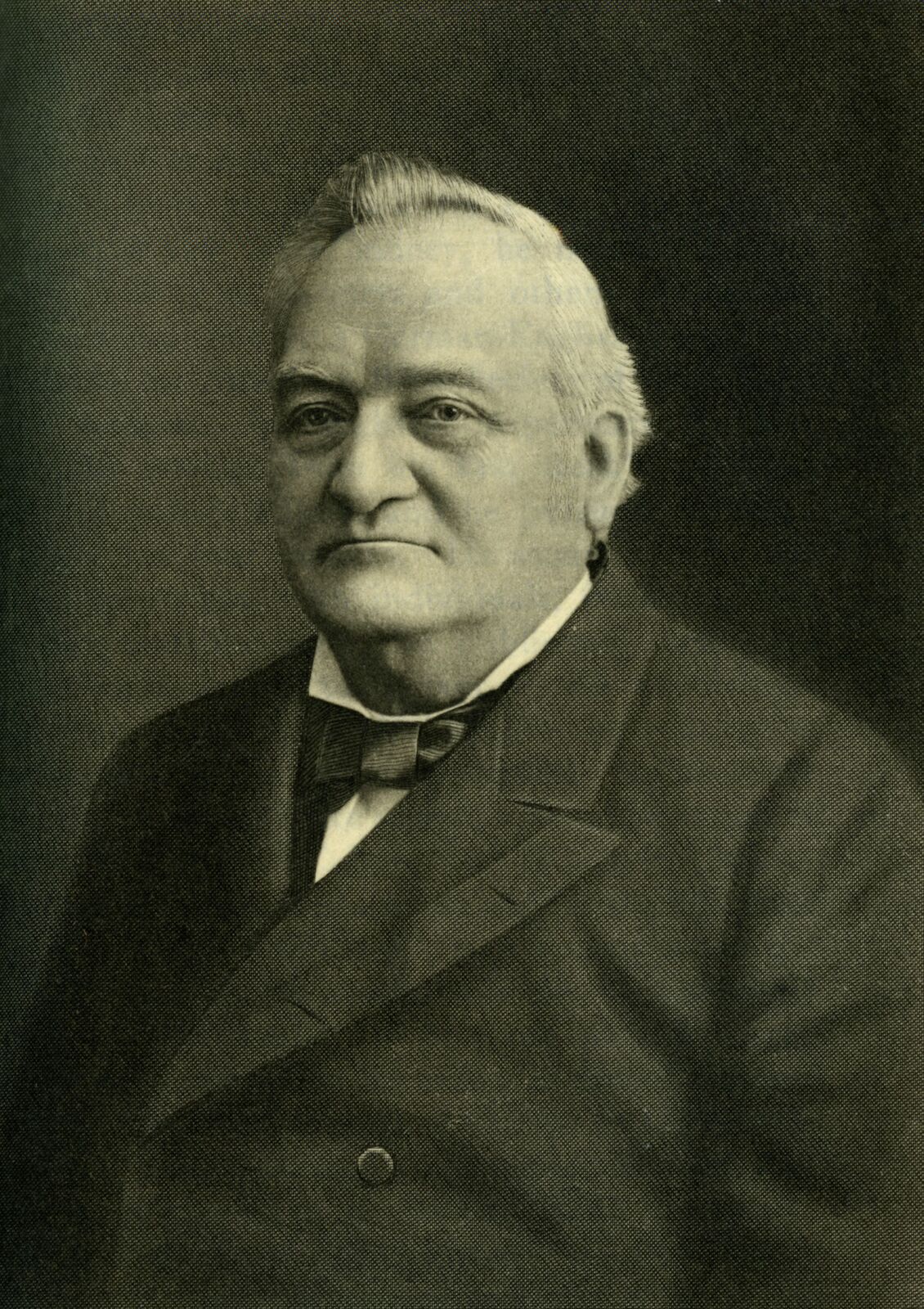
Dr. Samuel B. Hartman
"He stated to me specifically and repeatedly that no drug or combination of drugs, with the possible exception of quinin for malaria, will cure disease."
Samuel Brubaker Hartman was born in 1830 in Pennsylvania — Dauphin County per the DPLA/Columbus Metropolitan Library portrait record, which gives an exact date of March 1, 1830, though Sullivan (2007) instead gives Lancaster County and describes a German-Swiss farming family. Accounts of his medical training differ in detail: Sullivan (2007) has him apprenticing to a doctor in Medway, Ohio, and graduating from a medical school in Cleveland; Lockhart et al. (2025) states he graduated from the Jefferson Medical College in Philadelphia in 1857 and then practiced twelve years in Millersville, Pennsylvania. A contemporary Reading, Pennsylvania newspaper called him one of Lancaster’s best citizens and most popular physicians (Lockhart et al. 2025, quoting the Reading Times, July 23, 1867). In 1867 he purchased the rights to Mishler’s Herb Bitters and began selling patent remedies alongside his practice; by 1879 he was advertising his own formulas, La-cu-pia and Peruna, and around 1890 he gave up medical practice entirely to run the patent-medicine business full time from Columbus, Ohio (Lockhart et al. 2025; Sullivan 2007).
A doctor who redefined disease itself
Hartman’s authority rested on his medical credentials and his own repeated diagnosis: that “catarrh” — ordinary inflammation of a mucous membrane — was the hidden root of nearly every ailment, curable by his bottled tonic. His 1901 booklet “The Ills of Life” walked readers through pneumonia, dyspepsia, Bright’s disease, heart disease, and more, each recast as a form of catarrh that Peruna could reach (Adams 1907). Samuel Hopkins Adams, who interviewed Hartman in person for Collier’s Weekly in 1905, described him as “once a physician in good standing” running “the most prominent proprietary nostrum in the country” (Adams 1907). In that same interview, by Adams’s account, Hartman volunteered a strikingly different explanation of why Peruna seemed to work: “He stated to me specifically and repeatedly that no drug or combination of drugs, with the possible exception of quinin for malaria, will cure disease” (Adams 1907). A secondary account of the same 1905 conversation has Hartman explaining the mechanism as simple belief: customers saw the advertising, read the testimonials, were convinced, and felt the tonic’s mild stimulant effect as confirmation that they were being cured (Sullivan 2007, reporting Hartman’s 1905 remarks to Adams).
From millions in “bunco-profits” to a quiet exit
An Internal Revenue liquor-tax ruling forced Hartman to cut Peruna’s alcohol content and add laxatives, and sales collapsed; Collier’s mocked in 1907 that Hartman was left to retire on little more than the roughly twelve million dollars he had already made from the business (Adams 1907; Lockhart et al. 2025, quoting Colliers 1907). Hartman tried reviving the original high-alcohol formula under a new name, Katarno, sold through a separate New York company from 1906; a Katarno advertisement was still running as late as April 1913, but the brand never caught on and Peruna itself remained the only version of the product with any real sale (Lockhart et al. 2025). Hartman remained the company’s president until phasing out around 1916, two years before his death in 1918 (DPLA/Columbus Metropolitan Library portrait record; Lockhart et al. 2025). eventual_status: publicly_disconfirmed reflects Adams’s contemporaneous published exposé and Hartman’s own admission, quoted in it, that almost no drug — including his own — cures disease.