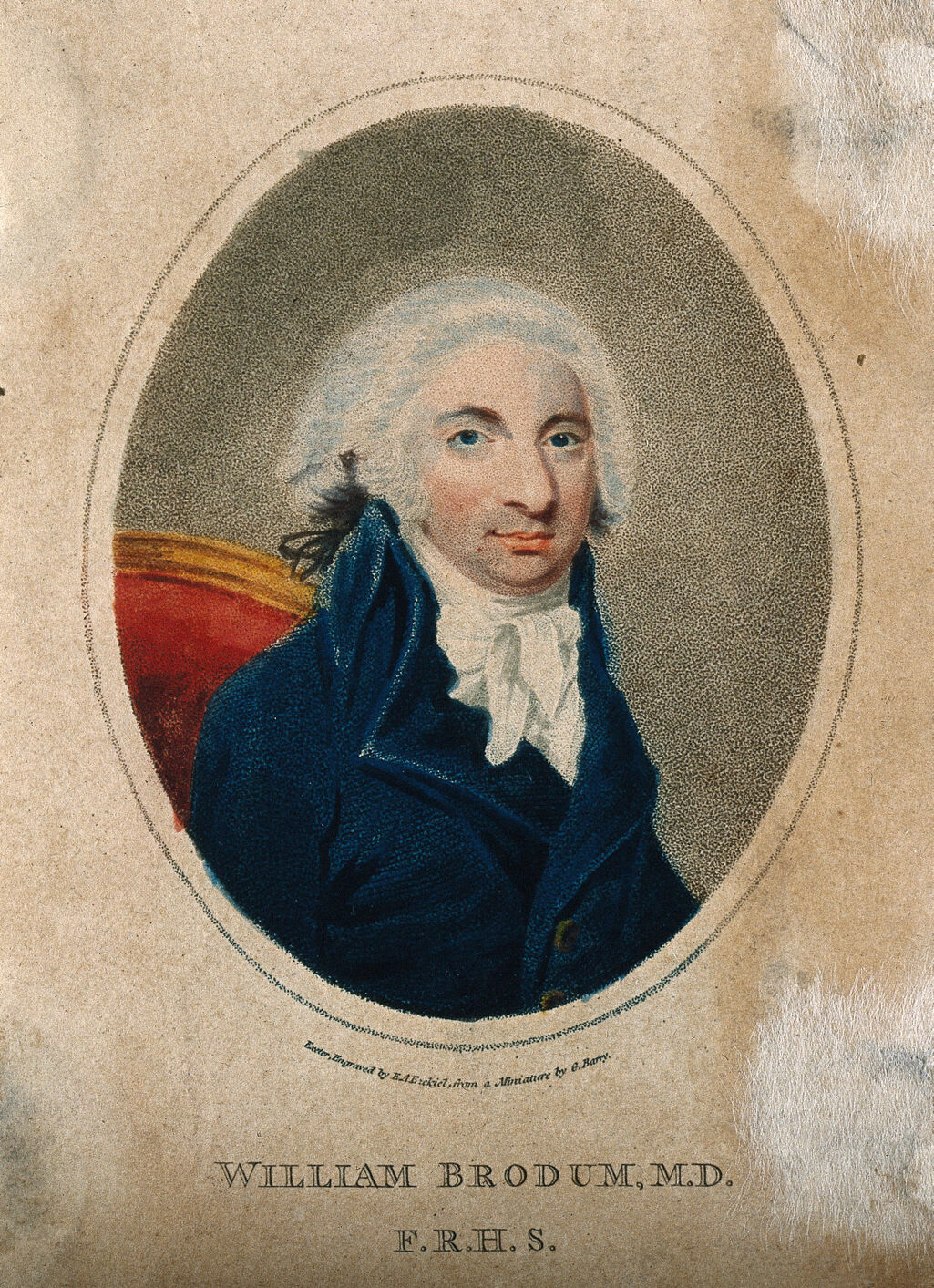
William Brodum
William Brodum was the proprietor of the Restorative Nervous Cordial and the Botanical Syrup, two of the best-publicised proprietary medicines of late-Georgian London, sold under royal letters patent from his premises at No. 9 Albion Street, Blackfriars. Alan Mackintosh’s study of the Georgian patent-medicine trade calls him “the most notorious” of the irregular medicine owners: “Although he claimed to have been trained as a military practitioner in continental Europe, Brodum was regarded as an irregular practitioner”, and, “often itinerant, he bought an MD from Marischal College, Aberdeen for 13 guineas, and aggressively publicised both himself and his patent medicines” (Mackintosh 2017). The degree, bought rather than earned by examination, was the prop that licensed the title “Dr. Brodum” on his broadsides and title pages.
No exact birth date survives for Brodum. Mackintosh’s note that he later made an effort to be taken for a regular physician, “stopping his travelling and attending Westminster Hospital as a 45-year-old medical student” after his and the Manchester owner John Lignum’s documented July 1793 Leeds advertisements, places his birth at around 1750, the approximate year recorded in born_year here and to be read as an estimate rather than an exact date. His Jewish parentage and an alleged foreign birth were a subject of hostile comment in his own lifetime: the 1805 attack “Of Quacks and Empiricism” in the Medical and Physical Journal asserted he had been born in Copenhagen, but a defence printed in the same journal called that assertion one “given on no authority”, adding that it was “utterly false”, while acknowledging that he “was born of Jewish parents” and had “become a convert to the Christian faith”. The birthplace is therefore recorded here as contested, not settled.
Brodum was a celebrity of the trade as much as a vendor. Mackintosh records that his fame was such that an elaborate masquerade in 1802, attended by the Prince of Wales and two of his brothers, included a mock village shop labelled “Doctor Brodum’s shop”. The publicly_disconfirmed status attaches to his remedies and their claims, not to commercial failure: the business prospered, and Brodum sued over at least one published attack (the Medical and Physical Journal of 1805 records an action brought by “William Brodum, Esquire” against the publisher of the paper “on the subject of Quacks and Empiricism”). Informed contemporaries nonetheless classed him among the empirics. John Corry’s Detector of Quackery, in the edition titled Quack Doctors Dissected, named Brodum alongside Samuel Solomon and Elisha Perkins as “modern Empirics”, the same company the archive keeps for him here.