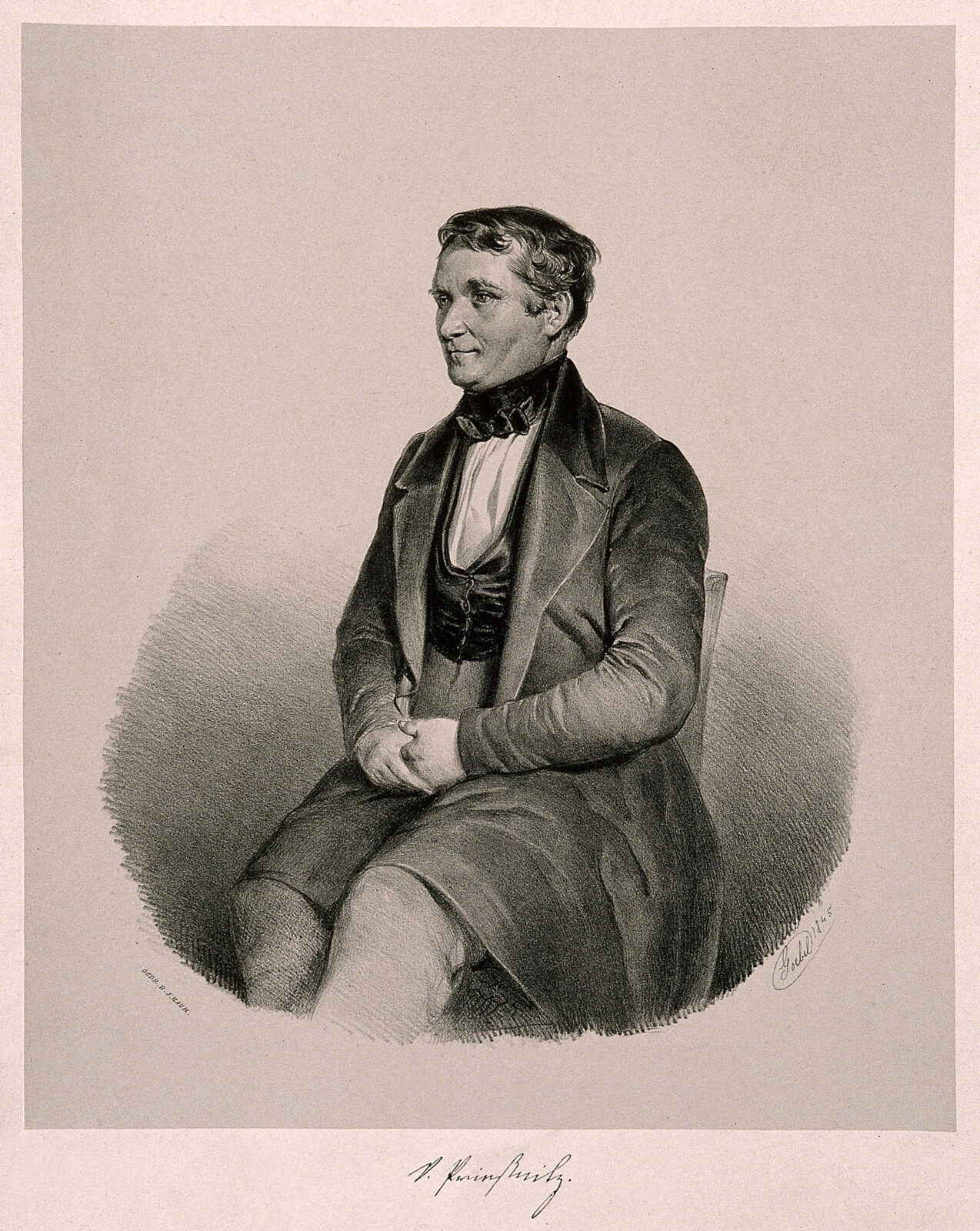
Vincenz Priessnitz
Vincenz Priessnitz (4 October 1799 to 28 November 1851) was born and died at Gräfenberg, near Freiwaldau in Austrian Silesia (now Lázně Jeseník, Czech Republic). He was the son of a farmer who lost his sight, attended the town school only briefly, and inherited the family holding; he had no medical training (Deutsche Biographie). According to the biographical column by S. Czeranko, his interest in cold water began with personal injuries treated by water as a youth: an injured wrist held under a cold-water pump at about thirteen, and broken ribs from an accident bound with wet bandages at about seventeen. From the 1820s he treated neighbours and then a widening public with water applications, building his first bathhouse at Gräfenberg in 1826 (having used a washing-trough before that) and obtaining government permission to run a cold-water cure establishment in 1831 (Deutsche Biographie).
The Vienna medical historian M. Skopec describes Priessnitz as “a small-scale farmer from Gräfenberg” who “from the 1820’s on aroused worldwide interest in hydrotherapy, on the basis of purely empirical observations.” His methods (the wet compress, the wet-sheet pack, partial and full baths, the douche, the cold plunge, and the sweating pack, with copious cold-water drinking, exercise, open-air exposure, and a spare diet) were lay innovations, not derived from any published theory; the Deutsche Biographie records that he worked from humoral-pathological views and published no writings of his own. His clientele grew from 49 patients in 1829 to 1,780 by 1839 and reached the high nobility: Claridge’s 1842 account lists an archduchess, ten princes and princesses, and at least 100 counts and barons among about 500 patients in residence in 1841. In 1846 he received the large gold medal of merit from the Austrian Emperor. He died at Gräfenberg in 1851 at the height of his fame. The status is recorded as quietly faded because the Priessnitz system, never put on a controlled-evidence footing, was superseded as scientific hydrotherapy developed (Wilhelm Winternitz at Vienna from 1864) and as modern medicine displaced the humoral framework on which his cure rested; what survived were specific water-application techniques, not the universal-cure claim.