Hulda Clark zapper
In 1993 Hulda Clark claimed that one parasite caused all cancers and that a recipe of five products would stop it in five days. Sellers quote her battery pulse from the 1995 diseases book. A 2004 order barred the named defendants, including David P. Amrein, from the disease claims without scientific evidence, and recorded no admission. A 2024 review found no clinical evidence for the device. Devices under her name are still for sale.
The page that said to cancel the date
The sellers’ pages reproduced a passage of The Cure for All Cancers telling a reader with a surgery date to cancel it. The Federal Trade Commission’s 2003 complaint quotes that sellers’ passage. It speaks to a person scheduled for surgery, chemotherapy, or radiation, and it answers yes to canceling that date. Stephen Barrett, quoting the 1993 book, reports Clark’s claim that the human intestinal fluke caused all cancers and that a recipe of five products would stop the cancer in the first five days. A companion passage in the same complaint says she found evidence of one parasite in every cancer case she examined, that smoking, diet, and the other usual explanations were not the cause, and that she held publication until a count of 100 cases passed in December 1992.
The person in front of that page had credentials a reader could check. Hulda Regehr Clark was born on 18 October 1928 in Rosthern, Saskatchewan, and died on 3 September 2009 in Chula Vista, California, at age 80. Her family’s death notice says she earned a bachelor’s degree and a master’s degree from the University of Saskatchewan and a Ph.D. from the University of Minnesota in 1958, that scientific work began in 1965 at Indiana University in Bloomington, and that she later ran a nutritional consulting practice, published seven books, and established a clinic in Tijuana. The notice says critics challenged the work and that she kept going until she was 79.
Order the box yourself
Access was a website, not a sealed lease. The sellers’ reproduced cancer-book passage tells the reader to order the supplies and to use the herbal program together with the zapper. A sellers’ page in the same complaint dates that device’s arrival to 1994. The complaint says that from 1999 at the latest two companies sold the Super-Zapper Deluxe, the Syncrometer, a 21-day program for advanced cancers, and an herbal program containing cloves, black walnut hulls, and wormwood. The companies were Dr. Clark Research Association, listing 8135 Engineer Road, San Diego, and Dr. Clark Behandlungzentrum GMbH, doing business as Dr. Clark Zentrum, with addresses in Munchenbuchsee and Hergiswil. The sites named in the complaint are drclark.com and drclark.net, aimed at buyers in the United States.
A clinic sat beside the mail-order path. Stephen Barrett’s Quackwatch account says Century Nutrition, in Tijuana, charged a basic fee of $4,500 plus 10 percent tax for two weeks of treatment, with room, meals, tests, supplements, and dental work on top. He also reports devices sold as matching her specifications at about $10 to more than $200. Those are his figures, not a court tally.
The device is still a retail object. On 14 October 2026 the Zapper Store page listed a Hulda Clark Parasite Zapper, the ElZapp (2024), as in stock. The same page offered shipping to the United States, Canada, and Australia. On 14 October 2026 the Health Products 2 category page listed several devices under Hulda Clark’s name. The complaint’s internet sales and these two later shops are why this case treats access as broad.
Five to ten volts, three times
The sellers’ reproduction of the 1995 diseases book says a positively offset direct current of 5 to 10 volts, applied for seven minutes and repeated for three treatments, kills bacteria, viruses, and parasites together. The quoted passage allows any frequency from 10 Hz to 500,000 Hz. It says the first pass kills the organisms, the second kills what the dying parasites release, and the third leaves none she can find. A sellers’ page reproduced in the same complaint dates the device’s arrival to 1994. A 2004 letter in the New England Journal of Medicine describes one unit, used by a 52-year-old man with a pacemaker, as a battery-powered square wave at 33.3 kHz, plus or minus 10 percent, applied to both hands. The letter cites her 1995 diseases book. It is one patient’s device, not a specification for every later unit.
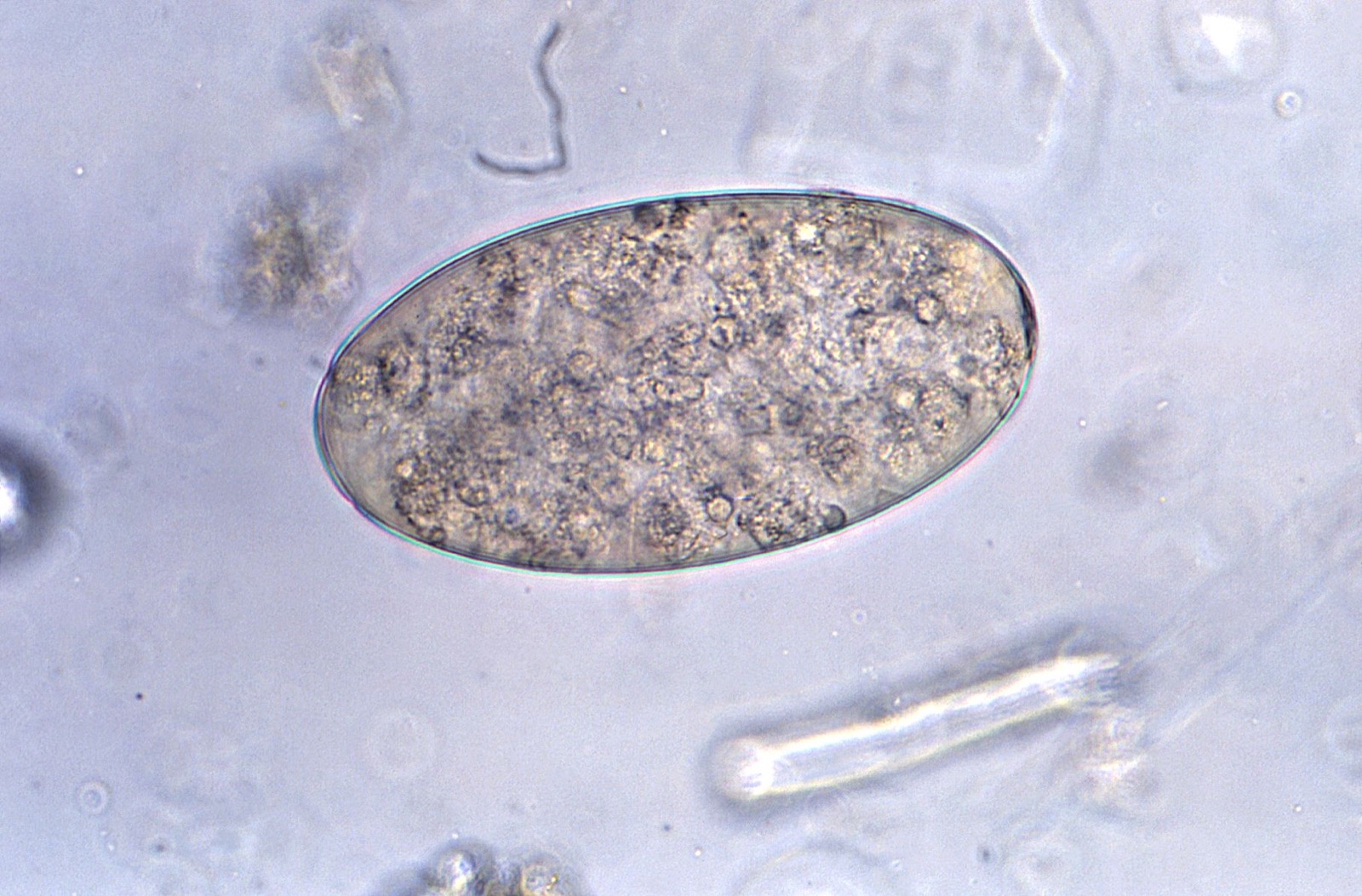
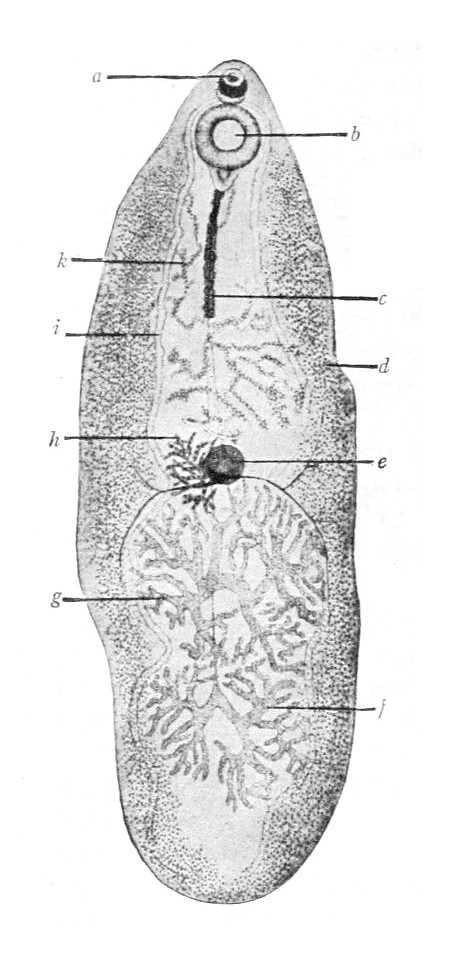
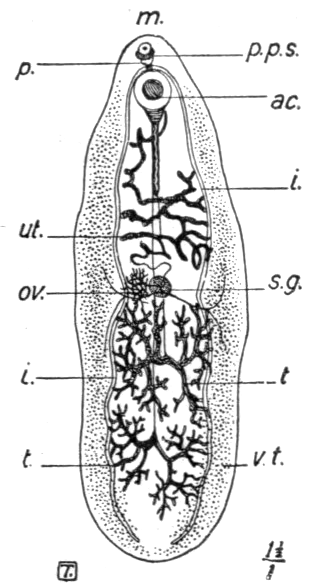
Stephen Barrett, quoting the 1993 book, identifies the parasite as the human intestinal fluke and says she named propyl alcohol as what let it establish in the liver. Science Feedback’s 2024 review names the species Fasciolopsis buski. A plate credited to Maximilian Braun, in The animal parasites of man (New York: William Wood, 1908) and dated 1911 on the Commons record, draws the whole animal. The lead photograph on this case is a 1979 Centers for Disease Control image of one egg, by Dr. Mae Melvin. It is a public-domain CDC photograph, not a specimen from Clark’s clinic and not a picture of the device. The same species is drawn in the 1908 Braun plate and in a 1919 textbook plate. Science Feedback says it is not passed from person to person and is found mainly in South and Southeast Asia.
The sign she treated as success was her own meter. The complaint reproduces a sellers’ passage claiming the Syncrometer is more accurate than the best existing testing methods, that it returns a positive or a negative rather than a quantity, and that the chance of a wrong call is about 5 percent. Barrett describes it as a galvanometer measuring skin resistance. Science Feedback describes it as a galvanometer with no diagnostic value. Barrett reports that the book labels 103 of 138 cancer patients cured, many without a recorded medical diagnosis, and that the book marks some cured where it noted a death within weeks. The meter reading is the surrogate the program put in place of a biopsy.
The books, the clinic, and two other companies
The stake in the record is Clark’s books and Tijuana clinic, alongside two companies the complaint says sold the Super-Zapper Deluxe. The death notice records the seven books and the clinic. Barrett writes that she owned New Century Press, the house that published the books, and he reports the Century Nutrition fee above. That is a direct stake in the books and the clinic. It does not say what share, if any, she had of the device companies.
The complaint names David P. Amrein as an officer of both corporations, and he signed the 2004 stipulation as president of each. The order requires a refund of the purchase price, including shipping, handling, and taxes, to each notified United States purchaser who asks within ninety days of the notice. It does not state how many people asked or what sum was paid. On 30 July 2004 the Commission filed an amended complaint correcting the spelling of the Swiss company’s name. The complaint’s spelling and the order’s spelling are both retained here, each with its own document.
The 2026 prices are not the 1990s prices. Zapper Store displayed the ElZapp (2024) at $1,800 against a comparison figure of $2,300. Health Products 2 displayed a Zapper Digital Ultra Trio at $589.05 and a Zapper Digital Professional V3 at $869.05, among other items on the category page. Barrett’s earlier device range and the clinic fee sit on a different scale. This case assigns no single price tier.
An order that admits nothing
The stipulated order states that the Commission filed the complaint on 8 January 2003. The complaint alleges that the defendants lacked a reasonable basis for the disease claims, including that the Super-Zapper Deluxe kills bacteria, viruses, and parasites and is effective against chronic infections, cancer, and AIDS, and that the program makes surgery and chemotherapy unnecessary. Those sentences are allegations.
Finding 8 of the 2004 order says the judgment is not an admission by the defendants and not a finding that they violated the FTC Act. Judge John R. Adams signed the order on 22 November 2004. Section I enjoins the named defendants, and persons in active concert who receive notice, from making the listed disease claims unless they possess and rely on competent and reliable scientific evidence at the time. Finding 9 says the judgment resolves the claims against the named defendants and leaves the Commission free to proceed against other persons.
A 2024 Science Feedback review found no clinical evidence that a low-voltage device kills parasites or helps people with cancer, Alzheimer’s disease, diabetes, or AIDS. Iria Carballo-Carbajal’s review, posted 12 January 2024, rates that claim incorrect. That 2024 review said the zapper was still marketed online as a cancer treatment, which addresses the claim still being sold and does not review the two shops read for this case. The review also says that, in one of the FTC’s cases, which it does not name, affidavits by a cancer specialist and a parasitologist described the theories as bad science. This case does not treat that description as a finding in the 2004 order.
The Zapper Store page describes a zapper as a holistic parasite killer and lists immunodeficiency diseases, including HIV and AIDS, and various types of cancers, among the conditions it presents the device for. The Health Products 2 category page says the device emits frequencies to disrupt parasites, bacteria, and viruses and addresses chronic illnesses including digestive issues, fatigue, and weakened immunity.
The authors of the New England Journal of Medicine letter reproduced the man’s dizziness and near-fainting while the device inhibited his pacemaker. The letter says the man’s pacemaker was pacing within its settings, that high-frequency signals and ventricular oversensing appeared during use, and that the package carried a pacemaker warning he disregarded. One patient. No cancer result is reported there.
Barrett reports an April 2000 dismissal of Indiana practicing-without-a-license charges on speedy-trial delay, not on the merits of the charges. Barrett writes that in February 2001 Mexican authorities ordered Century Nutrition shut and later limited it to conventional care, and that he could not confirm a fine had been withdrawn. This case leaves that fine where he left it.
A 1919 plate in Patrick Manson’s Tropical Diseases, filed on Commons as figure 193, draws the species Science Feedback places mainly in South and Southeast Asia. The 1993 book made it the cause of all cancers.
The pattern repeats
The same structural machinery appears in different treatments and eras. These cases show the claimed mechanism and how the claim met evidence.
Electronic Reactions of Abrams (ERA)
Overbeck's Rejuvenator
I-ON-A-CO
Part of the lineage
Evidence · 11 sources
- FTC v. Dr. Clark Research Association, complaint (2003)
- FTC v. Dr. Clark Research Association, stipulated final judgment (2004)
- Hulda Regehr Clark obituary, San Diego Union-Tribune (2009)
- The Bizarre Claims of Hulda Clark (2009)
- Hulda Clark's zapper device is based on pseudoscience; doesn't kill parasites or cure diseases (2024)
- Hazards of an alternative medicine device in a patient with a pacemaker (2004)
- Zapper Store, Hulda Clark Parasite Zapper ElZapp (2024) (2026)
- Health Products 2, Dr. Hulda Clark Zappers category (2026)
- File:Fasciolopsis buski egg 08G0039 lores.jpg (1979)
- File:Fasciolopsis buski Giant intestinal fluke.JPG (1911)
- File:Tropical Diseases - Fig 193.png (1919)