Liquozone (Liquid Ozone Company, Chicago)
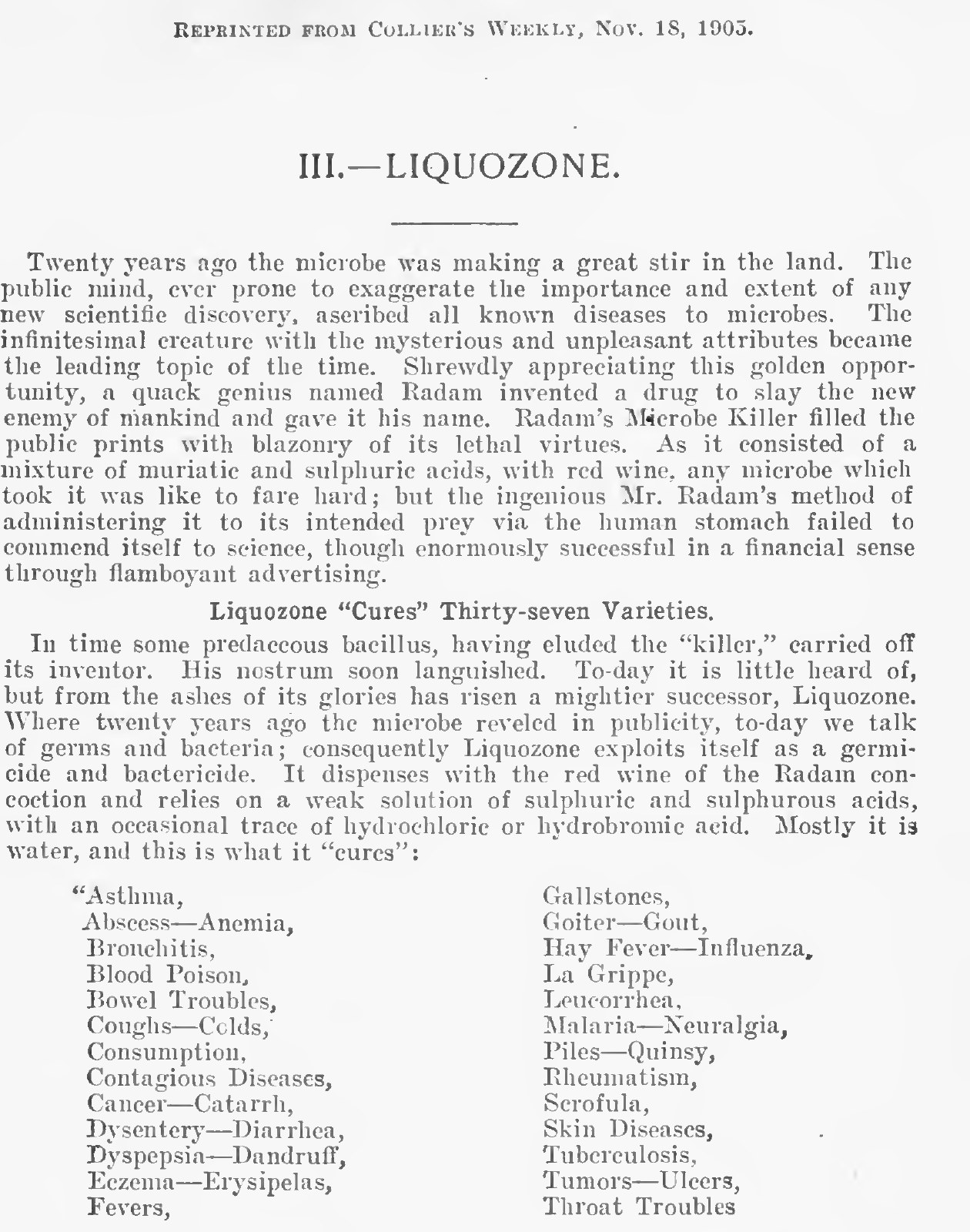
Liquozone's early advertising announced that it was "liquid oxygen" and "that is all," a germ-killer for complaints running from dandruff to cancer and consumption. Collier's analysis found dilute sulphuric and sulphurous acid in nearly 99 per cent water. In laboratory tests reported in October 1905, run with a company representative present, every guinea pig dosed against anthrax or diphtheria died. The adman behind it later put one year's net profit at $1.8 million.
Professor Pauli, late of the piano trade
The founding legend appeared in a company pamphlet: Liquozone was “the discovery of Professor Pauli, the great German chemist, who worked for twenty years to learn how to liquefy oxygen,” while men laughed at him. The professor did not survive contact with the company’s lawyers. When Samuel Hopkins Adams examined the product for Collier’s Weekly in 1905, the pamphlet had been withdrawn, and the Liquozone people conceded that Pauli’s original was Mr. Powley, “the ex-piano man of Toronto,” whose mixture, Powley’s Liquefied Ozone, had been “guaranteed to kill any disease germ known to science.” The company’s defence was that turning Powley into Pauli had been “a harmless flight of fancy.”
The man who bought Powley out was Douglas Smith (1861–1927), whom Adams introduced as “by profession a promoter” with “a keen vision for profits.” Smith moved the business to Chicago and organized it as the Liquid Ozone Company; a blog cataloguing artifacts from Illinois State University’s Old Main building, among them a Liquozone bottle, citing a later business history by Jeffrey L. Cruikshank and Arthur Schultz, dates the purchase to 1898. Claude C. Hopkins, the advertising man who joined the company, did not name the buyer in his 1927 memoir, but his account of the same purchase describes a Chicago man who had “made a small fortune out of the Oliver typewriter” and paid $100,000 for the product. “His powers of persuasion were almost resistless,” Hopkins added.
Smith’s authority was mostly borrowed. “Liquozone has the indorsement of an overwhelming number of medical authorities,” one pamphlet said, and Adams went through the authorities. Dr. Frank Billings of Chicago, whom the company cited as a private admirer, wrote to Collier’s on 31 July 1905 that he had never recommended Liquozone “in any way to any one.” A young Michael Reese Hospital physician, paid $25 to test the fluid in culture tubes, had certified germicidal properties there while telling the company’s agent the mixture would be worthless as medicine. A glowing notice credited to The New York Journal of Health came from a magazine that, Adams found, did not exist. Of five Chicago institutions advertised as constant users, Hull House said it had never used the nostrum and the Evanston Hospital said it knew nothing of it.
A free bottle at the corner druggist
Nothing about Liquozone was scarce. The early business went badly; by the time Hopkins was approached, he wrote, its balance sheet showed “some $45,000 less than nothing.” His remedy was to “buy the first fifty-cent bottle” for anyone who answered an advertisement: the respondent got an order on a local druggist, the company paid, and it then offered “a guaranty on six dollar bottles.” In the following year, by his count, the company received over 1,500,000 requests for the free bottle, at an average cost of 18 cents a request against average sales of 91 cents. He then took it abroad: a London office of 306 people, a factory in France, and, within two years, advertising in seventeen languages.
The advertising reached even the reform press. James Harvey Young, the historian of American patent medicine, records that William Jennings Bryan’s Commoner carried full-page Liquozone advertisements while Bryan denounced corporate immorality; when Collier’s editor Norman Hapgood chided him for it, Liquozone’s proprietor sent a lawyer to talk to Hapgood, and Collier’s crusade against patent medicines followed. By Adams’s account of late 1905, the revised campaign was still being “scattered broadcast to-day.”
Liquid oxygen at room temperature
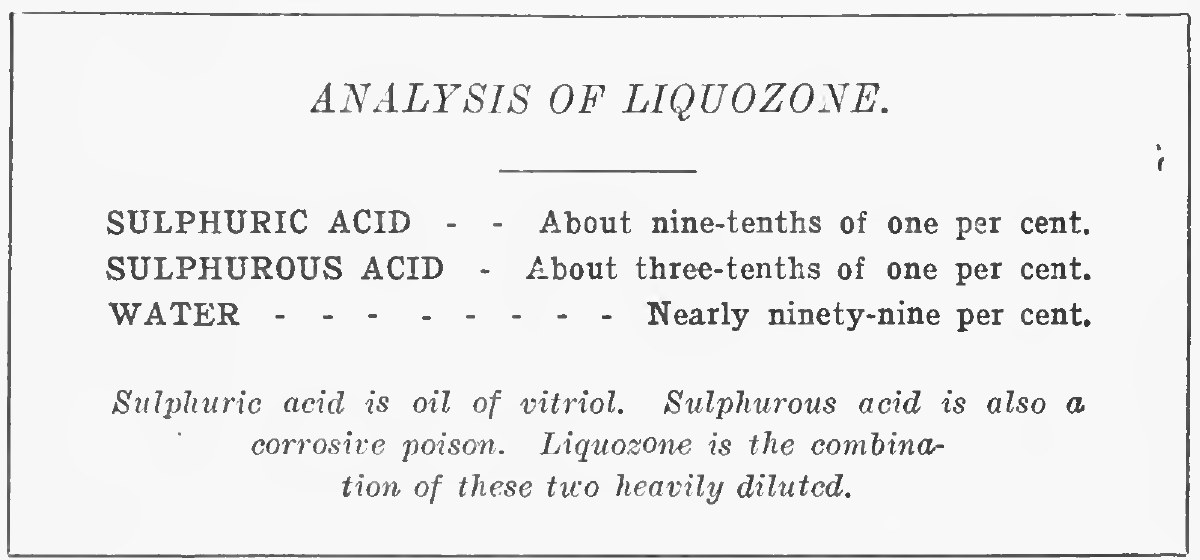
The early copy put it plainly: “Liquozone is liquid oxygen,” Smith’s advertising declared, “that is all.” Adams supplied the cryogenics. A spoonful of genuine liquid oxygen “would freeze a man’s tongue, teeth and throat to equal solidity before he ever had time to swallow,” and the undertaker would have to thaw him out for a respectable burial. What was actually in the bottle was simpler. The analysis Collier’s printed gave about nine-tenths of one per cent sulphuric acid, about three-tenths of one per cent sulphurous acid, and nearly ninety-nine per cent water. The company’s own revised booklet conceded that “Liquozone contains no free oxygen.”
The theory was germ theory stretched over everything. The advertised list, as Adams printed it, ran from asthma and dandruff through consumption, cancer, tuberculosis and blood poison to “all diseases that begin with fever,” each to be conquered by destroying its germs inside the human body. The revised pamphlet blamed germs for gout, goiter, dyspepsia and “most forms of kidney, liver and heart troubles,” and explained the selectivity: “Liquozone is deadly to vegetable matter, but helpful to animals,” and germs were vegetables. Adams observed that malaria, also on the list, was known to be caused by animal organisms in the blood, which by the pamphlet’s own logic Liquozone should help along.
Manufacture, the company said, required large apparatus and eight to fourteen days of impregnating water with gas. Adams inspected the huge wooden vats and could “testify to their impressive size.” He judged the product “precisely the same as could be achieved in fourteen seconds by mixing the acids with the water.” Young later made the comparison in one sentence: like Radam’s Microbe Killer, Liquozone was about 99 per cent water, minus Radam’s red wine.
A bankrupt concern and a quarter share
Ownership and control sat with a small circle. Adams called Smith “the head and center” of the enterprise and its president, and reported that Smith persuaded members of the company’s Chicago law firm to take stock and two of them to become directors; the lawyers, he wrote, accepted the testimonials at face value and did not examine the advertising. Hopkins joined on terms that tied his income to the company’s success: “I was to be given no salary,” he wrote; “In lieu of that, I was to have a one-fourth interest” in what he called a bankrupt concern.
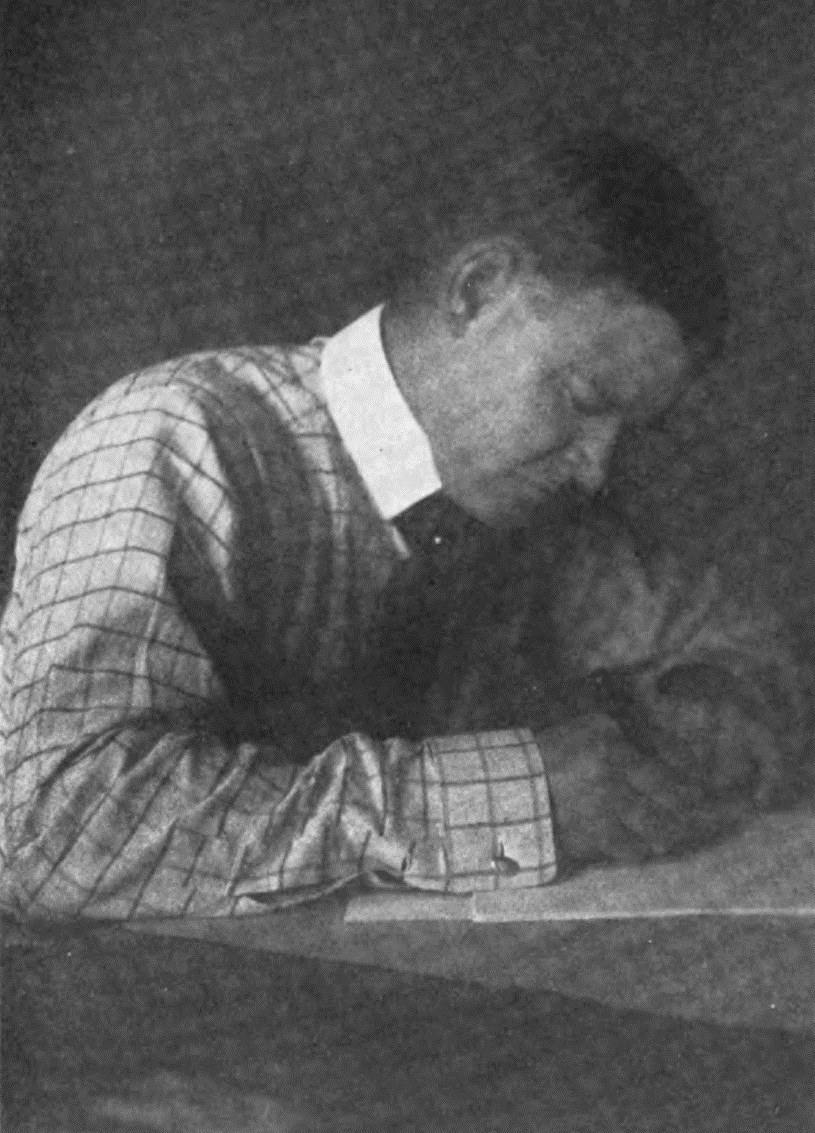
The free bottle was a sales cost, and Hopkins kept the ledger. Each request cost 18 cents and brought back 91 cents. In the first fiscal year after he arrived, he wrote, “our net profits were $1,800,000,” and in three years the company paid for nearly five million fifty-cent bottles for the public. These are his own figures in his own memoir, not audited accounts. The company also advertised a reward, $1,000 by Adams’s understanding, for any germ Liquozone would not kill; Adams called it “a pretty safe offer,” since nothing restricted how the unfortunate germ might be treated: it could be frozen solid in the bottle, or boiled. Of the testimonial side of the business, Adams later wrote that Liquozone, under its original management, “exhibited less conscience in its methods than any of its competitors that I have encountered,” and he reported that the company had written across the face of one customer’s testimonial letter: “Can change as we see fit.”
Twenty-four guinea pigs and a witness from the company
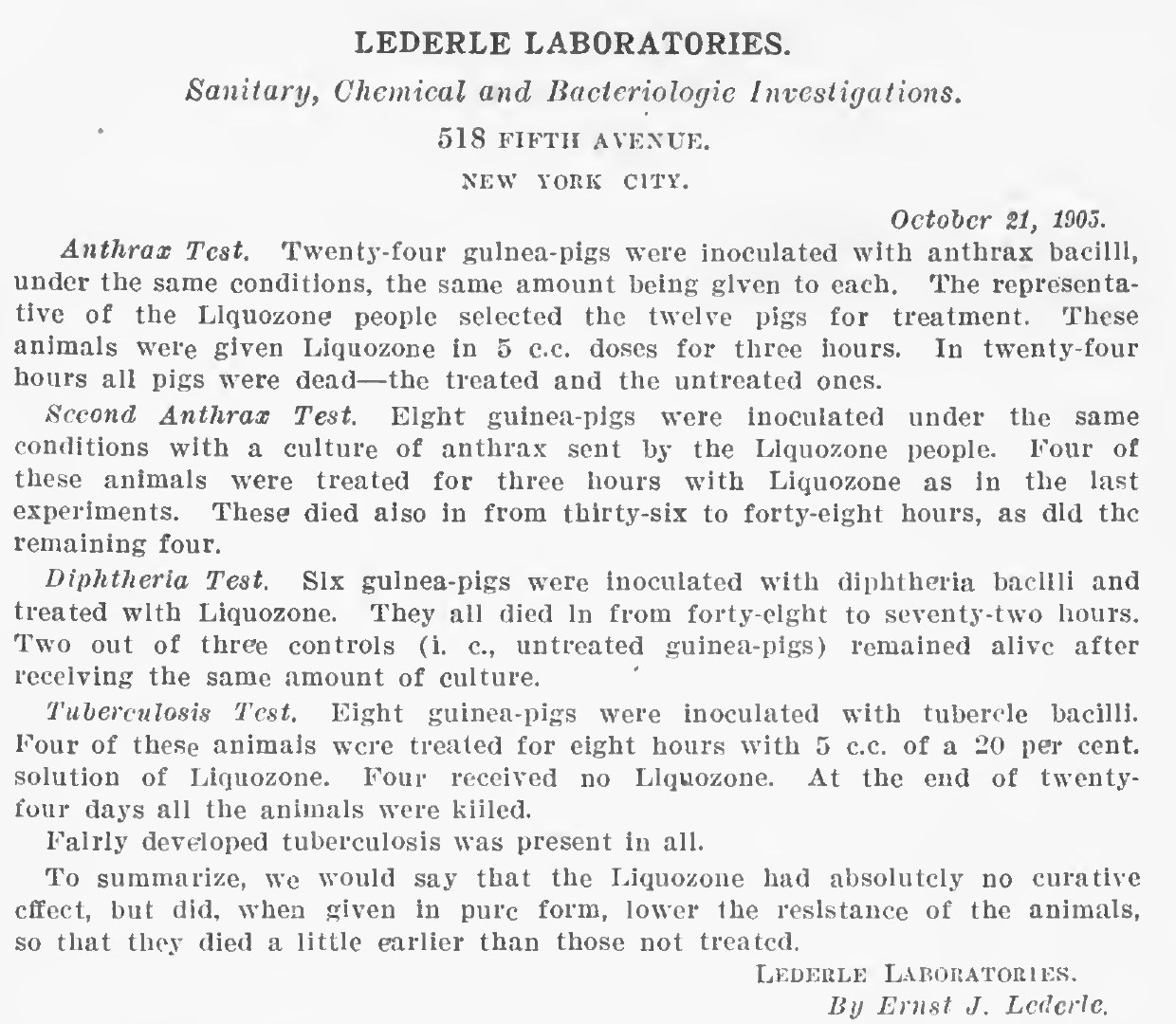
Collier’s waited more than four months for evidence that Liquozone killed germs inside a living body and received, Adams wrote, nothing but “specious generalities” and testimonials. During that wait it arranged tests at Lederle Laboratories in New York, with Dr. Gradwohl, representing the Liquozone Company, present and taking part. The report, dated 21 October 1905 and signed by Ernst J. Lederle, is short. Twenty-four guinea pigs were inoculated with anthrax, and the company’s representative picked the twelve to be treated; within twenty-four hours, all pigs were dead, treated and untreated alike. A second anthrax test, with a culture the Liquozone people supplied, ended the same way. All six guinea pigs inoculated with diphtheria and given Liquozone died, while two of three untreated controls survived. Every animal in the tuberculosis test had tuberculosis at twenty-four days, dosed or not. The laboratory concluded that Liquozone “had absolutely no curative effect,” and that in pure form it lowered the animals’ resistance, “so that they died a little earlier than those not treated.” Gradwohl said he was satisfied the tests were fair and that, in his opinion, they had proved “the total ineffectiveness of Liquozone as an internal germicide.”
The physician whose culture-tube certificate the company circulated told Adams that “its action would be harmful when taken internally,” and reported a case of gastric ulcer he thought probably due to its use. Adams recorded that North Dakota had forbidden its sale and that San Francisco and Lexington, Kentucky, had decreed against it. Facing that pressure, the company had already rewritten its copy in the summer of 1905 under the eye of its lawyer-directors: liquid oxygen, Professor Pauli and the testimonials were dropped, and the new copy no longer said Liquozone would cure any listed disease. It printed “I’m well because of Liquozone” in large type instead, above a list of diseases “where it applies.” Adams concluded that the reformed product was still what it had been, “a fraud.”
Hopkins, writing in 1927, offered a different summary: “Germicides are uncertain propositions,” and “We made hay while the sun shone.” The business, he added, still existed and was still profitable. Douglas Smith died in 1927. By then, the Made-in-Chicago Museum records, Chicagoans knew him best as a bank president and philanthropist, the donor of $1 million toward medical research at the University of Chicago.
The pattern repeats
The same structural machinery appears in different treatments and eras. These cases show the claimed mechanism and how the claim met evidence.
Part of the lineage
Evidence · 10 sources
- The Great American Fraud, chapter III: Liquozone (1905)
- The Great American Fraud, chapter VI: The Fundamental Fakes (1906)
- My Life in Advertising (chapter: My Liquozone Experience) (1927)
- The Toadstool Millionaires, chapter 13 (The Great American Fraud) (1961)
- Pepsodent Company, est. 1915 (Made-in-Chicago Museum) (2022)
- Liquozone Company, Chicago, IL (Old Main Artifacts) (2014)
- The Great American Fraud (1907), scanned edition (Wikimedia Commons PDF) (1907)
- Photograph of Samuel Hopkins Adams (Wikimedia Commons, from The Bookman) (1907)
- Microbes and the Microbe Killer (1890)
- Apparatus for Impregnating Liquids with Gases (US Patent 412,664) (1889)