Rife frequency generator (Rife machine)
In June 1931 Royal Raymond Rife warned against "medical fakers" who claimed electrical cures — then argued radio waves at a Mortal Oscillatory Rate could destroy pathogens. A 1938 account has him stopping short of a cancer cure. Cancer Research UK finds no reliable evidence. A 2026 shop still says the frequency will work for cancer, at $869 with straps.
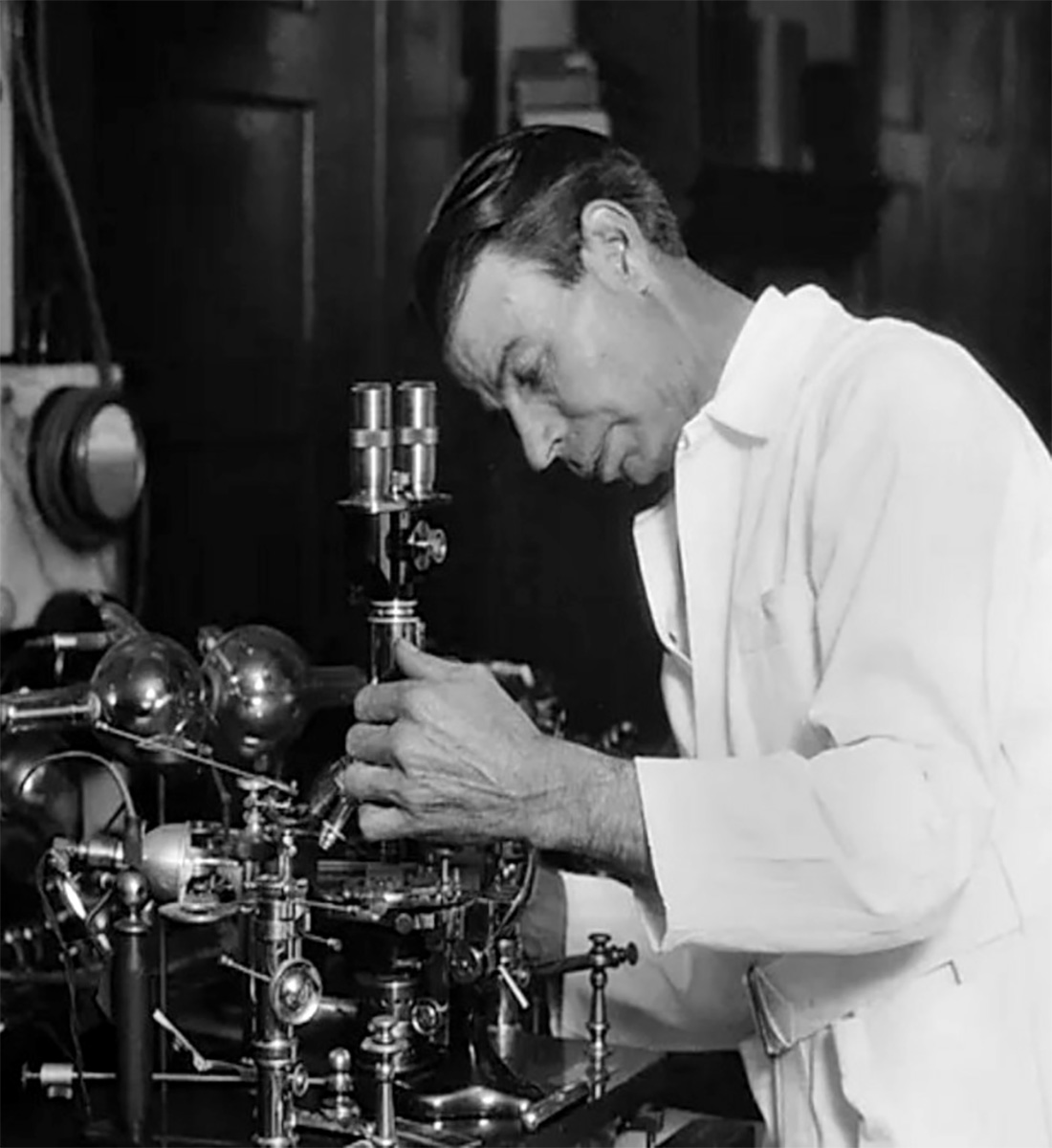
A warning about “medical fakers” in 1931
In June 1931, Royal Raymond Rife warned against “medical fakers” who claimed to cure disease with electrical vibrations. His own work, he said, did not uphold those claims. The warning appears in Wikipedia’s account of H. H. Dunn’s Popular Science profile. The irony writes itself later: devices bearing his name became a cancer-cure catalog item, and a 2026 seller still says the frequency will work for cancer. Rife was 43 in that profile: an inventor born in Elkhorn, Nebraska, on 16 May 1888, who would die in El Cajon, California, on 5 August 1971, aged 83. The biography notes that little reliable information about his life has been published.
The same biography describes the optical microscopes Rife built in the 1930s, his claimed magnifications of 17,000 times or more, and his time-lapse films of microbes. The reported false-colour effect was vivid: turquoise for typhoid bacteria, ruby red for Mycobacterium leprae, a colour said to come from that microbe alone when lit at a particular wavelength. He also reported a beam-ray device that could destroy microbial pathogens. A laboratory photograph dated 2 November 1929 shows him with one of his microscopes, according to its Wikimedia Commons record.
The distinction between destroying organisms and curing a patient matters to this story. In the biography’s account of Newell Jones’s San Diego Evening Tribune article of 6 May 1938, Rife stopped short of claiming he could cure cancer. He argued he could “devitalize disease organisms” in living tissue, “with certain exceptions.” His proposed mechanism was a “Mortal Oscillatory Rate”: radio waves tuned to that frequency could destroy the pathogenic organism. Cancer Research UK dates the machine to the 1920s and calls him an American scientist; the present-day seller Health Products 2 calls him “Dr. Royal Rife.”
In 1987, Barry Lynes’s book The Cancer Cure That Worked claimed Rife had succeeded in curing cancer. Wikipedia reports that the American Cancer Society described the book’s claims as implausible, and that devices bearing Rife’s name were subsequently marketed as cures for diseases including cancer and AIDS.
A machine you order, and use at home
The current offer is a catalog page, not a closed clinic. Health Products 2, in Port Ludlow, Washington, lists a Rife Digital Professional V3 at $869, with straps for the hands and feet, a healing mat at $114, a belt at $104, and the V3 plus mat at $979. The page says the mat can be laid on the chest and the belt wrapped at the throat or the head, and that the shop delivers across North America and worldwide, including Canada.
Cancer Research UK says the machines cost hundreds to thousands of pounds. It describes the session as pads on the hands or feet, or a handheld plasma tube, for a few minutes a day, several times a week. My Eden Life’s buyer’s guide, dated 23 March 2026, sorts the same label into price bands: about $300 to $1,500, $2,000 to $7,000, $7,000 to $11,000 and up, an integrated unit around $14,997 (or about $1,497 a month for 12 months), and practitioner-grade systems from $30,000 to $50,000 or more. The page banner says pre-orders are open. In the guide’s own words, “They are not approved to diagnose, treat, cure, or prevent any disease.”
An earlier sale was just as direct. Quackwatch reports that Shelvie Rettmann of Prior Lake, Minnesota, sold a Rife device for about $3,500 and a radionics machine for $1,700. Its account of a December 1997 Wisconsin announcement says a woman diagnosed with advanced colon and liver cancer was told Rettmann could cure her. At a first meeting, Rettmann allegedly photographed the woman and her daughter with a Polaroid, put the photos in a cup on a radionics machine, and advised Rife-generator treatments, a special diet, supplements, baths, and foot zoning. Quackwatch says the mother paid $1,778.85 and the daughter paid $495.30. Those details are the announcement as Quackwatch reports it. The 1998 court findings are separate.
The same search returned an eBay page for Rife devices, but its listings could not be read.
Match the frequency, and the organism is supposed to shatter
Rife’s proposed Mortal Oscillatory Rate gave the treatment a precise-sounding target. Quackwatch draws the claim as a picture: the generator produces radio waves at the same frequency as the offending bacteria, and the bacteria shatter the way a crystal glass breaks at the voice of an opera singer. Cancer Research UK says Rife and his supporters claim that each condition has an electromagnetic frequency, and that an impulse at that frequency can kill or disable diseased cells.
The picture is still the sales pitch. Health Products 2 writes, “This will work for cancer, infectious diseases, autoimmune issues, and even chronic pain,” and says the machine emits a frequency that resonates with bacteria, viruses, or parasites. My Eden Life’s guide asks the reader to think of an opera singer shattering glass, and says every organism has a frequency.
Quackwatch says the American Cancer Society pointed out the gap in the image: sound waves can break glass, but radio waves at the power of a Rife generator do not have enough energy to destroy bacteria. Quackwatch cites the 1994 review in CA: A Cancer Journal for Clinicians for that bacterial limit. The PubMed abstract of the same review, PMID 8124604, is a cancer finding. It says the Society found no evidence of objective benefit in the treatment of cancer from the devices mentioned in the review.
What later sellers charged
These prices belong to later sellers. Rettmann’s Rife device was about $3,500, and the radionics machine $1,700. Quackwatch’s account of the September 1998 judgment in Scott County District Court says Minnesota Attorney General Hubert Humphrey III had obtained a finding of deceptive trade practices and consumer fraud: she sold devices without FDA approval and told consumers she could cure cancer with a “Rife generator,” a radionics device, foot zoning, and vitamins and supplements. On that account the judge concluded she had sold over $7,000 worth of devices, treatments, and products to a man in Anoka, Minnesota, with pancreatic and liver cancer; that she promised a faster cure if he stopped chemotherapy; and that he stopped after a single session and died four months later. The court barred her from providing health-care services or products, ordered refunds on request, and imposed civil penalties of $50,000 plus the state’s fees and costs. She had filed for bankruptcy in July 1998, before that September announcement. Quackwatch says a refund was not assured.
Health Products 2’s basic machine is $869. My Eden Life’s own example sits near $14,997, inside a guide that also describes systems at $30,000 to $50,000 or more. Rife had died on 5 August 1971.
On 12 February 2001, Larry D. Spears, Acting Director, Office of Compliance, Center for Devices and Radiological Health, wrote to Lin Kenny, president of Bioray, Inc., at 9220 Al Pkwy E in Birmingham, Alabama. The letter says the agency learned of the Bioray Sound and Light Generator from www.rifeworks.com, that FDA records showed no marketing clearance, and that marketing the product without clearance made it adulterated under section 501(f)(1)(B) and misbranded under section 502(o) of the Food, Drug, and Cosmetic Act. The letter addresses Bioray’s generator. Quackwatch, revising its article on 10 December 2012, said some sellers had grown more cautious about claims on the internet and that the generator was still being marketed.
The cancer claim, judged and still for sale
In 1994 CA: A Cancer Journal for Clinicians published “Questionable methods of cancer management: electronic devices.” No authors are listed. PMID 8124604. The abstract says the American Cancer Society “has found no evidence that treatment with the devices mentioned in this review results in objective benefit in the treatment of cancer in human beings,” and urges people with cancer not to seek treatment with those devices. Quackwatch cites this review for its assessment of the generators’ radio-wave energy; the abstract itself refers only to “the devices mentioned in this review.”
Cancer Research UK’s page, last reviewed 13 June 2022 and marked due for review, says: “There is no reliable evidence that the Rife machine works as a cure for cancer.” It says no reputable scientific cancer organisation supports the cure claims. The same page describes laboratory studies and one small study in people with hepatocellular carcinoma, a liver cancer, and says the frequencies in that research were not the frequencies of Rife machines. It notes reports of electrical shocks and rashes. It says a person could harm their health by stopping cancer treatment for an unproven treatment. Most of the cure claims it sees on websites are personal accounts.
Health Products 2 still says the frequency will work for cancer, and it still lists the $869 machine. My Eden Life’s guide keeps the pre-order banner next to its disclaimer that the devices are not approved to diagnose, treat, cure, or prevent any disease. The 1998 judgment Quackwatch reports was against Rettmann. Separately, Wikipedia reports that promoters of devices bearing Rife’s name have been convicted of health fraud, including a 1996 felony case over a device marketed as a cure for diseases including cancer and AIDS.
The pattern repeats
The same structural machinery appears in different treatments and eras. These cases show the claimed mechanism and how the claim met evidence.
Part of the lineage
Evidence · 8 sources
- Royal Rife (Wikipedia) (2026)
- Rife Machine Operator Sued (2012)
- Questionable methods of cancer management: electronic devices (1994)
- Rife machines (Cancer Research UK) (2022)
- FDA warning letter to Bioray, Inc. (12 February 2001) (2001)
- Rife Machines For Sale (Health Products 2) (2026)
- Rife Machines Explained: Ultimate Buyer's Guide (2026 Edition) (2026)
- Royal Raymond Rife in his Lab - November 1929 (1929)