Pritikin diet and exercise program
In a 1979 interview, Nathan Pritikin said life span on his diet should reach 100 to 120 years. The Los Angeles Times reported that his first book called diet a route to 20 to 30 extra years of vigorous life, and that stays cost several thousand dollars. A 2023 review of one trial with 26 people did not show convincing evidence of fewer deaths than minimal intervention, at very low certainty. Miami still books stays.
An engineer with a longevity center
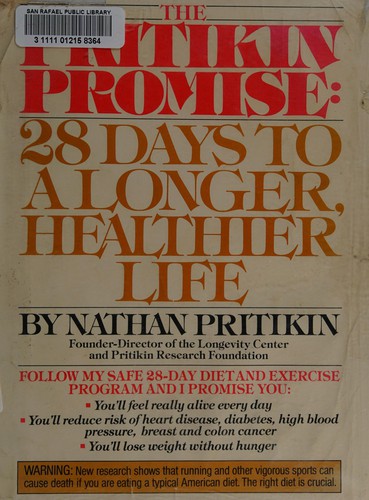
The Los Angeles Times, on 23 February 1985, reported that Nathan Pritikin had died at age 69. The paper called him a Santa Barbara nutritionist and a Chicago-born engineer and inventor. It said he found he was suffering from heart disease in 1957 and, in a separate sentence, that he developed heart disease in his early 40s. Those two datings are left as the paper gives them. He designed, the paper said, a diet of grains, fruits, and vegetables with a small amount of fish and poultry. The paper said he was convinced that strenuous exercise, and staying away from fats, oils, sugars, eggs, cheese, and salt, would prevent heart disease and would undo the damage of years of high-cholesterol eating, of drinking alcohol, and of smoking. His 1979 book, Pritikin Program for Diet & Exercise, hit best-seller lists. The paper said it sold nearly 2 million copies. He published three other books, the paper said, including The Pritikin Promise in 1983.
The same article reported that he killed himself in an Albany, New York, hospital where he was under treatment for terminal leukemia. A spokeswoman at the Santa Monica center said leukemia had been diagnosed in 1958, with remission until late in the preceding year, and that he also had anemia, kidney failure, and impending liver failure. The article does not treat that illness, or the manner of death, as a test of the diet.
Centers, a fee, and a public booking page
The paper said he founded his longevity center in Santa Barbara in 1974. It said he moved the center in 1978 to the old Del Mar Hotel, a former Synanon headquarters, on the beach at Santa Monica. It named further centers in Downingtown, Pennsylvania, and Surfside, Florida. The paper said enrollees paid several thousand dollars apiece to take part in programs of 13 or 26 days.
A 2022 paper on outpatient intensive cardiac rehabilitation states that the original Pritikin program began in 1976 as a residential lifestyle-change program. The center site, read on 8 November 2026, says it has been trusted by thousands since 1975. The three dates are not the same. Each is left with the source that states it.
On 8 November 2026 the center site offered a public Book a Consult control and listed a public telephone number for residential stays. The page described an immersive physician-led residential program, said stays begin at one week, and gave the address 8755 NW 36th Street, Miami, FL 33178. The footer carried a 2026 copyright line for the Pritikin Longevity Center. That open page is the basis for calling the current booking channel broad. The 1985 fee is not a finding about who was able to pay it.
A diet asked to add decades
The review defined its Pritikin category as carbohydrate at 70 to 75 percent of calories, protein at 15 to 20 percent, fat at 5 to 10 percent, and fiber at 40 to 45 grams per 1000 kilocalories. In a 1979 interview reported by the Los Angeles Times, Pritikin said the human life span should be 100 to 120 if people stayed on the diet. The Times said his first book, which the article does not name, stated that diet is probably the most feasible method of attaining an extra 20 to 30 years of vigorous life. Open Library edition OL3175165M records The Pritikin promise, with the subtitle 28 days to a longer healthier life, by Nathan Pritikin, published by Simon and Schuster in New York in 1983. The cover of that edition also prints shorter promises about feeling alive, about risk of heart disease, diabetes, high blood pressure, breast and colon cancer, and about weight. Those lines are the printed cover. They are not clinical findings.
The center spokeswoman, in the 1985 article, offered cholesterol, body fat, blood-pressure medication, and insulin use as signs the program had worked. The 2022 outpatient study reported changes in weight, diet, walking distance, and quality of life, and said the needed next measurements were cardiac events and mortality. Those stand-ins are not a count of deaths.
Fees at the Pritikin centers
The Times reported the fee in the article that described him as the founder of the Santa Barbara center, later moved to Santa Monica. Enrollees paid several thousand dollars apiece for programs of 13 or 26 days. The 1979 book was reported as a bestseller with nearly 2 million copies sold. That copy figure is the newspaper’s figure, not an audited royalty account. This record does not show what share of the fees or of the book sales he personally received. What the paper does establish is that people paid several thousand dollars to attend programs at the center he founded and at the other Pritikin centers the paper named, while the lifespan claim was in print.
One small trial, and a center that still books
Karam and colleagues included one Pritikin trial, with 26 participants, in a 2023 review of named dietary programmes and deaths. For deaths versus minimal intervention, the paper’s label for that row was that the programme might be superior, at very low certainty. The reported odds ratio was 0.21. The interval printed in the open full text runs from 0.01 to 5.56, a span wide enough to include both fewer deaths and more deaths. The authors wrote that programmes including Pritikin did not show convincing evidence of superiority to minimal intervention. The same review reported a mortality benefit for Mediterranean and low-fat programmes. That contrast is the paper’s own comparison.
Racette and colleagues, writing in 2022 about a Pritikin outpatient intensive cardiac rehabilitation program, reported short-term changes in weight, diet, walking, and quality of life. Their conclusion said the critical next step was to assess long-term outcomes, including cardiac events and mortality. The paper states that the Centers for Medicare and Medicaid Services had approved the Pritikin Program as one of three intensive cardiac rehabilitation programs. That is a coverage statement in the 2022 paper. It is not a count, in this study, of lives lengthened. The study itself left that measurement for later work.
On 8 November 2026 the Miami site offered residential stays under the Pritikin name, through the public booking page described in the access section. The 2023 review is the present assessment of the named programme’s mortality evidence. The site also displays laboratory and medication figures. No strong independent critique of those on-site figures was found after a Linkup search on 8 November 2026 for an independent critique of the Miami program.
Part of the lineage
External references
Evidence · 5 sources
- Nathan Pritikin, Crusader for Fitness, Kills Himself (1985)
- Comparison of seven popular structured dietary programmes and risk of mortality and major cardiovascular events in patients at increased cardiovascular risk: systematic review and network meta-analysis (2023)
- Benefits of the First Pritikin Outpatient Intensive Cardiac Rehabilitation Program (2022)
- The Pritikin promise (1983)
- Pritikin Longevity Center homepage (2026)