The Stroking Cure
In 1662 Valentine Greatrakes, an Irish Protestant gentleman, announced that God had given his bare hands the power to cure the king's evil, then ague and other diseases, by stroking. Vast numbers sought free treatment across Ireland and England. But weeks of stroking never eased Anne Conway's unrelenting headache, a 1666 demonstration failed to convince Charles II's court, and the one payment on record was 155 pounds he demanded and received from a noblewoman.
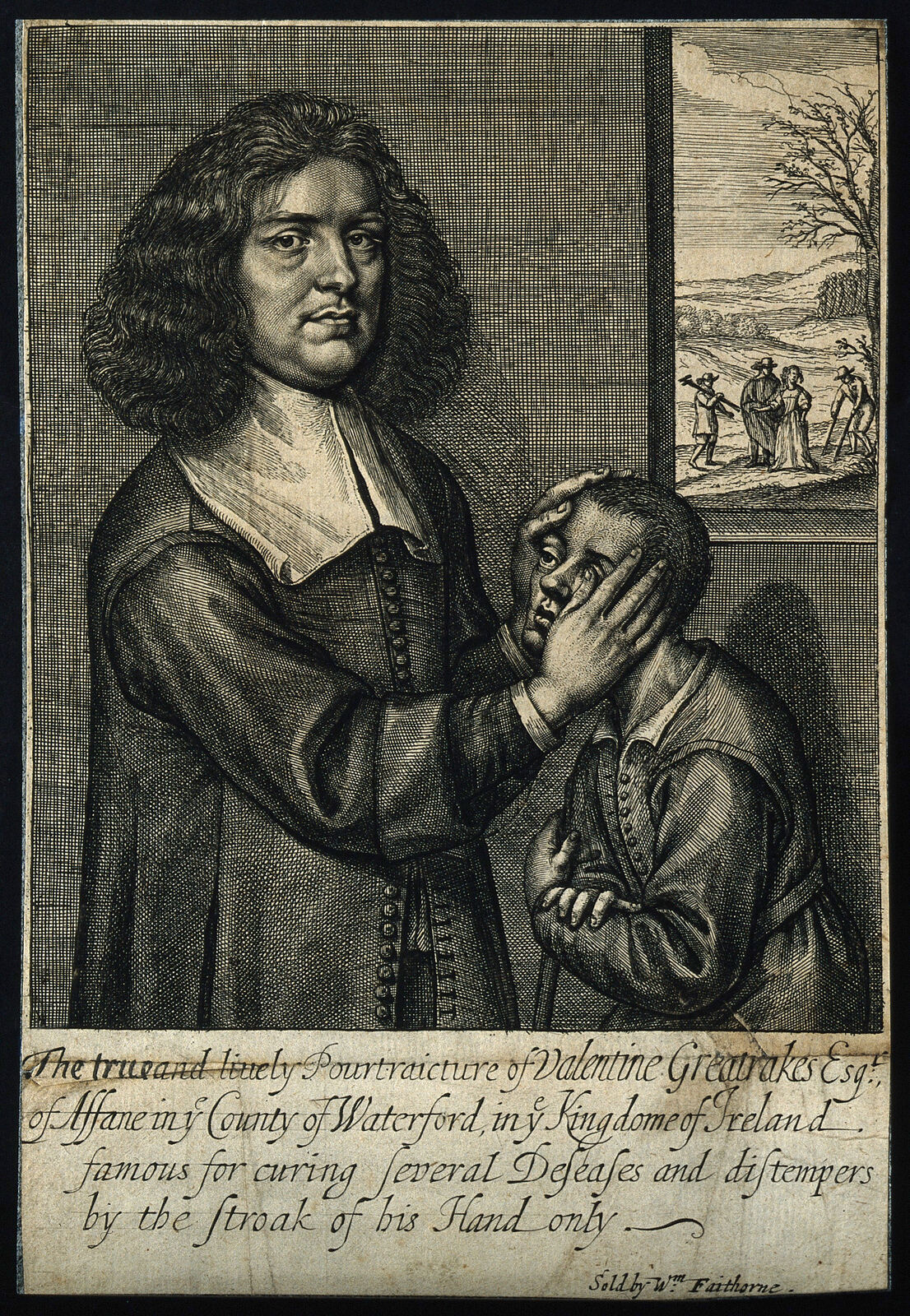
The gentleman who felt God move his hands
In 1662, on his estate at Affane in County Waterford, “the idea seized” a Protestant Irish landowner named Valentine Greatrakes that God had given him the power to cure the king’s evil, the disfiguring throat and neck swellings of scrofula, by the touch of his bare hands. He kept it to himself at first, then told his wife, who thought it a strange fancy and, half in jest, dared him to try it at once on a neighbor’s boy, William Maher of nearby Salterbridge, who had scrofula. Greatrakes laid his hands on the boy with prayer, and within a month, by his own and his family’s account, the boy was healed. Greatrakes was no wandering mountebank: he had served in the parliamentary forces in Ireland in the regiment of Colonel Robert Phaire and, from 1656, held local office as county magistrate, registrar for transportations, and clerk of the peace for County Cork, offices he was deprived of at the Restoration in 1660. He set apart three days a week for the cure, laying his hands on the sick while invoking a short blessing: “God Almighty heal thee for his mercy’s sake.” Word spread; the reports of these cures brought him a vast number of patients at Affane over the next three years, from Ireland and from England, and what began as a claimed cure for one disease widened into the treatment of ague and other diseases. The scale of it alarmed the authorities in Ireland well before his 1666 English tour: the dean and bishop of Lismore remonstrated with him, without effect, for practicing medicine without a license from his own church superior.
Free to everyone, gatekept by no one
What set Greatrakes apart in his own century was not scarcity but its opposite. He set no fee, required no subscription, and rejected the cases he judged manifestly incurable. In early 1666, at the urging of Anne, Viscountess Conway’s household, he crossed to England, and his fame detonated: he went on to treat patients at Worcester and then in London, where he stayed for several months in Lincoln’s Inn Fields and treated a great number of patients without charge. This was, in effect, an unlicensed alternative to the much older royal touch, the tradition of the reigning monarch healing the king’s evil by the touch of the hand. Greatrakes offered the same cure to anyone who could reach him, without ceremony, office, or crown. His authority rested on personal charisma and an accumulating stack of testimonial letters, not on a priced product, a license, or an institution.
Where does the disease go?
The physical-sounding account of what the stroking did comes from the contemporaries who watched it: according to Henry More and George Rust, both of whom met Greatrakes at Ragley, the touch would drive “the morbific matter” of the disease through the body until it was forced into an extreme part, the fingers, the toes, the nose, or the tongue, which the passing matter would render cold and numb, whereupon “the whole distemper vanished, and life and sense immediately returned to those parts.” Greatrakes framed the underlying power itself as an “extraordinary gift of God,” not a natural faculty, and he declined to describe his own cures as a miracle. That did not settle anything. His ally Henry Stubbe published a pamphlet the same year, addressed, like Greatrakes’s own letter, to Robert Boyle and titled to promise a “physicall discourse” on the cures; the Dictionary of National Biography records it as “attributing his success to miraculous agency,” the very framing Greatrakes himself declined. Lloyd, in a pamphlet titled to deny the cures were miracles, attacked Greatrakes’s private character.
The one payment on the record
On Greatrakes’s finances the Dictionary of National Biography is blunt: his treatment “was gratuitous,” with a single recorded exception. For his highest-profile English case, Anne, Viscountess Conway, he demanded and received 155 pounds, justified at the time as covering “the expenses of the journey and on account of the hazards of the enraged seas” rather than a standard fee, but a striking departure from the free treatment that had built his name. He returned to Ireland at the end of May 1666 to the life of a country gentleman with a recorded income of 1,000 pounds, and only occasionally practiced his cure again.
The cure that could not explain its own failures
Among Greatrakes’s best-documented cases is his clearest failure. Anne, Viscountess Conway, suffered from a severe headache that never left her, and when Greatrakes arrived at Ragley Castle in early 1666 he stroked her repeatedly, in the presence of prominent witnesses including the Cambridge Platonist Henry More, over several weeks. It did not work. The Dictionary of National Biography’s own summary is blunt: he “exerted his art upon her in vain.” Conway was not the only disappointed patient of standing. The year before, in Ireland, Greatrakes had treated the young astronomer John Flamsteed for chronic rheumatism; the record states Flamsteed “derived little or no benefit from the stroking.” In London, brought before Charles II and his courtiers at Whitehall, he failed there too. His English tour ended within months: he returned to Ireland by the end of May. Even a later, admiring biographical account could not paper over the pattern: the Dictionary of National Biography notes that his failures in some cases, “not apparently more hopeless than others in which he had been successful, could not be explained satisfactorily.”
The pattern repeats
The same structural machinery appears in different treatments and eras. These cases show the claimed mechanism and how the claim met evidence.
External references
Evidence · 14 sources
- Greatrakes, Valentine [nicknamed the Stroker] (1629–1683), faith healer (2004)
- Greatrakes the Stroker: The Interpretations of Historians (1982)
- Greatrakes the Stroker: The Interpretations of His Contemporaries (1982)
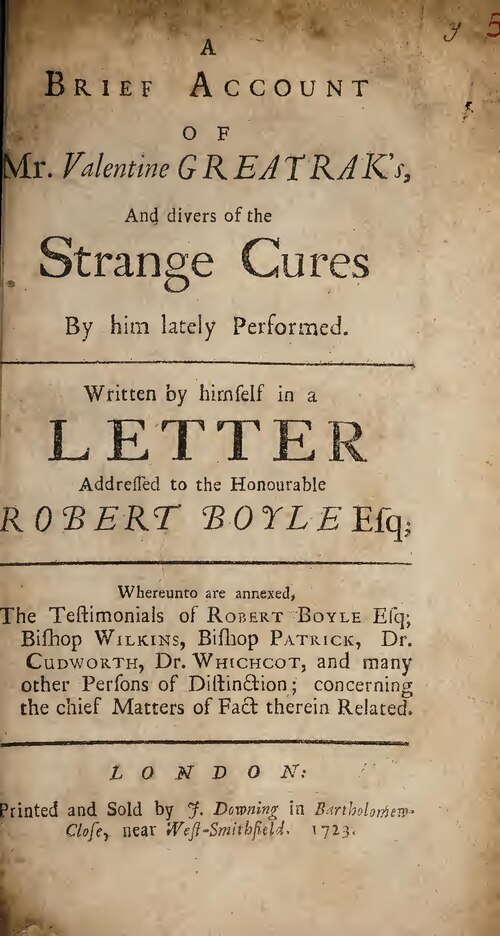
- A Brief Account of Mr. Valentine Greatrak's, and Divers of the Strange Cures by Him Lately Performed (1666)
- The Miraculous Conformist, or, An Account of Severall Marvailous Cures Performed by the Stroaking of the Hands of Valentine Greatarick (1666)
- Wonders no Miracles, or, Mr. Valentine Greatrates['s] Gift of Healing Examined (1666)
- Greatrakes, Valentine (1890)
- Conway, Anne (1887)
- The Famous Case of Lady Anne Conway (1937)
- A Brief Account of Mr Valentine Greatraks (2019)
- Review of The Miraculous Conformist: Valentine Greatrakes, the Body Politic, and the Politics of Healing in Restoration Britain, by Peter Elmer (2014)
- The King's Evil Without the King: The Royal Touch during the Interregnum (2025)
- Valentine Greatrakes. Line engraving by W. Faithorne, 1666. (1666)
- A Brief Account of Mr. Valentine Greatrak's (1723 reprint) title page (1723)