Cansema black salve
Greg Caton sold Cansema — bloodroot and zinc chloride in a black jar — as a natural way to remove skin cancers. In 2004 he pleaded guilty and drew 33 months; prosecutors said Alpha Omega Labs made 950,000 dollars in sales. Reviews in 2018 and 2023 found the paste burns ordinary tissue and does not cure cancer underneath. In 2026 the formula still ships from Ecuador under a disease disclaimer.
A black paste, a guilty plea
Gregory James Caton headed Alpha Omega Labs out of Lake Charles, Louisiana, and sold a black paste online as if a jar could do the work of an oncologist. An Associated Press report published on 25 August 2004 said he had pleaded guilty and been sentenced to 33 months in federal prison for defrauding customers and skirting federal health laws, and that he was to report to prison on 24 September. Prosecutors said the business made 950,000 dollars. They also said at least two women, one in Indiana and one in Texas, had been injured by a salve the company billed as a natural treatment for cancer, and that the salve was sulfuric acid the company said had been neutralized.
That sulfuric-acid account is the prosecutor’s, as the wire service reported it. A 2018 review in the Australian Journal of General Practice describes the black salve Caton sold as Cansema differently: a paste whose base is bloodroot and zinc chloride. The two accounts are not one recipe. His estate’s memorial, copyrighted 2026, dates him 1956 - 2021 and calls him the late Gregory James Caton. It gives no day and no cause. The memorial points readers to HerbHealers.com as the storefront for Alpha Omega Labs products.
A jar from Ecuador
The 2004 report said Alpha Omega began selling the treatments online in 1999. The company’s own homepage, last revised on 22 March 2021, still introduced Cansema Black Topical Salve as based on the century-old escharotic formula for removing skin cancers, with a money-back line and a link to testimonials. The page gave a manufacturing address in Guayaquil, Ecuador. It also said the site was for Historic and Informational Purposes ONLY, and sent orders to HerbHealers.com for customers in the United States and to AlphaOmegaLabs.com for everyone else.
Those two addresses now open one shop. Fetched on 25 October 2026, it calls itself the official Herbologics, Ltd and Alpha Omega Labs website, says all products are shipped from Ecuador, and carries a 2026 copyright. The Miami street address is labeled a mailing address only. The salve catalog lists an Amazon Black Topical Salve, a product name on this site rather than a listing at the retailer Amazon, at $24.95 for 22 grams and $59.95 for 102 grams. A further jar is titled Amazon Topical Salve The Original Formula: 1990-2003 and priced at $34.95. Its text says that from 1990 to 2003 the original Cansema formula consisted of just four ingredients: purified water, chaparral, bloodroot, and zinc chloride, with glycerine to hold moisture. The suggested use is as directed by a health care professional. The card does not repeat the 2021 line about removing skin cancers.
What the burn is doing
Andrew Croaker, Alvin Lim, and Cliff Rosendahl, writing in 2018, describe black salve as a paste of bloodroot, Sanguinaria canadensis, and zinc chloride. Zinc chloride, a synthetic corrosive, is usually the main ingredient by weight, which undercuts the claim that the paste is a natural therapy. They write that Caton formed Alpha Omega Labs in the 1990s and added chaparral (Larrea mexicana), graviola (Annona muricata), and oleander (Nerium oleander) to the bloodroot and zinc chloride base. The company’s 2026 card for the original formula names water, chaparral, bloodroot, and zinc chloride, and does not name oleander or graviola. The current black topical salve card does list a graviola leaf extract with the chaparral, bloodroot, and zinc chloride. Oleander stays the journal’s report of what was added, not an ingredient on the original-formula card.
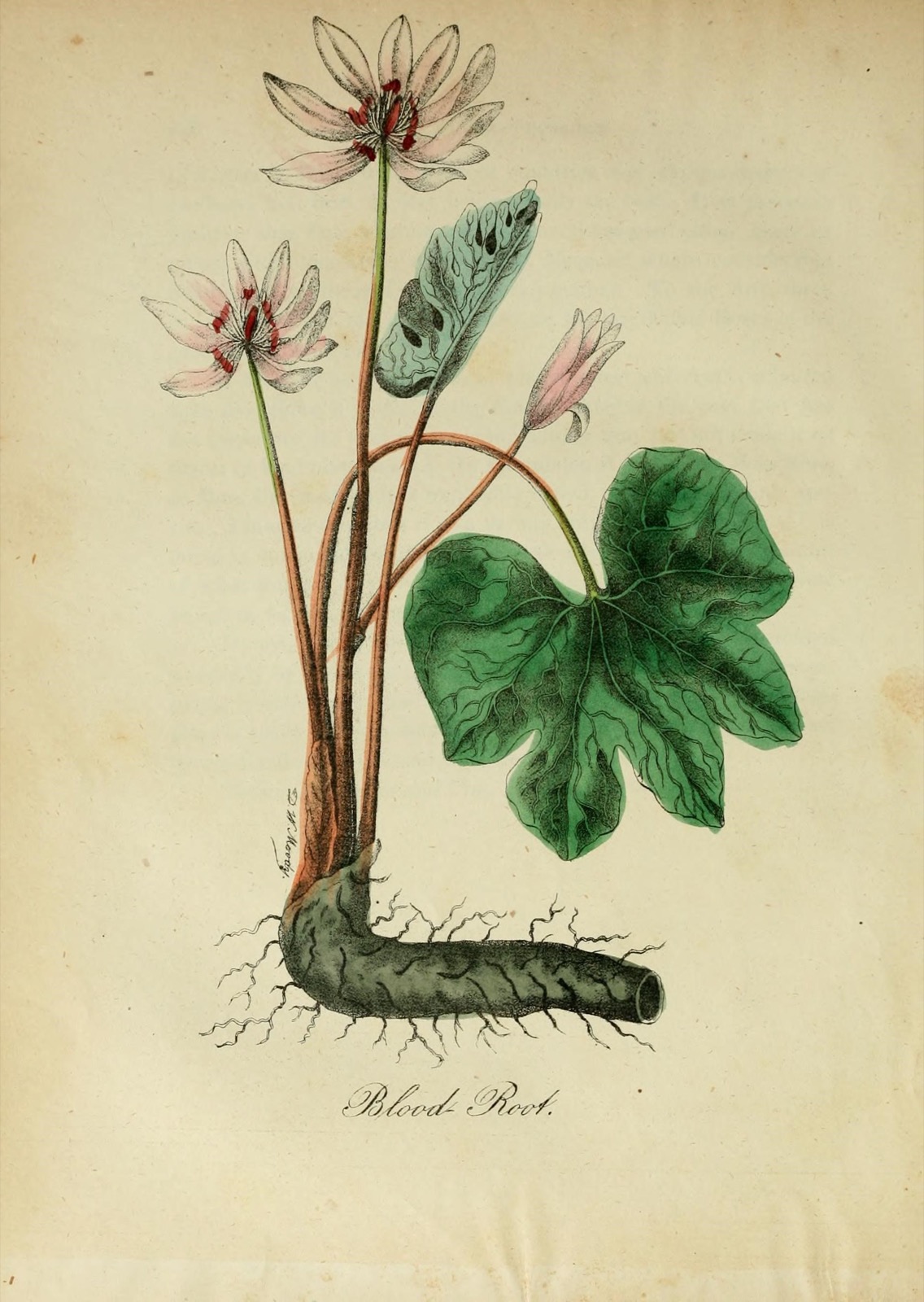
On the skin the review is direct. The paste destroys tissue and leaves an eschar of dead skin that later sloughs away. Bloodroot’s rhizome holds a red sap rich in cytotoxic alkaloids, sanguinarine the most prevalent. Yannick Borkens, in a 2023 paper in Skin Health and Disease, uses a jar of Cansema from Alpha Omega Labs in Ecuador as the picture of black salve, and writes that zinc chloride is in every such ointment. The ointment cauterises the surface. Cancer, where the lesion is in fact cancer, can continue in the tissue underneath.

Who took the money
Caton was the head of the company that sold the paste. The Associated Press, citing prosecutors, said Alpha Omega Labs made 950,000 dollars selling what were billed as natural remedies for cancer and other ailments. He pleaded guilty. The 2018 review states that he was convicted of mail fraud and of introducing unapproved new drugs into interstate commerce. After the prison sentence, the review says, he relocated to Ecuador, where Alpha Omega Labs operated outside United States jurisdiction and sold black salve online to the world. The 2026 shop is that firm’s storefront under the Herbologics name. The 950,000 dollar figure is what prosecutors told the court about the business. It is not a measured account of what Caton personally kept.
The hole is not a cure
Croaker, Lim, and Rosendahl wrote that black salve is promoted as an effective, safe, and natural skin-cancer treatment, that such claims are not evidence-based, and that serious complications have been reported. Sale in Australia is illegal, and the review says black salve is similarly banned in the United States. Some published cases looked clear on a short follow-up. Others grew back at the treated spot. One patient died of metastasis from a nasal basal-cell cancer that had appeared to resolve on the surface after black salve. Another had a fungating squamous-cell cancer of the scalp that had grown despite nine months of the salve. The review says only two primary melanomas treated with black salve have been reported in the literature, and both became metastatic. It cites five-year recurrence-free rates after standard excision of 95.2 percent for primary basal-cell cancer and 94.6 percent for squamous-cell cancer. The authors’ conclusion is that the paste is not natural, it is not cancer-specific, and it causes harm to normal tissue, and that patients have had metastasis, scarring, deformity, and death from using it. Those reports are about black salve as a class. They do not name Caton’s customers.
Borkens, in 2023, describes the same surface cautery and reports that the U.S. Food and Drug Administration said in 2020 it had documented 24 such cases in recent years, 15 of them in the last seven years. That count is his report of the agency’s statement.
The disclaimer on the 2026 catalog says the Food and Drug Administration has not evaluated the products and that they are not intended to diagnose, treat, cure, or prevent any disease. The jars remain for sale. The 2018 review sets Cansema in an older escharotic line: Jesse Fell’s bloodroot and zinc chloride paste in the 1850s, then Harry Hoxsey’s red paste of antimony trisulfide, zinc chloride, and bloodroot. Hoxsey’s paste is the subject of a separate case.
The pattern repeats
The same structural machinery appears in different treatments and eras. These cases show the claimed mechanism and how the claim met evidence.
Part of the lineage
Evidence · 10 sources
- Black salve in a nutshell (2018)
- Black Salve (or Escharotics). A Picture About an Unorthodox Medical Preparation in Oncology (2023)
- Internet Medicine Co. Head Going to Jail (2004)
- Salves, Creams and Tonics – Herbologics, Ltd (2026)
- Alpha Omega Labs (2021)
- Greg Caton - Where Truth Grows Wild (2026)
- File:The American Flora. Vol. 3, 1855 - pl. 28 Sanguinaria canadensis (10172375496).jpg (1855)
- File:Sanguinaria canadensis, Curtis's-162.png (1792)
- Case of the United States versus the Hoxsey Cancer Clinic; opinion of the United States Court of Appeals for the Fifth Circuit (1952)
- Hoxsey Herbal Treatment (2000)