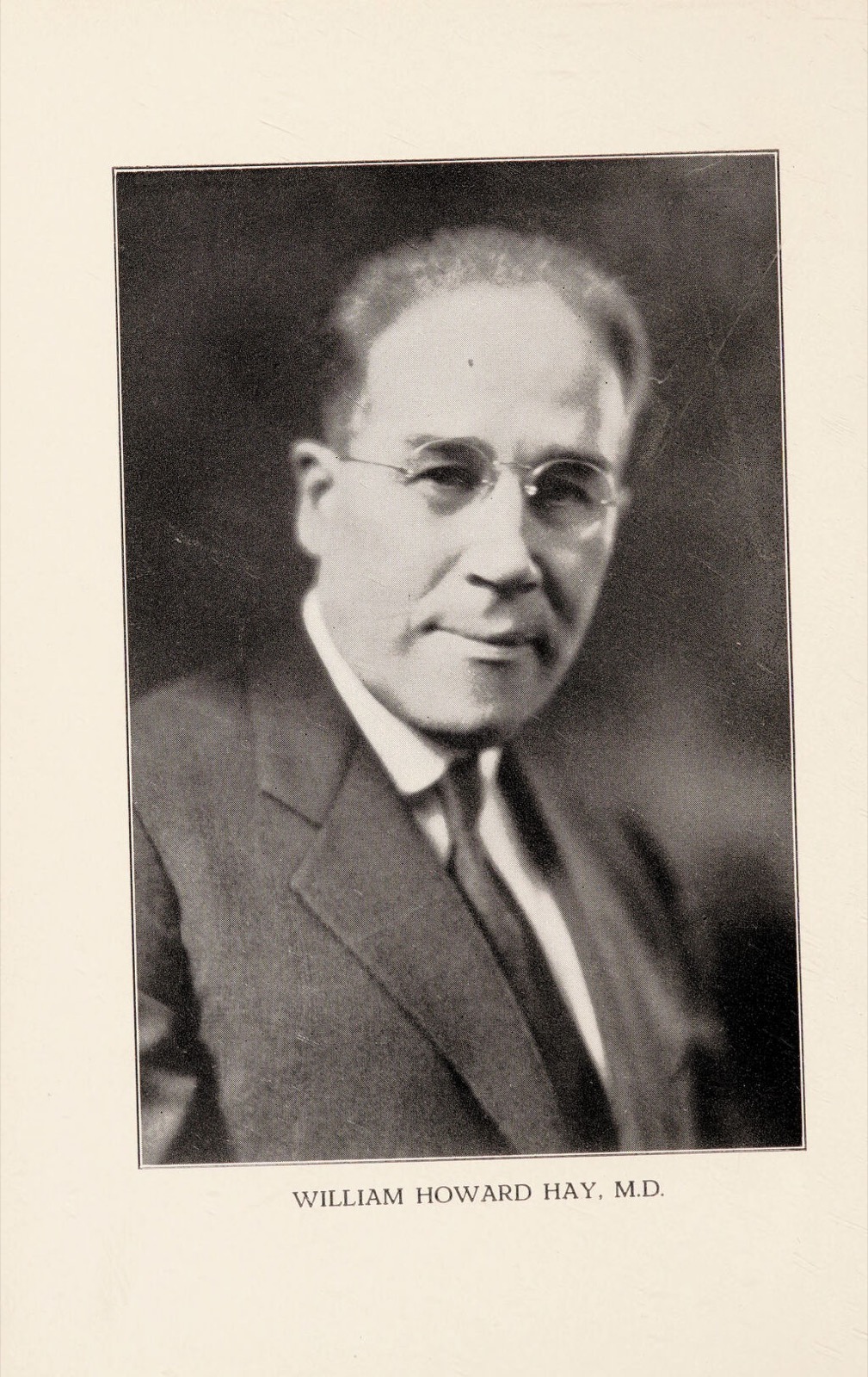
William Howard Hay
"It is with the hope that a somewhat more cheerful outlook on health and continued life may be stimulated in those less than well that this volume is dedicated to the victim himself."
William Howard Hay (1866-1940) was an American physician who, after roughly sixteen years of largely surgical practice, recast himself as the proprietor of a dietary system. By his own account (Introduction, A New Health Era, 1935) he “broke down” with Bright’s disease, high blood pressure, and a dilated heart, and recovered by adopting the regimen he went on to sell. The system, set out in Health via Food (1929) and the mid-1930s Harrap volumes, held that nearly all disease is one acidotic, self-poisoning state caused by wrong eating, and that the corrective is “food separation”: do not eat concentrated starches and concentrated proteins at the same meal, and weight the diet toward base-forming vegetables, salads, and fruit. He framed the payoff in terms of health, restored vitality, and longer life. Hay carried the doctrine into the medical press, defending intestinal autointoxication against its critics in the most sweeping form (Bested, Logan and Selhub, 2013, record him maintaining that autointoxication was responsible for all human ailments). The publicly_disconfirmed status attaches to that system: the autointoxication and acidosis framework was rejected in the early twentieth century, and modern controlled measurement finds no benefit from food separation over an energy-matched mixed diet.