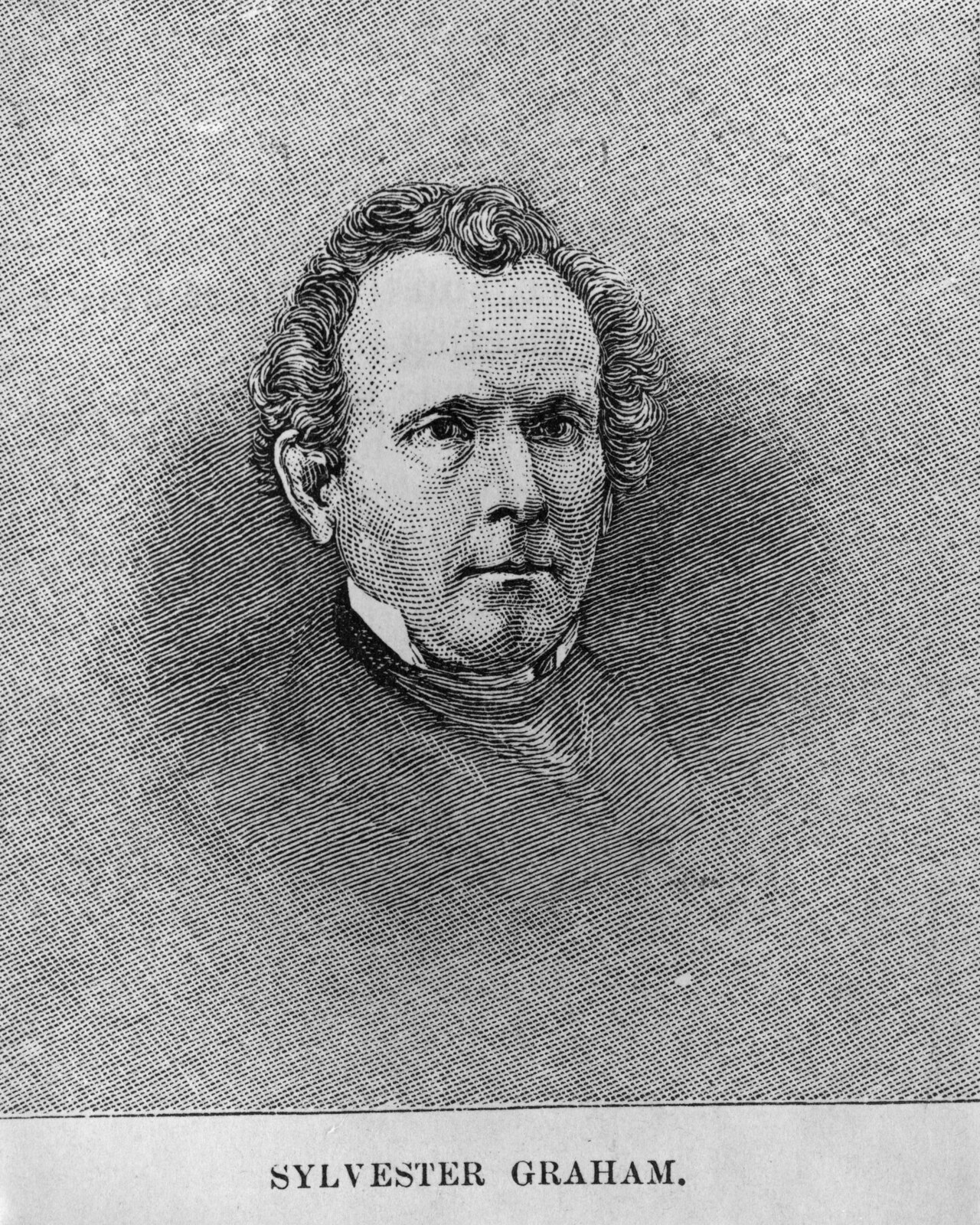
Sylvester Graham
Sylvester Graham (1794-1851) was an American Presbyterian minister who became, from 1830, the country’s most prominent lay health reformer of his generation. Trained for the ministry rather than medicine, he took a paid post as a lecturing agent for the Pennsylvania Temperance Society in 1830 and within months had broadened his subject from alcohol to diet, sexuality, and disease generally (Shryock 1931). The 1832 cholera epidemic in New York City, which orthodox medicine could not explain or stop, gave his temperance-and-diet lectures a mass audience: he argued that a plain vegetable diet and total abstinence from stimulants were the real protection against the epidemic, and crowds who could get no better answer elsewhere made him a national figure.
For the next two decades Graham supported himself entirely through lecturing, writing, and, from 1837, a journal he co-founded to promote his own system. His central theory held that stimulation of the nervous system by meat, spices, alcohol, tobacco, and above all sexual excess and masturbation was itself a cause of disease and, in the case of masturbation specifically, of insanity (Whorton 2001). His most restrictive and controversial lecture, delivered to women-only audiences on sexual physiology and the dangers of the “solitary vice,” was given only three times and provoked a riot on each occasion, beginning in Portland, Maine in 1834 (Haynes 2015).
Graham’s eventual_status is recorded as quietly_faded: no single experiment overturned his theory in his lifetime, but the organized Grahamite movement he built, boarding houses, the journal, and a distinct sectarian following, did not survive him for long as an institution, even as elements of his diet were absorbed into later reform movements. Graham died in 1851, at the age of fifty-seven, a death noted at the time in at least one contemporary medical-journal obituary (Buffalo Medical Journal, November 1851) and well short of the extreme old age his own system promised its strict adherents.