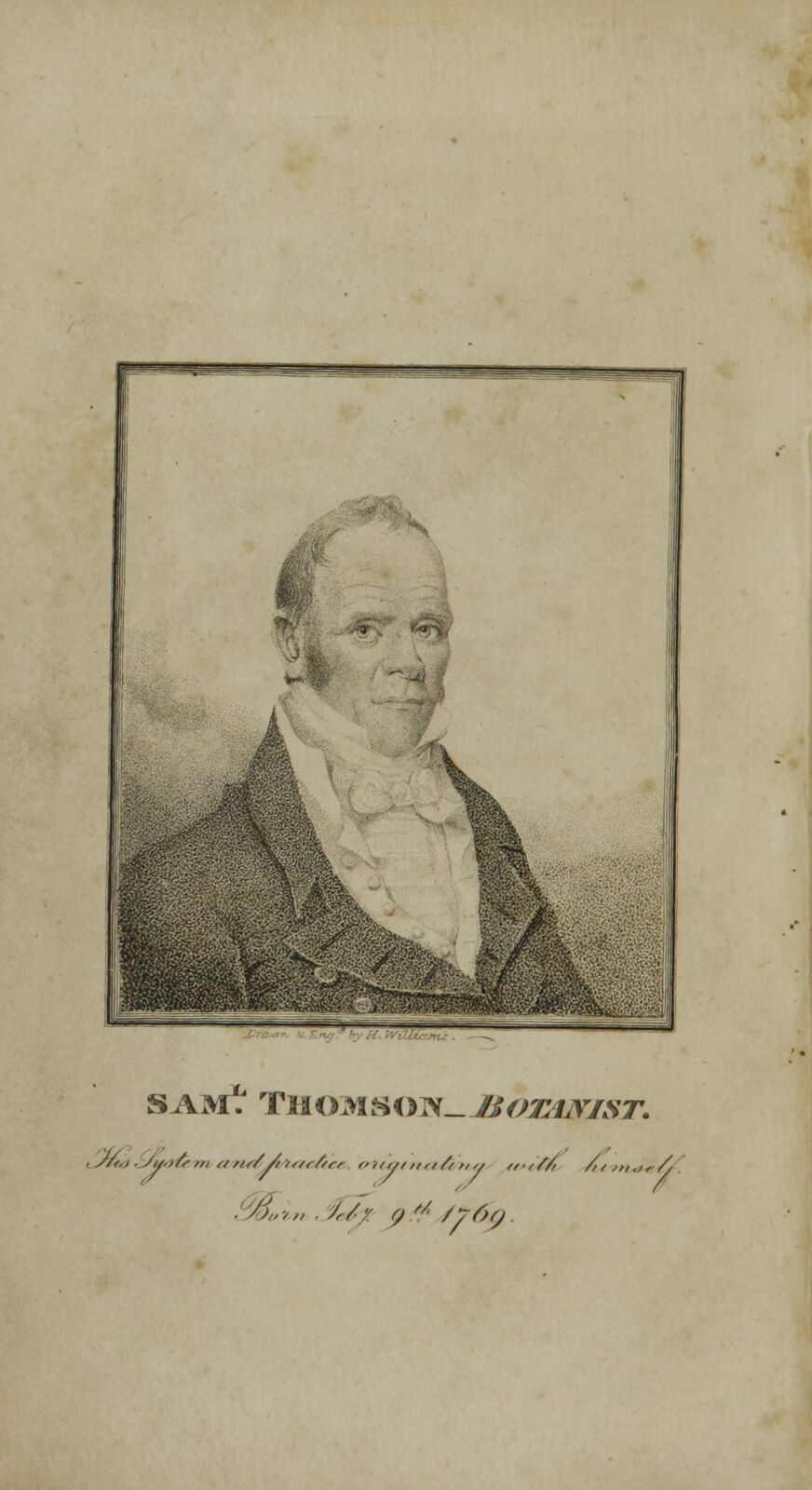
Samuel Thomson
"Disease has one general cause and may be removed by one general remedy (his own summary of the one-cause, one-cure doctrine)."
Samuel Thomson (1769-1843) was a self-taught New Hampshire farmer who, after crediting root doctors with curing himself and his wife where regular physicians had failed, began practicing herbal medicine in his own right around 1805-1806 and by 1806 was treating yellow-fever patients in Boston and New York (Flannery 2002). He developed a one-cause theory of disease (cold, cured by restoring the body’s natural heat) and a numbered system of botanical remedies, led by the emetic herb lobelia, delivered through steam baths, cayenne, and purges. Indicted for murder in December 1809 after a patient’s death, he was acquitted when the substance the prosecution called poison was shown in court to be marsh rosemary rather than lobelia (Thomson 1835).
In 1813 Thomson obtained a federal patent for his system and began selling “family rights” for $20, organizing purchasers into Friendly Botanic Societies and requiring physicians who wanted to use the remedies to pay $500 and swear to secrecy. By 1839 he claimed 100,000 rights sold, and contemporaries estimated botanical converts at roughly a third of Ohio’s population. He spent much of his later career suing agents and rival manufacturers to protect his patent income (Young 1961).
The publicly_disconfirmed status reflects James Harvey Young’s assessment, in the standard academic history of American patent medicine, that Thomsonianism was not a sound system of medicine for the American people, closing with the assessment that even Thomson’s own medicines failed him in the end (Young 1961; the sources do not establish that his own remedies caused his death, only that they did not save him). A different Thomsonian practitioner had already been convicted of manslaughter in 1837 for a patient’s death from an excessive dose of the same lobelia Thomson insisted was harmless at any dose, and the patent itself lapsed in 1852, by which point the movement was fading fast (Young 1961).